 |
| Shuttle Night Launch Shuttle Night Launch 2 Credit: © Mark Wade. 39,358 bytes. 477 x 154 pixels. |
| astronautix.com | Endeavour |
|
| Shuttle Night Launch Shuttle Night Launch 2 Credit: © Mark Wade. 39,358 bytes. 477 x 154 pixels. |
Endeavour is named after the first ship commanded by James Cook. Empty Weight was 151,205 lbs at rollout and 172,000 lbs with main engines installed.
Craft.Crew Size: 8. Design Life: 28 days. Orbital Storage: 30.00 days. Total Length: 37.2 m. Maximum Diameter: 23.8 m. Total Habitable Volume: 71.50 m3. Total Mass: 104,328 kg. Total Payload: 24,990 kg. Total Propellants: 21,600 kg. Total RCS Impulse: 954,000.00 kgf-sec. Primary Engine Thrust: 24,213 kgf. Main Engine Propellants: N2O4/MMH. Main Engine Isp: 316 sec. Total spacecraft delta v: 700 m/s. Electric system: 14.00 total average kW. Electric System: 12,000.00 total kWh. Electrical System: Fuel Cells.
Upgrades and Features
Endeavour features new hardware designed to improve and expand orbiter capabilities. Most of this equipment will be incorporated into the other three orbiters during out-of-service major inspection and modification programs. Endeavour's upgrades include:
o A 40-foot diameter drag chute that is expected to reduce the orbiter's rollout distance by 1,000 to 2,000 feet.
o The plumbing and electrical connections needed for Extended Duration Orbiter (EDO) modifications to allow up to 28-day missions.
o Updated avionics systems that include advanced general purpose computers, improved inertial measurement units and tactical air navigation systems, enhanced master events controllers and multiplexer-demultiplexers, a solid-state star tracker and improved nose wheel steering mechanisms.
o An improved version of the Auxiliary Power Units (APU's) that provide power to operate the Shuttle's hydraulic systems.
Construction Milestones
07/31/87 Contract Award
02/15/82 Start structural assembly of Crew Module (yes 1982)
09/28/87 Start structural assembly of aft-fuselage
12/22/87 Wings arrive at Palmdale from Grumman
08/01/87 Start of Final Assembly
07/06/90 Completed Final Assembly
04/25/91 Rollout from Palmdale
05/07/91 Delivery to Kennedy Space Center
04/06/92 Flight Readiness Firing
05/07/92 First Flight (STS-49)
 | Shuttle Orbiter - Shuttle Orbiter side view Credit: © Mark Wade. 1,859 bytes. 402 x 158 pixels. |
Attempted capture of Intelsat V1.
Second attempted capture of Intelsat V1.
Intelsat V1 finally captured in first three-person spacewalk.
Tested tools and techniques for assembly of the International Space Station.
Manned seven crew. Carried Spacelab-J with microgravity and biology experiments. Payloads: Spacelab-J, nine getaway special canister experiments, Israel Space Agency Investigation About Hornets (ISAIAH), Shuttle Amateur Radio Experiment (SAREX) II, Solid Surface Combus-tion Experiment (SSCE). Additional Details: STS-47.
Manned five crew. Deployed TDRSS 6. Payloads: Tracking and Data Relay Satellite (TDRS)-F/Inertial Upper Stage (IUS); Diffuse X-ray Spectrometer (DXS); Chromosome and Plant Cell Division in Space (CHROMEX); Commercial Generic Bioprocessing Apparatus (CGBA) A; Physiological and Anatomical Rodent Experiment (PARE) 02; Solid Surface Combustion Experiment (SSCE). Additional Details: STS-54.
 | Shuttle Landing Credit: NASA. 24,373 bytes. 474 x 298 pixels. |
Tested tools and techniques for extravehicular activity.
Manned six crew. Carried Spacehab 1; retrieved Eureca-1 spacecraft. Payloads: Spacehab 01, retrieval of European Retriev-able Carrier (EURECA) Satellite, Superfluid Helium On-Orbit Transfer (SHOOT), Consortium for Materials Development in Space Complex Autonomous Payload (CONCAP)-IV, Fluid Acquisition and Resupply Experiment (FARE), Shuttle Amateur Radio Experiment (SAREX) II, Air Force Maui Optical Site (AMOS), GAS bridge assembly with 12 getaway special payloads. Additional Details: STS-57.
Latched Eureca antenna. Conducted tests to refine procedures for servicing of the Hubble Space Telescope and construction of the International Space Station
Manned seven crew. Hubble repair mission. Conducted the most EVAs (5) on a Space Shuttle Flight to that date. Payloads: Hubble Space Telescope (HST) Servicing Mission (SM) 1, IMAX Camera, IMAX Cargo Bay Camera (ICBC), Air Force Maui Optical Site (AMOS). Additional Details: STS-61.
Hubble Space Telescope Servicing Mission 1 - gyroscope replacement.
Hubble Space Telescope Servicing Mission 1 - solar array replacement.
 | Shuttle Orbiter - Shuttle Orbiter 2 view Credit: © Mark Wade. 4,696 bytes. 402 x 425 pixels. |
Hubble Space Telescope Servicing Mission 1 - WFPC-P installation.
Hubble Space Telescope Servicing Mission 1 - COSTAR installation.
Hubble Space Telescope Servicing Mission 1 - solar array drive replacement.
Carried SIR-C SAR radar. Payloads: Space Radar Laboratory (SRL) 1; Consortium for Materials Development in Space Com-plex Autonomous Payload (CONCAP) IV; three getaway special (GAS) payloads; Space Tissue Loss (STL) A, B; Visual Function Tester (VFT) 4; Shuttle Amateur Radio Experiment (SAREX) II. Additional Details: STS-59.
Carried SIR-C SAR. Landed at Edwards Air Force Base on October 11. Payloads: Space Radar Laboratory (SRL) 2, five Getaway Special payloads, Chromosome and Plant Cell Division in Space (CHROMEX) 5, Biological Research in Canisters (BRIC) 01, Cosmic Radiation Effects and Activation Monitor (CREAM), Military Application of Ship Tracks (MAST), Commercial Protein Crystal Growth (CPCG). Additional Details: STS-68.
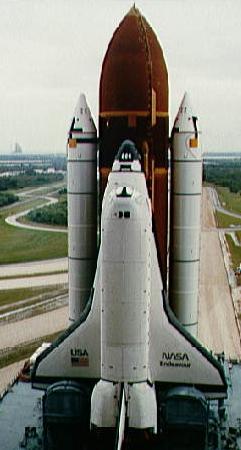 | STS Credit: NASA. 19,745 bytes. 241 x 450 pixels. |
Deployed and retrieved Spartan 201, WSF 2. Payloads: Wake Shield Facility (WSF) 2; Shuttle Pointed Autonomous Research Tool for As-tronomy (SPARTAN) 201; International Extreme Ultraviolet Hitchhiker (IEH)1; Inter-Mars Tissue Equivalent Proportional Counter (ITEPC); Extravehicular Activity Development Flight Test (EDFT) 2; Capillary Pumped Loop (CAPL) 2/ getaway special (GAS) bridge assembly with five GAS payloads; Auroral Photography Experiment (APE) B; Biological Research in Canisters (BRIC); Commercial Generic Bioprocessing Apparatus (CGBA), Configuration A; Electrolysis Perfor-mance Improvement Concept Study (EPICS); Space Tissue Loss (STL)/National Institutes of Health (NIH) Cells (C); Commercial Middeck Instrumentation Technology Associates Experiment (CMIX). Additional Details: STS-69.
Tested tools and techniques for extravehicular activity.
Deployed and retrieved OAST Flyer; retrieved SFU Space Flyer Unit. Beside the two satellite retrievals, the mission included two spacewalks. Additional Details: STS-72.
Tested tools and techniques for extravehicular activity.
Tested tools and techniques for extravehicular activity.
Deployed and retrieved Spartan 2; deployed PAMS-STU; carried Spacehab module. Payloads: Shuttle Pointed Research Tool for Astronomy (SPARTAN) 207/Inflatable Antenna Experiment (IAE); Technology Experiments Advancing Missions in Space (TEAMS) 01 (includes Vented Tank Resupply Experiment (VTRE), Global Positioning System (GPS) Attitude and Navigation Experiment (GANE) (RME 1316), Liquid Metal Test Experiment (LMTE) and Passive Aerodynami-cally Stabilized Magnetically Damped Satellite (PAMS) Satellite Test Unit (STU); SPACEHAB-4; Brilliant Eyes Ten-Kelvin Sorption Cryocooler Experiment (BETSCE); 12 getaway specials attached to a GAS bridge assembly (GAS 056, 063, 142, 144, 163, 200, 490, 564, 565, 703, 741 and the Reduced-Fill Tank Pressure Control Experiment (RFTPCE); Aquatic Research Facility (ARF) 01; Biological Research in Canisters (BRIC) 07, Block III. Additional Details: STS-77.
Penultimate Shuttle mission to Mir. Andy Thomas replaced David Wolf as the resident NASA astronaut. Endeavour docked with the SO module on Mir at 20:14 GMT on January 24, 1998.
Payloads included:
Despite fits problems with his Sokol emergency spacesuit, Andy Thomas replaced David Wolf as a Mir crew member on January 25. Endeavour undocked from Mir on January 29 at 16:57 GMT and made one flyaround of the station before departing and landing at Kennedy Space Center's runway 15 at 22:35 GMT on January 31.
First attempted launch of STS-88 was scrubbed at 09:03 GMT on December 3 due to a problem with a hydraulic system sensor. Launch came the next day, with Endeavour entering an initial 75 km x 313 km x 51.6 degree orbit. Half an orbit after launch, at 09:19 GMT, Endeavour fired its OMS engines to raise the orbit to 180 km x 322 km x 51.6 degree.
On December 5 at 22:25 GMT Nancy Currie unberthed the Unity space station node from the payload bay using the RMS arm. She then moved the Unity to a position docked to the Orbiter Docking System in the payload bay in readiness for assembly with the Russian-launched Zarya FGB ISS component. After rendezvous with the Zarya FGB module, on December 6 at 23:47 GMT Endeavour grappled Zarya with the robot arm, and at 02:07 GMT on December 7 it was soft docked to the PMA-1 port on Unity. After some problems hard dock was achieved at 02:48 GMT. Unity and Zarya then formed the core of the future International Space Station. Ross and Newman made three space walks to connect cables between Zarya and Unity, on December 7, 9 and 12. On the last EVA a canvas tool bag was attached to the exterior of Unity to provide tools for future station assembly workers. Docking cables were disconnected to prevent Unity and Zarya from inadvertently undocking. Following an internal examination of the embryonic space station, Endeavour undocked at 20:30 GMT on December 13. The SAC-A and Mightysat satellites were ejected from the payload bay on December 14 and 15. Deorbit burn was December 16 at 03:48 GMT, and Endeavour landed at 04:53:29 GMT, on Runway 15 at the Kennedy Space Center.
Payloads included:
On an extremely successful mission the space shuttle Endeavour deployed the 61 metre long STRM mast. This was a side-looking radar that digitally mapped with unprecedented accuracy the entire land surface of the Earth between latitudes 60 deg N and 54 deg S. Sponsors of the flight included the US National Imagery and Mapping Agency (NIMA), NASA, and the German and Italian space agencies. Some of the NIMA data would remain classified for exclusive use by the US Department of Defense. Additional Details: STS-99.