| astronautix.com | Apt |
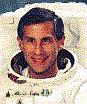
Official NASA Biography - 1997
Dr. Apt is an instrument-rated commercial pilot, and has logged over 4,000 hours flying time in approximately 25 different types of airplanes, seaplanes, sailplanes, and human-powered aircraft.
He was selected as an astronaut candidate by NASA in June 1985, and qualified as an astronaut in July 1986. His assignments to date have included Shuttle Orbiter modification support at Kennedy Space Center, developing techniques for servicing the Hubble Space Telescope and the Gamma Ray Observatory, development of EVA (space walk) construction and maintenance techniques for Space Station, as a spacecraft communicator (CAPCOM) for Shuttle flights, the voice link between the flight crew and the Mission Control Center (MCC), and the Astronaut Office EVA point of contact. He has also been the supervisor of Astronaut Training in the Astronaut Office, and has served as Chief of the Astronaut Office Mission Support Branch.
Apt flew as a member of the crew of the space Shuttle Atlantis on the STS-37 mission, which launched from Kennedy Space Center, Florida, on April 5, 1991. During the mission, the crew deployed the Gamma Ray Observatory to study the universe by observing the most energetic form of radiation. Apt and crew mate Jerry Ross performed an unscheduled space walk during which they manually deployed the observatory's large radio antenna when remotely controlled motors failed to do so. On the next day, they conducted the first scheduled space walk in 5-1/2 years. They tested concepts for getting around on large space structures, and gathered basic engineering data on the forces a crew member can exert on bolts and equipment. The crew alsoconducted research on biologically important molecules, tested concepts for radiating heat from Space Station, operated an amateur radio station, and took over 4000 photographs of the Earth. After completing 93 orbits of the Earth, the crew landed Atlantis at Edwards Air Force Base, California, on April 11, 1991.
Dr. Apt was Endeavour's flight engineer on the crew of STS-47, Spacelab-J. This eight-day cooperative mission between the United States and Japan was launched on September 12, 1992, to perform life science and materials processing experiments in space. Dr. Apt was responsible for operating the Orbiter during one of the two shifts on this dual shift mission. After completing 126 orbits of the Earth, the crew landed Endeavour at Kennedy Space Center, Florida, on September 20, 1992.
He flew again aboard Endeavour on STS-59, the first flight of the Space Radar Laboratory, from April 9-20, 1994. As the blue shift commander, he was responsible for operating Endeavour during one of the two shifts on an 11-day mission to observe the land surface and oceans of Earth with three imaging radar systems, and to map air pollution in the lower atmosphere. The crew flew Endeavour through the largest series of maneuvers in Shuttle history to point the radar precisely at hundreds of ecology, geology, and oceanography sites, providing research scientists the equivalent of 26,000 encyclopedia volumes of data. After completing 183 orbits of the Earth, the crew landed Endeavour at Edwards Air Force Base, California.
Most recently, he served aboard Atlantis during mission STS-79, September 16-26, 1996. The crew docked Atlantis with the Russian Mir space station, having ferried supplies, personnel, and scientific equipment to this base 240 miles above the Earth. The crew transferred over 4 tons of scientific experiments and supplies to and from the Mir station and exchanged U.S. astronauts on Mir for the first time - leaving John Blaha and bringing Shannon Lucid home after her record six months stay aboard Mir. This historic mission of international cooperation and scientific research ended at Kennedy Space Center, Florida, after 160 orbits of the Earth.
With the completion of his fourth flight, Dr. Apt has logged over 847 hours (35 days) in space, including 10 hours and 49 minutes on two space walks. He has flown around the Earth 562 times.
Dr. Apt will leave NASA in late May to become Director of the Carnegie Museum of Natural History in Pittsburgh, Pennsylvania.
Manned five crew. Unscheduled EVA to manually deploy the Gamma-Ray Observatory's high-gain antenna, which failed to deploy upon ground command. Payloads: Gamma-Ray Observatory (GRO), Crew/ Equipment Translation Aids (part of Extravehicular Activity Development Flight Experiment), Ascent Particle Monitor (APM), Bioserve Instrumentation Technology Associates Materials Dispersion Apparatus (BlMDA), Protein Crystal Growth (PCG)-Block Il, Space Station Heatpipe Advanced Radiator Element (SHARE)-ll, Shuttle Amateur Radio Experiment (SAREX)-ll, Radiation Monitoring Equipment (RME)-lIl, Air Force Maui Optical Site (AMOS) Calibration Test.
Manually deployed Gamma-Ray Observatory's high-gain antenna.
Tested CETA (Crew / Equipment Translation Aids - rail with cart for moving astronauts around exterior of International Space Station).
Manned seven crew. Carried Spacelab-J with microgravity and biology experiments. Payloads: Spacelab-J, nine getaway special canister experiments, Israel Space Agency Investigation About Hornets (ISAIAH), Shuttle Amateur Radio Experiment (SAREX) II, Solid Surface Combus-tion Experiment (SSCE).
Carried SIR-C SAR radar. Payloads: Space Radar Laboratory (SRL) 1; Consortium for Materials Development in Space Com-plex Autonomous Payload (CONCAP) IV; three getaway special (GAS) payloads; Space Tissue Loss (STL) A, B; Visual Function Tester (VFT) 4; Shuttle Amateur Radio Experiment (SAREX) II.
On September 19 Atlantis docked with the Russian Mir space station. Aboard Atlantis in the payload bay were the Orbiter Docking System, the modified Long Tunnel, and the Spacehab Double Module, containing supplies for the Mir. Astronaut John Blaha relieved Shannon Lucid as NASA resident on the complex. Atlantis undocked from the Mir complex on September 23 at 23:33 GMT. Valeriy Korzun, Aleksandr Kaleri and John Blaha remain on Mir. On September 26 Atlantis closed its payload bay doors, and at 11:06 GMT fired its OMS engines for a three minute long deorbit burn. After entry interface at 11:42 GMT the spaceship flew across Canada and the US for a landing at the Kennedy Space Center's Runway 15 at 12:13 GMT.