| astronautix.com | Voss |
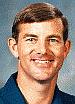
On his first mission, Voss served on the crew of STS-44, aboard Space Shuttle Atlantis, which launched the night of November 24, 1991. The primary mission objective was accomplished with the successful deployment of a Defense Support Program (DSP) satellite with an Inertial Upper Stage (IUS) rocket booster. In addition, the crew also conducted two Military Man in Space experiments, three radiation monitoring experiments, and numerous medical tests to support longer duration Shuttle flights. The mission was concluded after 110 orbits of the Earth with Atlantis returning to a landing on the lakebed at Edwards Air Force Base, California, on December 1, 1991, after 166 hours in space.
Voss next served on the crew of STS-53 which launched from the Kennedy Space Center, Florida, on December 2, 1992. The crew of five deployed the classified Department of Defense payload DOD-1 and also performed several Military Man in Space and NASA experiments. After completing 115 orbits of the Earth in 175 hours, Discovery landed at Edwards Air Force Base, California, on December 9, 1992.
Jim's last flight was as Payload Commander on STS-69 which launched on September 7, 1995. The crew successfully deployed and retrieved a SPARTAN satellite and the Wake Shield Facility. Also on board was the International Extreme Ultraviolet Hitchhiker payload, and numerous secondary payloads and medical experiments. Jim conducted an EVA (extravehicular activity) lasting 6 hours 46 minutes to test space suit modifications and to evaluate procedures and tools to be used to construct the International Space Station. Endeavour landed at the Kennedy Space Center on September 18, 1995 after 171 orbits of the Earth and 260 hours in space.
Manned six crew. Deployed Defense Support Program satellite. Payloads: Defense Support Program satellite/ Inertial Upper Stage, Interim Operational Contamination Monitor, Terra Scout, Military Man in Space, Shuttle Activation Monitor, Cosmic Radiation Effects and Activation Monitor, Radiation Monitoring Equipment Ill, Air Force Maui Optical Site Calibration Test, Ultraviolet Plume Instrument, Visual Function Tester 1.
Manned five crew. Deployed classified military satellite USA 89. The ODERACS payload was unable to be deployed because of payload equipment malfunction. Payloads: Department of Defense (DOD)1; Glow Experiment/Cryogenic Heat Pipe Experiment Payload (GCP); Orbital Debris Radar Calibration System (ODERACS); Battlefield Laser Acquisition Sensor Test (BLAST); Cloud Logic To Optimize Use of Defense Systems (CLOUDS) 1A; Cosmic Radiation Effects and Activation Monitor (CREAM); Fluid Acquisition and Resupply Equipment (FARE); Hand-held, Earth-oriented, Real-time, Cooperative, User-friendly, Location-targeting and Environmental System (HER-CULES); Microencapsulation in Space (MIS)-1; Radiation Monitoring Equipment (RME) III; Spare Tissue Loss (STL); Visual Function Tester (VFT)2.
Deployed and retrieved Spartan 201, WSF 2. Payloads: Wake Shield Facility (WSF) 2; Shuttle Pointed Autonomous Research Tool for As-tronomy (SPARTAN) 201; International Extreme Ultraviolet Hitchhiker (IEH)1; Inter-Mars Tissue Equivalent Proportional Counter (ITEPC); Extravehicular Activity Development Flight Test (EDFT) 2; Capillary Pumped Loop (CAPL) 2/ getaway special (GAS) bridge assembly with five GAS payloads; Auroral Photography Experiment (APE) B; Biological Research in Canisters (BRIC); Commercial Generic Bioprocessing Apparatus (CGBA), Configuration A; Electrolysis Perfor-mance Improvement Concept Study (EPICS); Space Tissue Loss (STL)/National Institutes of Health (NIH) Cells (C); Commercial Middeck Instrumentation Technology Associates Experiment (CMIX).
Tested tools and techniques for extravehicular activity.
Objective of mission STS-101 was repair, resupply and construction tasks aboard the international space station. This was the first launch with new electronic cockpit displays and other upgrades. The solid boosters separated at 10:13 GMT and the main engines cutoff at 10:19 GMT. The external tank, ET-102 then separated, with both orbiter and ET-102 in a 52 x 320 km initial orbit. At 10:54 GMT the OMS engines fired to raise perigee to 159 x 329 km x at 51.6 deg. Atlantis docked with the International Space Station's PMA-2 docking adapter on the Unity node at 04:31 GMT on May 21. At that time the ISS was in a 332 x 341 km orbit.
On May 22 mission specialists Jeff Williams and James carried out external maintenance work on the ISS.
On May 23 at 00:03 GMT the Atlantis crew opened the first hatch to PMA-2 and entered the Station. The crew replaced a set of batteries in Zarya, installed fans and ducting to improve airflow, and delivered supplies and equipment. Three hour-long orbit raising burns on May 24 and 25 by the RCS engines on Atlantis raised the station to a 372 x 380 km x 51.6 deg orbit.
The STS-101 crew left the station on May 26, closing the PMA-2 hatch at 08:08 GMT and undocking at 23:03 GMT. Atlantis performed a 180 degree flyaround of the station and departed the vicinity around 23:44 GMT.
Atlantis closed its payload bay doors around 02:30 GMT on May 29 and fired the OMS engines for deorbit at 05:12 GMT. The vehicle landed on RW15 at Kennedy Space Center at 06:20 GMT. Atlantis was to be turned around for the next ISS shuttle flight, STS-106.
Left in orbit was the renovated International Space Station, equipped with an upgraded electrical system, new fans, filters, fire extinguishers, smoke detectors and communications gear.
The crew reattached the US crane, attached the Russian Strela transfer boom, and replaced a faulty antenna on the Unity node. EVA handrails were fixed to the station exterior for use on later spacewalks.
Discovery was launched on mission STS-102 (Space Station flight 5A.1) into an initial 60 x 222 km x 51.6 deg orbit. The mission was delivery of supplies and equipment, and changeout of the Expedition One and Expedition Two station crews. STS-102 carried the Leonardo Multi Purpose Logistics Module (MPLM), built by Alenia Spazio (Torino), to the International Space Station. The MPLM was a descendant of the Spacelab long modules. Also carried was a Spacehab/Energia unpressurized Integrated Cargo Carrier with LCA/MTSAS-A, RU, and PFCS. A sidewall adapter beam with two GAS canisters (G-783 and WSVFM) was also on board. WSVFM measured vibration during launch. Another adapter beam, probably at the rear of the payload bay, carried SEM-9. SEM-9 and G-783 contained high school microgravity experiments.
Leonardo carried 16 'racks' of equipment, including the Human Research Facility Rack (Rack 13) which allowed the astronauts to do extensive medical experiments, the CHeCS Rack (28), the DDCU-1 and DDCU-2 racks (7 and 9), the Avionics-3 (Rack 6), and the MSS Avionics/Lab (Rack 11) and Avionics/Cupola (Rack 12) racks for a total of 7 equipment racks to be installed on Destiny. Three Resupply Stowage Racks (50, 51, 52) and four Resupply Stowage Platforms (180, 181, 182 and 188) remained installed on Leonardo, with their equipment bags being individually transferred to the Station. System Racks 2, 3, 4, 5 and 8 were already on Destiny together with stowage racks 110 through 117. Each rack had a mass of 150-300 kg.
The orbiter fired its OMS engines at 1221 GMT to raise the orbit to 185 x 219 km. Discovery docked with the PMA-2 port on the Station at 0639 GMT on March 10. The LCA (Lab Cradle Assembly) was attached to Destiny's +Z side during an EVA. It was to be used on the next mission to temporarily place a Spacelab pallet on Destiny during installation of the Station's robot arm. Later, it would be the site for the main Station truss, beginning with segment S0.
The PMA-3, on Unity at the -Z nadir position, had to be moved to the port position to make room for Leonardo. An external stowage platform was attached to Destiny and the External Stowage Platform and the PFCS Pump Flow Control System were added to the port aft trunnion on Destiny. A rigid umbilical (RU) was connected to the PDGF grapple fixture on Destiny to support the Station's future robot arm. Leonardo was docked to Unity at -Z for a while so that its cargo could be transferred to the station easily; it was then be returned to the payload bay and brought back to earth.
At 0232 GMT on March 19 command of ISS was transferred to Expedition 2 and the hatches were closed. Discovery undocked at 0432 GMT and flew once around the station before departing at 0548 GMT. ISS mass after undocking was 115527 kg. The OMS engines fired for the deorbit burn at 0625 GMT on March 21, and Discovery touched down on runway 15 at Kennedy Space Center at 0731 GMT.