| astronautix.com | Nicollier |
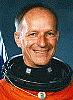
NAME: Claude Nicollier
BIRTHPLACE AND DATE: Vevey, Switzerland, 2 September 1944.
EDUCATION: Claude Nicollier graduated from the Gymnase de Lausanne, Switzerland, in 1962. He received a bachelor of science ("Licence") in Physics from the University of Lausanne in 1970 and a master of science degree in Astrophysics from the University of Geneva in 1975. He also graduated as a Swiss Air Force pilot in 1966, as airline pilot in 1974, and as test pilot in 1988.
FAMILY: Married, two daughters.
RECREATIONAL INTERESTS: Enjoys playing alphorn, snow skiing, mountain climbing, flying and photography.
ORGANISATIONS: Member of the Swiss Astronomical Society of the Pacific and the Swiss Airforce Officers Society. Fellow of the British Interplanetary Society. Honorary member of the Swiss Aero Club, and of the Swiss Society of Engineers and Architects.
EXPERIENCE: Nicollier worked as a graduate scientist with the Institute of Astronomy at Lausanne University and the Geneva Observatory between 1970 and 1973. Whilst still participating part-time in research activities, he also joined the Swiss Air Transport Scholl in Zurich and was assigned as DC-9 pilot for Swissair. At the end of 1976 he accepted a Fellowship at the European Space Agency's (ESA) Space Science Department at Noordwijk, The Netherlands, where he worked as a research scientist in various infrared astronomy programmes.
In 1978 he was selected by ESA as a member of the first group of European astronauts, after which he joined NASA astronaut candidates for training as a mission specialist. His technical assignments in the NASA Astronaut Office have included flight software verification in the Shuttle Avionics Integration Laboratory (SAIL), participation in the development of retrieval techniques for the Tethered Satellite System (TSS), Remote Manipulator Systems (RMS) and International Space Station (ISS) support. During 1988 he attended the Empire Test Pilot School in Boscombe Down, England, from where he graduated as a test pilot in December. Nicollier holds a commission as captain in the Swiss Air Force and, during leave periods in Switzerland, flies Northtrop F-5E's and Hawker Hunters. He has logged 5,300 hours flying time, including 3,700 in jet aircraft. Nicollier is based at ESA's European Astronaut Centre (EAC) in Cologne, Germany, and has been detached to the NASA Astronauts office in Houston since July 1980. He was a mission specialist on the STS-46 flight of the Space Shuttle Atlantis (31 July to 8 August 1992), during which crew members deployed ESA's retrievable science platform (EURECA) and conducted the first Tethered Satellite System (TSS) test flight. Nicollier then flew as a mission specialist on STS-61 (2-13 December, 1993) during which the crew of Endeavour repaired and refurbished the Hubble Space Telescope, a joint ESA/NASA project. He was selected for his third flight as a mission specialist on STS-75 in January 1995. The 15-day mission, which started on 22 February 1996, featured the second deployment of the Tethered Satellite System (TSS) which unexpectedly broke after reaching a distance of 19.5 kilometres from the Space Shuttle. Scientists were able to devise a programme of research making the most of the satellite's free flight while the astronauts� work centred on orbital investigations using the US Microgravity Payload (USPM-3). The flight ended on 9 March 1996.
Since July 1996, Nicollier (who has logged more than 792 hours in space) has lead the Astronaut Office Robotics Branch for the Space Shuttle and International Space Station at NASA/JSC.
SPECIAL HONOURS: After the Hubble Space Telescope Recovery mission in 1993 Claude Nicollier received one of the most prestigious aeronautical awards in America, the Robert J. Collier Trophy, from the National Aeronautic Association. He also holds a Silver Medal from the Academie Nationale de l'Air et de l'Espace, France (1994), the prix de L'Universite de Lausanne (1994), and honorary doctorates from the Swiss Federal Institute of Technology (EPFL) of Lausanne, and the Geneva University (both in 1994). He was appointed professor at the EFPL of Lausanne in November 1994. In 1998, he was awarded the Einstein Medal by the Einstein Society of Bern.
In August 1998, Claude Nicollier began training for his fourth spaceflight, the STS-104 mission scheduled for May 2000. During this third servicing mission of the Hubble Space Telescope, Nicollier will carry out his first "spacewalks". He will install new instruments and upgrade systems to enhance the capabilities of the orbiting telescope.
July 1998.
Planned EOM-1 shuttle mission. Cancelled after Challenger disaster. No crew named, later combined with STS-61K
Manned seven crew. Deployed Eureca-1; failed to deploy Italian tether probe TSS-1. Payloads: Tethered Satellite System (TSS)-1; European Retrievable Carrier (EURECA)-1L; Evaluation of Oxygen Integration with Materials (EOlM)-lll/ Thermal Energy Management Processes (TEMP)-2A; Consortium for Materials Development In Space Complex Autonomous Payloads (CONCAP)-ll and Ill; IMAX Cargo Bay Camera (ICBC); Limited Duration Space Environment Candidate Materials Exposure (LDCE); Pituitary Growth Hormone Cell Function (PHCF); Ultravio-let Plume Instrument (UVPl).
Manned seven crew. Hubble repair mission. Conducted the most EVAs (5) on a Space Shuttle Flight to that date. Payloads: Hubble Space Telescope (HST) Servicing Mission (SM) 1, IMAX Camera, IMAX Cargo Bay Camera (ICBC), Air Force Maui Optical Site (AMOS).
Carried TSS-1R tether satellite; satellite tether broke during deployment, making TSS-1R an unintentional free flyer
Payloads: Tethered Satellite System (TSS) Reflight (1R); Orbital Acceleration Research Experiment (OARE) (part of United States Microgravity Payload 3); USMP-3; Commercial Protein Crystal Growth (CPCG) 09, Block IV; Middeck Glovebox Experiment (MGBX) (part of USMP-3). During the deployment of TSS, the tether broke and the satellite was lost.
Hubble Space Telescope (HST) servicing mission SM-3A, delayed repeatedly by technical problems with the shuttle fleet after the near-disastrous previous launch. Finally launched after the last possible day to avoid Y2K computer problems; one spacewalk was cancelled so that the shuttle could return by December 28. Hubble was in a 591 km x 610 km x 28.5 deg orbit at launch. After separation of the external tank ET-101 the Orbiter was in a 56 km x 587 km x 28.5 deg transfer orbit. The OMS 2 burn at 0134 UTC raised the orbit to 313 km x 582 km. The payload bay contained:
Installed in the Hubble space telescope a new 486/25 mhz computer and replaced Fine Guidance Sensor FGS-2.