| astronautix.com | Jernigan |
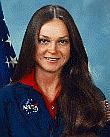
STS-40 Spacelab Life Sciences (SLS-1) was a dedicated space and life sciences mission aboard Space Shuttle Columbia. During the nine-day flight crew members performed experiments which explored how humans, animals and cells respond to microgravity and readapt to Earth's gravity on return. Other payloads included experiments designed to investigate materials science, plant biology and cosmic radiation. Mission duration was 218 hours, 14 minutes, 20 seconds. Landing was at Edwards Air Force Base, California.
STS-52 was also launched aboard Space Shuttle Columbia. During the ten-day flight, the crew deployed the Italian Laser Geodynamic Satellite (LAGEOS) which will be used to measure movement of the Earth's crust, and operated the U.S. Microgravity Payload 1 (USMP-1). Also, the Space Vision System (SVS), developed by the Canadian Space Agency, was tested by the crew using a small target assembly which was released from the remote manipulator system. The SVS will be used for Space Station construction. In addition, numerous other experiments were performed by the crew encompassing the areas of geophysics, materials science, biological research and applied research for Space Station. Mission duration was 236 hours, 56 minutes 13 seconds. Landing was at Kennedy Space Center, Florida.
STS-67 Astro-2 mission aboard the Space Shuttle Endeavour was the second flight of the Astro observatory, a unique complement of three telescopes. During this record-setting 16-day mission, the crew conducted observations around the clock to study the far ultraviolet spectra of faint astronomical objects and the polarization of ultraviolet light coming from hot stars and distant galaxies. Mission duration was 399 hours and 9 minutes. Landing was at Edwards Air Force Base in California.
On STS-80 the crew aboard Space Shuttle Columbia successfully deployed and retrieved the Wake Shield Facility (WSF) and the Orbiting Retrievable Far and Extreme Ultraviolet Spectrometer (ORFEUS) satellites. The free-flying WSF created a super vacuum in its wake and grew thin film wafers for use in semiconductors and other high-tech electrical components. The ORFEUS instruments, mounted on the reusable Shuttle Pallet Satellite, studied the origin and makeup of stars. Her two planned spacewalks were lost due to a jammed outer hatch on the airlock. Mission duration was a record breaking 423 hours, 53 minutes.
Carried Spacelab life sciences module. Payloads: Spacelab Life Sciences (SLS)-1 with long module, getaway special bridge assembly with 12 getaway specials, Physiological Monitoring System (PMS), Urine Monitoring System (UMS), Animal Enclosure Modules (AEM), Middeck Zero-gravity Dynamics Experiment (MODE), 7 Orbiter Experiments Program experiments.
Deployed Lageos 2, CTA. Payloads: Laser Geodynamic Satellite (LAGEOS) II/ Italian Research Interim Stage (IRIS), Canadian Experiments (CANEX) 2, United States Micro-gravity Payload (USMP) 1, Attitude Sensor Pack-age (ASP), Tank Pressure Control Experiment (TPCE), Physiological Systems Experiment (PSE), Heat Pipe Performance (HPP) experiment, Commercial Protein Crystal Growth (CPCG), Shuttle Plume Impingement Experiment (SPIE), Commercial Materials ITA Experiment (CMIX), Crystals by Vapor Transport Experiment (CVTE).
Carried Astro 2 astronomy payload with 3 UV telescopes.(attached to Endeavour).Payloads: Ultraviolet Astronomy (ASTRO) 2; Middeck Active Control Experiment (MACE); Protein Crystal Growth�Thermal Enclosure System (PCG-TES) 03; Protein Crystal Growth�Single-Locker Thermal Enclosure System (PCG-STES) 02; Commercial Materials Dispersion Apparatus Minilab/Instrumentation Technology Associates, Inc. Experiments (CMIX) 03; Shuttle Amateur Radio Experiment (SAREX) II; two getaway special experiments.
Mission STS-80 carried the Orfeus astronomy satellite, the Wake Shield Facility, and spacewalk equipment. The Orfeus satellite was deployed on November 20. It carried an ultraviolet telescope and spectrographs. Wake Shield Facility was deployed on November 22 and retrieved on November 26 . On 1996 Nov 29, crewmembers Tamara Jernigan and Thomas Jones were to conduct the first of several planned EVAs. However the shuttle's exit hatch would not open and NASA cancelled this and the other planned spacewalks of the mission. On December 4 at the astronauts retrieved the Orfeus satellite using the RMS arm. Reentry attempts on Dec 5 and Dec 6 were called off due to bad weather. Columbia finally landed at 11:49 GMT December 7 on Runway 33 at Kennedy Space Center, making STS-80 the longest shuttle mission to that date .
Discovery docked at the PMA-2 end of the International Space Station PMA-2/Unity/PMA-1/Zarya stack. The crew transferred equipment from the Spacehab Logistics Double Module in the payload bay to the interior of the station. Tammy Jernigan and Dan Barry made a space walk to transfer equipment from the payload bay to the exterior of the station. The ODS/EAL docking/airlock truss carried two TSA (Tool Stowage Assembly) packets with space walk tools. The Integrated Cargo Carrier (ICC), built by Energia and DASA-Bremen, carried parts of the Strela crane and the US OTD crane as well as the SHOSS box which contains three bags of tools and equipment to be stored on ISS's exterior.
The STS-96 payload bay manifest:
On May 30 at 02:56 GMT Tammy Jernigan and Dan Barry entered the payload bay of Discovery from the tunnel adapter hatch, and made a 7 hr 55 min space walk, transferring equipment to the exterior of the station.
On May 31 at 01:15 GMT the hatch to Unity was opened and the crew began several days of cargo transfers to the station. Battery units and communications equipment were replaced and sound insulation was added to Zarya. Discovery undocked from ISS at 22:39 GMT on June 3 into a 385 x 399 km x 51.6 degree orbit, leaving the station without a crew aboard. On June 5 the Starshine satellite was ejected from the payload bay. The payload bay doors were closed at around 02:15 GMT on June 6 and the deorbit burn was at 04:54 GMT. Discovery landed on runway 15 at Kennedy Space Center at 06:02 GMT.
On May 30 at 02:56 GMT Tammy Jernigan and Dan Barry entered the payload bay of space shuttle Discovery from the tunnel adapter hatch. During the space walk they transferred equipment to the exterior of the station.