| astronautix.com | Godwin |
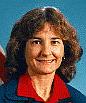
Dr. Godwin is an instrument rated private pilot.
Selected by NASA as an astronaut candidate in June 1985, Dr. Godwin became an astronaut in July 1986. Her technical assignments have included working with flight software verification in the Shuttle Avionics Integration Laboratory (SAIL), and coordinating mission development activities for the Inertial Upper Stage (IUS), deployable payloads, and Spacelab missions. She also has served as: Chief of Astronaut Appearances; Chief of the Mission Development Branch of the Astronaut Office, and as the astronaut liaison to its Educational Working Group; Deputy Chief of the Astronaut Office. A veteran of three space flights, Dr. Godwin has logged over 633 hours in space, including a 6-hour spacewalk. In 1991 she served as a Mission Specialist on STS-37, was the Payload Commander on STS-59 in 1994, and in 1996 was on the crew of STS-76, a Mir docking mission.
STS-37 launched from the Kennedy Space Center, Florida, on April 5, 1991 and landed at Edwards Air Force Base, California, on April 11, 1991. During the 93 orbits of the mission, the crew of Atlantis deployed the Gamma Ray Observatory (GRO) to study gamma ray sources in the universe. GRO, at almost 35,000 pounds, was the heaviest payload deployed to date by the Shuttle Remote Manipulator System (RMS). The crew also conducted an unscheduled space walk to free the GRO high gain antenna, and conducted the first scheduled extravehicular activity in 5-1/2 years to test concepts for moving about large space structures. Several middeck experiments and activities were conducted including test of elements of a heat pipe to study fluid transfer processed in microgravity environments (SHARE), a chemical processing apparatus to characterize the structure of biologicalmaterials (BIMDA), and an experiment to grow larger and more perfect protein crystals than can be grown on the ground (PCG II). Atlantis carried amateur radio equipment for voice contact, fast scan and slow scan TV, and packet radio. Several hundred contacts were made with amateur radio operators around the world. Mission duration was 143 hours, 32 minutes, 44 seconds.
STS-59, the Space Radar Laboratory (SRL) mission, April 9-20, 1994, was launched aboard Space Shuttle Endeavour. SRL consisted of three large radars, SIR-C/X-SAR (Shuttle Imaging Radar C/X-Band Synthetic Aperture Radar), and a carbon monoxide sensor that were used to enhance studies of the Earth's surface and atmosphere. The imaging radars operated in three frequencies and four polarizations. This multispectral capability of the radars provided information about the Earth's surface over a wide range of scales not discernible with previous single-frequency experiments. The carbon monoxide sensor MAPS (Measurement of Air Pollution by Satellite) used gas filter radiometry to measure the global distribution of CO in the troposphere. Real-time crew observations of surface phenomena and climatic conditions augmented with over 14,000 photographs aided investigators in interpretation and calibration of the data. The mission concluded with a landing at Edwards AFB after orbiting the Earth 183 times in 269 hours, 29 minutes.
STS-76, the third docking mission to the Russian space station Mir, launched on March 22, 1996 with a crew of six aboard Atlantis. Following rendezvous and docking with Mir, transfer of a NASA astronaut to Mir for a 5-month stay was accomplished to begin a continuous presence of U.S. astronauts aboard Mir for the next two year period. the crew also transferred 4800 pounds of science and mission hardware, food, water and air to Mir and returned over 1100 pounds of U.S. and ESA science and Russian hardware. Dr. Godwin performed a six-hour spacewalk, the first while docked to an orbiting space station, to mount experiment packages on the Mir docking module to detect and assess debris and contamination in a space station environment. The packages will be retrieved by a future shuttle mission. The Spacehab module carried in the Shuttle payload bay was utilized extensively for transfer and return stowage of logistics and science and also carried Biorack, a small multipurpose laboratory used during this mission for research of plant and animal cellular function. This mission was also the first flight of Kidsat, an electronic camera controlled by classroom students via a Ku-band link between JSC Mission Control and the Shuttle, which uses digitized photography from the Shuttle for science and education. Following 145 orbits of the Earth, Atlantis landed with a crew of five at Edwards Air Force Base in California on March 31, 1996.
Manned five crew. Unscheduled EVA to manually deploy the Gamma-Ray Observatory's high-gain antenna, which failed to deploy upon ground command. Payloads: Gamma-Ray Observatory (GRO), Crew/ Equipment Translation Aids (part of Extravehicular Activity Development Flight Experiment), Ascent Particle Monitor (APM), Bioserve Instrumentation Technology Associates Materials Dispersion Apparatus (BlMDA), Protein Crystal Growth (PCG)-Block Il, Space Station Heatpipe Advanced Radiator Element (SHARE)-ll, Shuttle Amateur Radio Experiment (SAREX)-ll, Radiation Monitoring Equipment (RME)-lIl, Air Force Maui Optical Site (AMOS) Calibration Test.
Carried SIR-C SAR radar. Payloads: Space Radar Laboratory (SRL) 1; Consortium for Materials Development in Space Com-plex Autonomous Payload (CONCAP) IV; three getaway special (GAS) payloads; Space Tissue Loss (STL) A, B; Visual Function Tester (VFT) 4; Shuttle Amateur Radio Experiment (SAREX) II.
Shuttle-Mir Mission 3. Docked with the Mir space station 24 March 1996; Shannon Lucid was left on Mir for an extended stay. First American EVA on Mir. Payloads: SPACEHAB/Mir 03; KidSat; Shuttle Amateur Radio Experiment (SAREX) II, Configuration M; RME 1304�Mir/ Environmental Effects Payload (MEEP); orbiter docking system RME 1315; Trapped Ions in Space Experiment (TRIS); Extravehicular Activity Development Flight Test (EDFT) 04.
Attached MEEP materials exposure experiment to outside of Mir (retrieved on STS-86).