| astronautix.com | Dunbar |
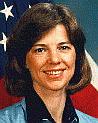
She is a private pilot with over 200 hours in single engine land aircraft, has logged more than 700 hours flying time in T-38 jets as co-pilot, and has over 100 hours as co-pilot in a Cessna Citation Jet.
Dr. Dunbar became a NASA astronaut in August 1981. Her technical assignments have included assisting in the verification of Shuttle flight software at the Shuttle Avionics Integration Laboratory (SAIL), serving as a member of the Flight Crew Equipment Control Board, participation as a member of the Astronaut Office Science Support Group, supporting operational development of the remote manipulator system (RMS). She has served as chief of the Mission Development Branch, as the Astronaut Office interface for "secondary" payloads, and as lead for the Science Support Group. In 1993 Dr. Dunbar served as Deputy Associate Administrator, Office of Life and Microgravity Sciences, NASA Headquarters, Washington, D.C. In February 1994, she traveled to Star City, Russia, where she spent 13-months training as a back-up crew member for a 3-month flight on the Russian Space Station, Mir. In March 1995, she was certified by the Russian Gagarin Cosomonaut Training Center as qualified to fly on long duration Mir Space Station flights. From October, 1995 to November, 1996, she was detailed to the NASA JSC Mission Operations Directorate as Assistant Director where she was responsible for chairing the International Space Station Training Readiness Reviews, and facilitating Russian/American operations and training strategies.
A veteran of four space flights, Dr. Dunbar has logged more than 996 hours (41.5 days) in space. She was a mission specialist on STS 61-A in 1985, STS-32 in 1990, was the Payload Commander on STS-50 in 1992, and was a mission specialist on STS-71 in 1995.
STS 61-A, the West German D-1 Spacelab mission, launched from Kennedy Space Center, Florida, on October 30, 1985. The 61-A mission was the first to carry eight crew members, the largest to fly in space, and was also the first in which payload activities were controlled from outside the United States. More than 75 scientific experiments were completed in the areas of physiological sciences, materials science, biology, and navigation. During the seven-day mission, Dr. Dunbar was responsible for operating Spacelab and its subsystems and performing a variety of experiments. Her mission training included six months of experiment training in Germany, France, Switzerland, and The Netherlands. After completing 111 orbits of the Earth in 168 hours 44 minutes 51 seconds, Challenger and her crew landed at Edwards Air Force Base, California, on November 6, 1985.
STS-32 launched from the Kennedy Space Center, Florida, on January 9, 1990. During the ten-day mission, crew members aboard Columbia successfully deployed the Syncom IV-F5 satellite, and retrieved the 21,400-pound Long Duration Exposure Facility (LDEF) using the RMS. They also operated a variety of middeck experiments including the Microgravity Disturbance Experiment (MDE) using the Fluids Experiment Apparatus (FEA), Protein Crystal Growth (PCG), American Flight Echocardiograph (AFE), Latitude/Longitude Locator (L3), Mesoscale Lightning Experiment (MLE), Characterization of Neurospora Circadian Rhythms (CNCR),and the IMAX Camera. Dr. Dunbar was principal investigator for the MDE/FEA Experiment. Additionally, numerous medical test objectives, including in-flight lower body negative pressure (LBNP), in-flight aerobic exercise and muscle performance were conducted to evaluate human adaptation to extended duration missions. Following 173 orbits of the Earth in 261 hours 1 minute 38 seconds, Columbia returned with a night landing at Edwards Air Force Base, California, on January 20, 1990.
Dr. Dunbar flew as Payload Commander on STS-50, the United States Microgravity Lab-1 mission dedicated to microgravity fluid physics and materials science. Over 30 experiments sponsored by over 100 investigators were housed in the "Spacelab" in the Shuttle's Payload Bay. A payload crew of 4 operated around-the-clock for 13 days performing experiments in scientific disciplines such as protein crystal growth, electronic and infrared detector crystal growth, surface tension physics, zeolite crystal growth, and human physiology. STS-50 launched from the Kennedy Space Center, Florida, on June 25, 1992, and concluded with a landing at the Kennedy Space Center on July 9, 1992, following 221 orbits of the Earth in 331 hours 30 minutes 4 seconds.
On STS-71 Dr. Dunbar served as MS-3 on a seven-member crew launched June 27, 1995, from the Kennedy Space Center and as a member of an eight-member crew which returned there on July 7, 1995. This was the first Space Shuttle mission to dock with the Russian Space Station Mir, and involved an exchange of crews. The Atlantis Space Shuttle was modified to carry a docking system compatible with the Russian Mir Space Station. It also carried a Spacelab module in the payload bay in which the crew performed medical evaluations on the returning Mir crew. These evaluations included ascertaining the effects of weightlessness on the cardio/vascular system, the bone /muscle system, the immune system, and the cardio/pulmonary system. Mission duration was 235 hours, 23 minutes
Manned eight crew. Launched GLOMR; carried Spacelab D1. Payloads: Spacelab D-1 with habitable module and 76 experiments. Six of the eight crew members were divided into a blue and red team working 12-hour shifts for 24-hour-a-day operation. The remaining two crew members were 'switch hitters.'.
Planned shuttle LDEF (Long Duration Exposure Facility) recovery mission. Cancelled after Challenger disaster.
Manned five crew. Deployed Leasat 5, retrieved LDEF. Night landing. Payloads: Deployment of Syncom IV-5, retrieval of Long Duration Exposure Facility (LDEF), Fluids Experiment Apparatus (FEA)-3, Protein Crystal Growth (PCG) III-2, Latitude/Longitude Locator (L3), American Flight Echocardiograph (AFE), Characterization of Neurospora Circadian Rhythms in Space (CNCR)-01, Air Force Maui Optical Site (AMOS)-4, Mesoscale Lightning Experiment (MLE), IMAX, Interim Operational Contamination Monitor (lOCM).
Carried United States Microgravity Laboratory. First extended-duration mission. Payloads: United States Microgravity Laboratory (USML)-1; Orbital Acceleration Research Experiment (OARE); Investigations Into Polymer Membrane Processing (IPMP), Shuttle Amateur Radio Experiment (SAREX)-ll; Ultraviolet Plume Instrument (UVPl) .
Mir Expedition EO-18. Soyuz TM-21 carried the EO-18 Mir crew and American Norman Thagard. Thagard was the first American to be launched in a Soyuz. Soyuz docked with Mir at 07:45:26 GMT on March 16 . On July 4 Soyuz TM-21 undocked and backed off to a distance of 100 m from Mir. The US space shuttle Atlantis, with the EO-18 crew aboard, then undocked and began a flyaround at a distance of 210 m, while the EO-19 crew aboard Soyuz took pictures before redocking with the station. Soyuz TM-21 again undocked with the EO-19 crew on September 11 from the Kvant rear port on Mir and landed at 50 deg 41'N 68 deg 15'E, 108 km northeast of Arkalyk in Kazakhstan, at 06:52:40 GMT .
Mir Expedition EO-19. Transferred Budarin, Solovyov to Mir, returned Soyuz TM-21 crew to Earth. After undocking from Mir on July 4, Atlantis spent several days on orbit, carrying out medical research work with the Spacelab-Mir module in the cargo bay. Payloads: Shuttle/Mir Mission 1, Spacelab-Mir, IMAX camera, Shuttle Amateur Radio Experiment (SAREX).
Penultimate Shuttle mission to Mir. Andy Thomas replaced David Wolf as the resident NASA astronaut. Endeavour docked with the SO module on Mir at 20:14 GMT on January 24, 1998.
Payloads included:
Despite fits problems with his Sokol emergency spacesuit, Andy Thomas replaced David Wolf as a Mir crew member on January 25. Endeavour undocked from Mir on January 29 at 16:57 GMT and made one flyaround of the station before departing and landing at Kennedy Space Center's runway 15 at 22:35 GMT on January 31.