| astronautix.com | Musgrave |
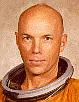
He has flown 17,700 hours in 160 different types of civilian and military aircraft, including 7,500 hours in jet aircraft. He has earned FAA ratings for instructor, instrument instructor, glider instructor, and airline transport pilot, and U.S. Air Force Wings. An accomplished parachutist, he has made more than 500 free falls -- including over 100 experimental free-fall descents involved with the study of human aerodynamics.
Dr. Musgrave was employed as a mathematician and operations analyst by the Eastman Kodak Company, Rochester, New York, during 1958.
He served a surgical internship at the University of Kentucky Medical Center in Lexington from 1964 to 1965, and continued there as a U. S. Air Force post-doctoral fellow (1965-1966), working in aerospace medicine and physiology, and as a National Heart Institute post-doctoral fellow (1966-1967), teaching and doing research in cardiovascular and exercise physiology. From 1967 to 1989, he continued clinical and scientific training as a part-time surgeon at the Denver General Hospital and as a part-time professor of physiology and biophysics at the University of Kentucky Medical Center.
He has written 25 scientific papers in the areas of aerospace medicine and physiology, temperature regulation, exercise physiology, and clinical surgery.
Dr. Musgrave first flew on STS-6, which launched from the Kennedy Space Center, Florida, on April 4, 1983, and landed at Edwards Air Force Base, California, on April 9, 1983. During this maiden voyage of Space Shuttle Challenger, the crew performed the first Shuttle deployment of an IUS/TDRS satellite, and Musgrave and Don Peterson conducted the first Space Shuttle extravehicular activity (EVA) to test the new space suits and construction and repair devices and procedures. Mission duration was 5 days, 23 minutes, 42 seconds.
On STS-51F/Spacelab-2, the crew aboard Challenger launched from the Kennedy Space Center, Florida, on July 29, 1985, and landed at Edwards Air Force Base, California, on August 6, 1985. This flight was the first pallet-only Spacelab mission, and the first mission to operate the Spacelab Instrument Pointing System (IPS). It carried 13 major experiments in astronomy, astrophysics, and life sciences. During this mission, Dr. Musgrave served as the systems engineer during launch and entry, and as a pilot during the orbital operations. Mission duration was 7 days, 22 hours, 45 minutes, 26 seconds.
On STS-33, he served aboard the Space Shuttle Discovery, which launched at night from the Kennedy Space Center, Florida, on November 22, 1989. This classified mission operated payloads for the Department of Defense. Following 79 orbits, the mission concluded on November 27, 1989, with a landing at sunset on Runway 04 at Edwards Air Force Base, California. Mission duration was 5 days, 7 minutes, 32 seconds.
STS-44 also launched at night on November 24, 1991. The primary mission objective was accomplished with the successful deployment of a Defense Support Program (DSP) satellite with an Inertial Upper Stage (IUS) rocket booster. In addition the crew also conducted two Military Man in Space Experiments, three radiation monitoring experiments, and numerous medical tests to support longer duration Shuttle flights. The mission was concluded in 110 orbits of the Earth with Atlantis returning to a landing on the lakebed at Edwards Air Force Base, California, on December 1, 1991. Mission duration was 6 days, 22 hours, 50 minutes, 42 seconds.
STS-61 was the first Hubble Space Telescope (HST) servicing and repair mission. Following a night launch from Kennedy Space Center on December 2, 1993, the Endeavour rendezvoused with and captured the HST. During this 11-day flight, the HST was restored to its full capabilities through the work of two pairs of astronauts during a record 5 spacewalks. Dr. Musgrave performed 3 of these spacewalks. After having travelled 4,433,772 miles in 163 orbits of the Earth, Endeavour returned to a night landing in Florida on December 13, 1993. Mission duration was 10 days, 19 hours, 59 minutes.
Most recently, Dr. Musgrave served aboard Space Shuttle Columbia on STS-80 (November 19 to December 7, 1996). During the flight the crew deployed and retrieved the Wake Shield Facility (WSF) and the Orbiting Retrievable Far and Extreme Ultraviolet Spectrometer (ORFEUS) satellites. The free-flying WSF created a super vacuum in its wake in which to grow thin film wafers for use in semiconductors and the electronics industry. The ORFEUS instruments, mounted on the reusable Shuttle Pallet Satellite, studied the origin and makeup of stars. In completing this mission he logged a record 278 earth orbits, traveled over 7 million miles in 17 days, 15 hours, 53 minutes.
Epic repair mission which brought Skylab into working order. Included such great moments as Conrad being flung through space by the whiplash after heaving on the solar wing just as the debris constraining it gave way; deployment of a lightweight solar shield, developed in Houston in one week, which brought the temperatures down to tolerable levels. With this flight US again took manned spaceflight duration record.
Skylab 2 , consisting of a modified Apollo CSM payload and a Saturn IB launch vehicle, was inserted into Earth orbit approximately 10 minutes after liftoff. The orbit achieved was 357 by 156 km and, during a six-hour period following insertion, four maneuvers placed the CSM into a 424 by 415 km orbit for rendezvous with the Orbital Workshop. Normal rendezvous sequencing led to stationkeeping during the fifth revolution followed by a flyaround inspection of the damage to the OWS. The crew provided a verbal description of the damage in conjunction with 15 minutes of television coverage. The solar array system wing (beam) 2 was completely missing. The solar array system wing (beam) 1 was slightly deployed and was restrained by a fragment of the meteoroid shield. Large sections of the meteoroid shield were missing. Following the flyaround inspection, the CSM soft-docked with the OWS at 5:56 p.m. EDT to plan the next activities. At 6:45 p.m. EDT the CSM undocked and extravehicular activity was initiated to deploy the beam 1 solar array. The attempt failed. Frustration of the crew was compounded when eight attempts were required to achieve hard docking with the OWS. The hard dock was made at 11:50 p.m. EDT, terminating a Skylab 2 first-day crew work period of 22 hours.
Manned four crew. First flight of space shuttle Challenger; deployed TDRSS. Payloads: Deployment of Tracking and Data Relay Satellite (TDRS)-A with Inertial Upper Stage (lUS)-2, Continuous Flow Electrophoresis System (CFES), Monodisperse Latex Reactor (MLR), Night/Day Optical Survey of Lightning (NOSL) experiment, three getaway specials (GAS).
Tested EMU Manoeuvring Unit. Tested EVA emergency procedures.
Manned seven crew. At 5 minutes, 45 seconds into ascent the number one engine shut down prematurely and an abort to orbit was declared. Despite the anomaly the mission continued. Launched PDP; carried Spacelab 2. Payloads: Spacelab-2 with 13 experiments, Shuttle Amateur Radio Experiment (SAREX), Protein Crystal Growth (PCG). The flight crew was divided into a red and blue team. Each team worked 12-hour shifts for 24-hour-a-day operation.
Manned five crew. Deployed a classified payload. Orbits of Earth: 78. Distance traveled: 3,218,687 km. Landed at: Concrete runway 04 at Edwards Air Force Base, Cali. Landing Speed: 368 kph. Touchdown miss distance: 570.00 m. Landing Rollout: 2,366.00 m. Payloads: DoD Mission - third space shuttle night launch.
Manned six crew. Deployed Defense Support Program satellite. Payloads: Defense Support Program satellite/ Inertial Upper Stage, Interim Operational Contamination Monitor, Terra Scout, Military Man in Space, Shuttle Activation Monitor, Cosmic Radiation Effects and Activation Monitor, Radiation Monitoring Equipment Ill, Air Force Maui Optical Site Calibration Test, Ultraviolet Plume Instrument, Visual Function Tester 1.
Manned seven crew. Hubble repair mission. Conducted the most EVAs (5) on a Space Shuttle Flight to that date. Payloads: Hubble Space Telescope (HST) Servicing Mission (SM) 1, IMAX Camera, IMAX Cargo Bay Camera (ICBC), Air Force Maui Optical Site (AMOS).
Hubble Space Telescope Servicing Mission 1 - gyroscope replacement.
Hubble Space Telescope Servicing Mission 1 - WFPC-P installation.
Hubble Space Telescope Servicing Mission 1 - solar array drive replacement.
Mission STS-80 carried the Orfeus astronomy satellite, the Wake Shield Facility, and spacewalk equipment. The Orfeus satellite was deployed on November 20. It carried an ultraviolet telescope and spectrographs. Wake Shield Facility was deployed on November 22 and retrieved on November 26 . On 1996 Nov 29, crewmembers Tamara Jernigan and Thomas Jones were to conduct the first of several planned EVAs. However the shuttle's exit hatch would not open and NASA cancelled this and the other planned spacewalks of the mission. On December 4 at the astronauts retrieved the Orfeus satellite using the RMS arm. Reentry attempts on Dec 5 and Dec 6 were called off due to bad weather. Columbia finally landed at 11:49 GMT December 7 on Runway 33 at Kennedy Space Center, making STS-80 the longest shuttle mission to that date .