| astronautix.com | Akers |
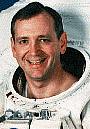
Official NASA Biography - 1997
On STS-41, October 6-10, 1990, he was responsible for the mission's primary payload, the Ulysses spacecraft. The STS-41 crew successfully deployed the interplanetary probe and started it on its four-year journey via Jupiter to investigate the polar regions of the Sun.
STS-49, May 7-16, 1992, was the maiden flight of the new Space Shuttle Endeavour. The STS-49 crew successfully completed four EVA's (space walks), three rendezvous, and a variety of secondary objectives. Akers was one of a three-member EVA team who successfully captured the stranded INTELSAT (International Telecommunications Satellite). This was the first 3-person EVA and the longest EVA (8.5 hours) in history. Akers also performed a second EVA on this flight to evaluate Space Station Freedom construction techniques.
On STS-61, December 2-13, 1993, Akers again served as an EVA crew member. During the 11-day mission, the crew captured the Hubble Space Telescope and restored it to full capacity through a record five space walks by four astronauts. Akers performed two of these bringing his total EVA time to 29 hours and 40 minutes.
STS-79, September 16-26, 1996, was the fourth Shuttle mission to rendezvous with the Russian Space Station Mir. Akers was the flight engineer and responsible for the transfer of over 3.5 tons of supplies to and from the Mir. This mission also marked the first exchange of U.S. astronauts on Mir - leaving John Blaha and returning Shannon Lucid home after her record six month stay in space.
Manned five crew. Deployed Ulysses spacecraft. Payloads: Deploy Ulysses, Shuttle Solar Backscatter Ultraviolet, Intelsat Solar Array Coupon, Solid-Surface Combustion Experiment, Investigations Into Polymer Membrane Processing, Chromo-some and Plant Cell Division in Space, Physiological Systems Experiment, Voice Command System, Radiation Monitoring Equipment III, Air Force Maui Optical Site.
Retrieved Intelsat 6 and attached new SRM. First active dual rendezvous of two orbiting spacecraft (Endeavour and Intelsat-Vl) First deployment of a drag chute on the orbiter fleet. Payloads: Intelsat-Vl reboost mission hardware, Assembly of Station by EVA Methods (ASEM), Commercial Protein Crystal Growth (CPCG), Air Force Maui Optical Site (AMOS) Calibration Test, Ultraviolet Plume Instrument (UVPl).
Intelsat V1 finally captured in first three-person spacewalk.
Tested tools and techniques for assembly of the International Space Station.
Manned seven crew. Hubble repair mission. Conducted the most EVAs (5) on a Space Shuttle Flight to that date. Payloads: Hubble Space Telescope (HST) Servicing Mission (SM) 1, IMAX Camera, IMAX Cargo Bay Camera (ICBC), Air Force Maui Optical Site (AMOS).
Hubble Space Telescope Servicing Mission 1 - solar array replacement.
Hubble Space Telescope Servicing Mission 1 - COSTAR installation.
On September 19 Atlantis docked with the Russian Mir space station. Aboard Atlantis in the payload bay were the Orbiter Docking System, the modified Long Tunnel, and the Spacehab Double Module, containing supplies for the Mir. Astronaut John Blaha relieved Shannon Lucid as NASA resident on the complex. Atlantis undocked from the Mir complex on September 23 at 23:33 GMT. Valeriy Korzun, Aleksandr Kaleri and John Blaha remain on Mir. On September 26 Atlantis closed its payload bay doors, and at 11:06 GMT fired its OMS engines for a three minute long deorbit burn. After entry interface at 11:42 GMT the spaceship flew across Canada and the US for a landing at the Kennedy Space Center's Runway 15 at 12:13 GMT.