| astronautix.com | Hoffman |
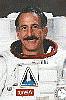
From 1972 to 1975, during post-doctoral work at Leicester University, he worked on several x-ray astronomy rocket payloads. He also designed and supervised the construction and testing of the test equipment for use in an x-ray beam facility which he used to measure the scattering and reflectivity properties of x-ray concentrating mirrors. During his last year at Leicester, he was project scientist for the medium-energy x-ray experiment on the European Space Agency's EXOSAT satellite and played a leading role in the proposal and design studies for this project.
He worked in the Center for Space Research at the Massachusetts Institute of Technology (MIT) from 1975 to 1978 as project scientist in charge of the orbiting HEAO-1 A4 hard x-ray and gamma ray experiment, launched in August 1977. His involvement included pre-launch design of the data analysis system, supervising its operation post-launch, and directing the MIT team undertaking the scientific analysis of flight data being returned. He was also involved extensively in analysis of x-ray data from the SAS-3 satellite being operated by MIT. His principal research was the study of x-ray bursts, about which he authored or co-authored more than 20 papers.
Dr. Hoffman made his first space flight as a mission specialist on STS 51-D, April 12-19, 1985, on the Shuttle Discovery. On this mission, he made the first STS contingency space walk, in an attempted rescue of a malfunctioning satellite.
Dr. Hoffman made his second space flight as a mission specialist on STS-35, December 2-10, 1990, on the Shuttle Columbia. This Spacelab mission featured the ASTRO-1 ultraviolet astronomy laboratory, a project on which Dr. Hoffman had worked since 1982.
Dr. Hoffman made his third space flight as payload commander and mission specialist on STS-46, July 31-August 8, 1992, on the Shuttle Atlantis. On this mission, the crew deployed the European Retrievable Carrier (EURECA), an ESA-sponsored free-flying science platform, and carried out the first test flight of the Tethered Satellite System (TSS), a joint project between NASA and the Italian Space Agency. Dr. Hoffman had worked on the Tethered Satellite project since 1987.
Dr. Hoffman made his fourth flight as an EVA crew member on STS-61, December 2-13, 1993, on the Shuttle Endeavour. During this flight, the Hubble Space Telescope (HST) was captured, serviced, and restored to full capacity through a record five space walks by four astronauts.
Most recently, Dr. Hoffman flew on STS-75 (February 22 to March 9, 1996) on the Shuttle Columbia. This was a 16-day mission whose principal payloads were the reflight of the Tethered Satellite System (TSS) and the third flight of the United States Microgravity Payload (USMP-3). The TSS successfully demonstrated the ability of tethers to produce electricity. The TSS experiment produced a wealth of new information on the electrodynamics of tethers and plasma physics before the tether broke at 19.7 km, just shy of the 20.7 km goal. The crew also worked around the clock performing combustion experiments and research related to USMP-3 microgravity investigations. The mission was completed in 252 orbits covering 6.5 million miles in 377 hours and 40 minutes.
With the completion of his fifth space flight, Dr. Hoffman has logged more than 1,211 hours and 21.5 million miles in space.
Planned shuttle mission for deployment of commercial communications satellites. Cancelled due to payload delays.
Planned TDRS/IUS deployment shuttle mission. Cancelled due to IUS failure.
Manned seven crew. Payloads: Telesat (Canada communications satellite)-I with Payload Assist Module (PAM)-D deployment, Syncom IV-3 communications satellite deploy-ment with its unique stage (unique stage failed to ignite), Continuous Flow Electrophoresis (CFES), Phase Partitioning Experiment (PPE), student experiments, two getaway specials (GAS) Informal science studies (Toys in Space).
RMS 'Ryswatters' installed.
Planned Astro-1 shuttle mission. Cancelled after Challenger disaster.
Manned seven crew. Carried ASTRO-1 observatory. Payloads: Ultraviolet Astronomy TeIescope (Astro), Broad-Band X-Ray Telescope (BBXRT), Shuttle Amateur Radio Experiment (SAREX), Air Force Maui Optical Site (AMOS).
Manned seven crew. Deployed Eureca-1; failed to deploy Italian tether probe TSS-1. Payloads: Tethered Satellite System (TSS)-1; European Retrievable Carrier (EURECA)-1L; Evaluation of Oxygen Integration with Materials (EOlM)-lll/ Thermal Energy Management Processes (TEMP)-2A; Consortium for Materials Development In Space Complex Autonomous Payloads (CONCAP)-ll and Ill; IMAX Cargo Bay Camera (ICBC); Limited Duration Space Environment Candidate Materials Exposure (LDCE); Pituitary Growth Hormone Cell Function (PHCF); Ultravio-let Plume Instrument (UVPl).
Manned seven crew. Hubble repair mission. Conducted the most EVAs (5) on a Space Shuttle Flight to that date. Payloads: Hubble Space Telescope (HST) Servicing Mission (SM) 1, IMAX Camera, IMAX Cargo Bay Camera (ICBC), Air Force Maui Optical Site (AMOS).
Hubble Space Telescope Servicing Mission 1 - gyroscope replacement.
Hubble Space Telescope Servicing Mission 1 - WFPC-P installation.
Hubble Space Telescope Servicing Mission 1 - solar array drive replacement.
Carried TSS-1R tether satellite; satellite tether broke during deployment, making TSS-1R an unintentional free flyer
Payloads: Tethered Satellite System (TSS) Reflight (1R); Orbital Acceleration Research Experiment (OARE) (part of United States Microgravity Payload 3); USMP-3; Commercial Protein Crystal Growth (CPCG) 09, Block IV; Middeck Glovebox Experiment (MGBX) (part of USMP-3). During the deployment of TSS, the tether broke and the satellite was lost.