| astronautix.com | Walker Dave |
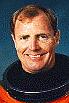
He has logged more than 7000 hours flying time--over 6500 hours in jet aircraft.
On his first flight, Walker was the pilot on STS 51-A which launched from Kennedy Space Center, Florida, on November 8, 1984. This was the second flight of the Orbiter Discovery. During the mission the crew deployed two satellites, Canada's Anik D-2 (Telesat H), and Hughes' LEASAT-1 (Syncom IV-1). In the first space salvage mission in history the crew also retrieved for return to Earth the Palapa B-2 and Westar VI satellites. STS 51-A completed 127 orbits of the Earth before landing at Kennedy Space Center, Florida, on November 16, 1984.
As mission commander of STS-30, Walker and his crew launched from Kennedy Space Center, Florida, on May 4, 1989, aboard the Orbiter Atlantis. During the four-day mission, crew members successfully deployed the Magellan Venus-exploration spacecraft, the first U.S. planetary science mission launched since 1978, and the first planetary probe to be deployed from the Shuttle. Magellan arrived at Venus in August 1990, and mapped over 95% of the surface of Venus. In addition, crew members also worked on secondary payloads involving fluid research in general, chemistry, and electrical storm studies. Following 64 orbits of the Earth, the STS-30 mission concluded with the first cross-wind landing test of the Shuttle Orbiter at Edwards Air Force Base, California, on May 8, 1989.
Walker next commanded a five-man crew on STS-53 which launched from the Kennedy Space Center, Florida, on December 2, 1992. The crew of five deployed the classified Department of Defense payload DOD-1 and then performed several Military-Man-in-Space and NASA experiments. After completing 115 orbits of the Earth in 175 hours, Discovery landed at Edwards Air Force Base, California, on December 9, 1992.
Most recently, Walker again commanded a five-man crew on STS-69 which launched on September 7, 1995. The crew successfully deployed and retrieved a SPARTAN satellite and the Wake Shield Facility. Also on board was the International Extreme Ultraviolet Hitchhiker payload, and numerous secondary payloads and medical experiments. Endeavour landed at the Kennedy Space Center on September 18, 1995 after 171 orbits of the Earth in 260 hours, 29 minutes, 8 seconds.
Walker left NASA in April 1996 to become Vice President, Sales & Marketing, for NDC Voice Corporation in Southern California.
Planned Department of Defense or TDRS deployment shuttle mission. Cancelled due to IUS failure.
Manned five crew. First retrieval of two satellites (PALAPA B-2 and WESTAR Vl) for return to earth. Deployed Anik D2, Leasat 2; recovered Westar 6, Palapa B2. Payloads: Telesat (Canada communications satellite)-H with Payload Assist Module (PAM)-D deploy-ment, Syncom IV-1 communications satellite deployment with its unique stage, retrieval of PALAPA B-2 and WESTAR VI communications satellites with PAM-D which failed to ignite on the STS-41-B mission. Manned maneuvering unit (MMU) used for retrieval. Diffusive Mixing of Organic Solutions (DMOS) experiment.
Planned shuttle mission for deployment of Galileo spacecraft. Cancelled after Challenger disaster.
Manned five crew. Deployed Magellan Venus probe. Payloads: Deploy IUS with Magellan spacecraft. Fluids Experiment Apparatus (FEA). Mesoscale Lightning Experiment (MLE), Air Force Maui Optical Site (AMOS) experiment.
Manned five crew. Deployed classified military satellite USA 89. The ODERACS payload was unable to be deployed because of payload equipment malfunction. Payloads: Department of Defense (DOD)1; Glow Experiment/Cryogenic Heat Pipe Experiment Payload (GCP); Orbital Debris Radar Calibration System (ODERACS); Battlefield Laser Acquisition Sensor Test (BLAST); Cloud Logic To Optimize Use of Defense Systems (CLOUDS) 1A; Cosmic Radiation Effects and Activation Monitor (CREAM); Fluid Acquisition and Resupply Equipment (FARE); Hand-held, Earth-oriented, Real-time, Cooperative, User-friendly, Location-targeting and Environmental System (HER-CULES); Microencapsulation in Space (MIS)-1; Radiation Monitoring Equipment (RME) III; Spare Tissue Loss (STL); Visual Function Tester (VFT)2.
Deployed and retrieved Spartan 201, WSF 2. Payloads: Wake Shield Facility (WSF) 2; Shuttle Pointed Autonomous Research Tool for As-tronomy (SPARTAN) 201; International Extreme Ultraviolet Hitchhiker (IEH)1; Inter-Mars Tissue Equivalent Proportional Counter (ITEPC); Extravehicular Activity Development Flight Test (EDFT) 2; Capillary Pumped Loop (CAPL) 2/ getaway special (GAS) bridge assembly with five GAS payloads; Auroral Photography Experiment (APE) B; Biological Research in Canisters (BRIC); Commercial Generic Bioprocessing Apparatus (CGBA), Configuration A; Electrolysis Perfor-mance Improvement Concept Study (EPICS); Space Tissue Loss (STL)/National Institutes of Health (NIH) Cells (C); Commercial Middeck Instrumentation Technology Associates Experiment (CMIX).