| astronautix.com | Hieb |
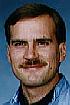
Selected by NASA in June 1985, Mr. Hieb became an astronaut in July 1986, qualified for assignment as a mission specialist on future Space Shuttle flight crews. Since then he has held a variety of technical assignments including launch support activities at Kennedy Space Center, and has served in both the Mission Development Branch and in the Operations Development Branch of the Astronaut Office. He supported the STS-26 mission as a part of the close-out crew prior to launch and as a part of the change-out crew just after landing. A veteran of three space flights, Mr. Hieb flew on STS-39 in 1991, STS-49 in 1992, and STS-65 in 1994. He has logged over 750 hours in space, including over 17 hours of EVA (space walk).
Mr. Hieb first flew on the crew of STS-39, an unclassified Department of Defense mission which launched on April 28, 1991 from the Kennedy Space Center in Florida. During the mission, he was responsible for operating the Infrared Background Signature Satellite (IBSS) from within the payload bay, on the Remote Manipulator System (RMS) and as a free-flying satellite. He also operated the RMS to release the IBSS, and then to retrieve the IBSS a day and a half later. After 134 orbits of the Earth which covered 3.5 million miles and lasted just over 199 hours, the crew landed at California, on May 6, 1991.
Mr. Hieb was also a mission specialist on the crew of STS-49, the maiden voyage of the new Space Shuttle Endeavour, which launched from the Kennedy Space Center on May 7, 1992. During that mission, Hieb along with astronaut Pierre Thuot, performed three space walks which resulted in the capture and repair of the stranded Intelsat VI F3 communications satellite. The third space walk, which also included astronaut Tom Akers, was the first ever three-person space walk. This 8 hour and 29 minute space walk, the longest in history, broke a twenty year old record that was held by Apollo 17 astronauts. The mission concluded on May 16, 1992 with a landing at Edwards Air Force Base after orbiting the Earth 141 times in 213 hours and traveling 3.7 million miles.
Mr. Hieb wa
Manned seven crew. Deployed USA 70, CRO A, CRO B, CRO C; deployed and retrieved IBSS. Payloads: Infrared Background Signature Survey (lBSS), Air Force Program (AFP)-675, Space Test Payload (STP)-I, Multi-Purpose Experiment Canister (MPEC), Cloud Logic to Optimize Use of Defense Systems (CLOUDS)-1A, Radiation Monitoring Equipment (RME)-lll.
Retrieved Intelsat 6 and attached new SRM. First active dual rendezvous of two orbiting spacecraft (Endeavour and Intelsat-Vl) First deployment of a drag chute on the orbiter fleet. Payloads: Intelsat-Vl reboost mission hardware, Assembly of Station by EVA Methods (ASEM), Commercial Protein Crystal Growth (CPCG), Air Force Maui Optical Site (AMOS) Calibration Test, Ultraviolet Plume Instrument (UVPl).
Attempted capture of Intelsat V1.
Second attempted capture of Intelsat V1.
Intelsat V1 finally captured in first three-person spacewalk.
Carried IML-2; microgravity, biology experiments. Payloads: International Microgravity Laboratory (IML) 2, Orbital Acceleration Research Experiment (OARE), Commercial Protein Crystal Growth (CPCG), Air Force Maui Optical Site (AMOS), Military Applications of Ship Tracks (MAST), Shuttle Amateur Radio Experiment (SAREX).