-
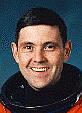
NAME: Robert D. Cabana (Colonel, USMC)
- NASA Astronaut
-
PERSONAL DATA:
- Born January 23, 1949, in Minneapolis, Minnesota, where his parents still reside. Married to the former Nancy Joan Shimer of Cortland, New York. Three children, Jeffrey, Christopher and Sarah. He enjoys jogging, cycling, softball, sailing, and woodworking.
-
EDUCATION:
- Graduated from Washburn High School, Minneapolis, Minnesota, in 1967; received a bachelor of science degree in mathematics from the United States Naval Academy in 1971.
-
ORGANIZATIONS:
- Member of the Society of Experimental Test Pilots, the Association of Space Explorers, the Naval Academy Alumni Association, and Sigma Pi Sigma.
-
SPECIAL HONORS:
- Recipient of The Daughters of the American Revolution Award for the top Marine to complete naval flight training in 1976. Distinguished Graduate, U.S. Naval Test Pilot School. Awarded the De La Vaulx medal by the Federation Aeronautique Internationale in 1994. Personal decorations include the Defense Superior Service Medal, the Distinguished Flying Cross, the Defense Meritorious Service Medal, the Meritorious Service Medal, the National Intelligence Medal of Achievement, the NASA Medal for Outstanding Leadership, two NASA Exceptional Service Medals, and three NASA Space Flight Medals.
-
EXPERIENCE:
- After graduation from the Naval Academy, Cabana attended the Basic School in Quantico, Virginia, and completed naval flight officer training in Pensacola, Florida, in 1972. He served as an A-6 bombardier/navigator with Marine Air Wings in Cherry Point, North Carolina, and Iwakuni, Japan. He returned to Pensacola in 1975 for pilot training and was designated a naval aviator in September 1976. He was then assigned to the 2nd Marine Aircraft Wing in Cherry Point, North Carolina, where he flew A-6 Intruders. He graduated from the U.S. Naval Test Pilot School in 1981, and served at the Naval Air Test Center in Patuxent River, Maryland, as the A-6 program manager, X-29 advanced technology demonstrator project officer, and as a test pilot for flight systems and ordnance separation testing on A-6 and A-4 series aircraft. Prior to his selection as an astronaut candidate he was serving as the Assistant Operations Officer of Marine Aircraft Group Twelve in Iwakuni, Japan.
He has logged over 5,000 hours in 33 different kinds of aircraft.
-
NASA EXPERIENCE:
- Selected by NASA in June 1985, Cabana completed initial astronaut training in July 1986, qualifying for assignment as a pilot on future Space Shuttle flight crews. His initial assignment was as the Astronaut Office Space Shuttle flight software coordinator until November 1986. At that time he was assigned as the Deputy Chief of Aircraft Operations for the Johnson Space Center where he served for 2-1/2 years. He then served as the lead astronaut in the Shuttle Avionics Integration Laboratory (SAIL) where the Orbiter's flight software is tested prior to flight. Cabana has served as a spacecraft communicator (CAPCOM) in Mission Control during Space Shuttle missions, has served as Chief of Astronaut Appearances, and Chief of the Astronaut Office. A veteran of three space flights, Cabana has logged over 627 hours in space. He served as pilot on STS-41 (October 6-10, 1990) and STS-53 (December 2-9, 1992), and was mission commander on STS-65 (July 8-23, 1994). Cabana will command the crew of STS-88, the first Space Shuttle mission to carry hardware to space for the assembly of the International Space Station. The 7-day mission is targeted for launch in July 1998.
-
SPACEFLIGHT EXPERIENCE:
- STS-41Discovery launched on October 6, 1990 from the Kennedy Space Center, Florida, and landed at Edwards Air Force Base, California, on October 10, 1990. During 66 orbits of the Earth, the five-man crew successfully deployed the Ulysses spacecraft, starting the interplanetary probe on its four-year journey, via Jupiter, to investigate the polar regions of the Sun; operated the Shuttle Solar Backscatter Ultraviolet instrument (SSBUV) to map atmospheric ozone levels; activated a controlled "fire in space" experiment (the Solid Surface Combustion Experiment [SSCE]); and conducted numerous other middeck experiments involving radiation measurements, polymer membrane production, and microgravity effects on plants.
STS-53 Discovery launched from the Kennedy Space Center, Florida, on December 2, 1992. The crew of five deployed the classified Department of Defense payload DOD-1 and then performed several Military-Man-in-Space and NASA experiments. After completing 115 orbits of the Earth in 175 hours, Discovery landed at Edwards Air Force Base, California, on December 9, 1992.
STS-65 Columbia launched from the Kennedy Space Center, Florida, on July 8, 1994, returning to Florida on July 23, 1994. The STS-65 crew conducted the second International Microgravity Laboratory (IML-2) mission utilizing the long spacelab module in the payload bay. The flight consisted of 82 experiments from 15 countries and six space agencies from around the world. During the record setting 15-day flight, the crew conducted experiments which focused on materials and life sciences research in a microgravity environment paving the way for future operations and cooperation aboard International Space Station. The mission was accomplished in 236 orbits of the Earth in 353 hours and 55 minutes.
OCTOBER 1997
- STS-41 - - 1990 Oct 6 - Assignment: Prime Crew. Flight Time: 4.09 days. Flight details: STS-41.
Manned five crew. Deployed Ulysses spacecraft. Payloads: Deploy Ulysses, Shuttle Solar Backscatter Ultraviolet, Intelsat Solar Array Coupon, Solid-Surface Combustion Experiment, Investigations Into Polymer Membrane Processing, Chromo-some and Plant Cell Division in Space, Physiological Systems Experiment, Voice Command System, Radiation Monitoring Equipment III, Air Force Maui Optical Site.
- STS-53 - - 1992 Dec 2 - Assignment: Prime Crew. Flight Time: 7.31 days. Flight details: STS-53.
Manned five crew. Deployed classified military satellite USA 89. The ODERACS payload was unable to be deployed because of payload equipment malfunction. Payloads: Department of Defense (DOD)1; Glow Experiment/Cryogenic Heat Pipe Experiment Payload (GCP); Orbital Debris Radar Calibration System (ODERACS); Battlefield Laser Acquisition Sensor Test (BLAST); Cloud Logic To Optimize Use of Defense Systems (CLOUDS) 1A; Cosmic Radiation Effects and Activation Monitor (CREAM); Fluid Acquisition and Resupply Equipment (FARE); Hand-held, Earth-oriented, Real-time, Cooperative, User-friendly, Location-targeting and Environmental System (HER-CULES); Microencapsulation in Space (MIS)-1; Radiation Monitoring Equipment (RME) III; Spare Tissue Loss (STL); Visual Function Tester (VFT)2.
- STS-65 - - 1994 Jul 8 - Assignment: Prime Crew. Flight Time: 14.75 days. Flight details: STS-65.
Carried IML-2; microgravity, biology experiments. Payloads: International Microgravity Laboratory (IML) 2, Orbital Acceleration Research Experiment (OARE), Commercial Protein Crystal Growth (CPCG), Air Force Maui Optical Site (AMOS), Military Applications of Ship Tracks (MAST), Shuttle Amateur Radio Experiment (SAREX).
- STS-88 - - 1998 Oct 29 - Assignment: Prime Crew. Flight Time: 11.80 days. Flight details: STS-88.
First attempted launch of STS-88 was scrubbed at 09:03 GMT on December 3 due to a problem with a hydraulic system sensor. Launch came the next day, with Endeavour entering an initial 75 km x 313 km x 51.6 degree orbit. Half an orbit after launch, at 09:19 GMT, Endeavour fired its OMS engines to raise the orbit to 180 km x 322 km x 51.6 degree.
On December 5 at 22:25 GMT Nancy Currie unberthed the Unity space station node from the payload bay using the RMS arm. She then moved the Unity to a position docked to the Orbiter Docking System in the payload bay in readiness for assembly with the Russian-launched Zarya FGB ISS component. After rendezvous with the Zarya FGB module, on December 6 at 23:47 GMT Endeavour grappled Zarya with the robot arm, and at 02:07 GMT on December 7 it was soft docked to the PMA-1 port on Unity. After some problems hard dock was achieved at 02:48 GMT. Unity and Zarya then formed the core of the future International Space Station. Ross and Newman made three space walks to connect cables between Zarya and Unity, on December 7, 9 and 12. On the last EVA a canvas tool bag was attached to the exterior of Unity to provide tools for future station assembly workers. Docking cables were disconnected to prevent Unity and Zarya from inadvertently undocking. Following an internal examination of the embryonic space station, Endeavour undocked at 20:30 GMT on December 13. The SAC-A and Mightysat satellites were ejected from the payload bay on December 14 and 15. Deorbit burn was December 16 at 03:48 GMT, and Endeavour landed at 04:53:29 GMT, on Runway 15 at the Kennedy Space Center.
Payloads included:
- Sill: RMS arm No. 303
- Bay 1-2: Tunnel Adapter 002
- Bay 3-4: Orbiter Docking System/External Airlock (Boeing/Palmdale)
- Bay 7-13: Unity (Node 1) (Boeing/Huntsville), including the PMA-1 and PMA-2 docking adapters (Boeing/Huntington Beach)
- Bay 2 Port: GABA adapter with SAC-A satellite
- Bay 4 Starboard: Carrier with Tool Stowage Assembly
- Bay 5 Port: GABA adapter with two PFR space walk platforms and one
PFR stanchion.
- Bay 5 Starboard: GABA adapter with two more PFR space walk platforms and one
PFR stanchion.
- Bay 6 Port: GABA adapter with Mightysat
- Bay 6 Starboard: APC carrier with TCS laser rendezvous sensor
- Bay 7 Starboard: APC carrier with TCS laser rendezvous sensor
- Bay 13 Port: GABA adapter with SEM-7 and G-093 canisters
- Bay 13 Starboard: GABA adapter with IMAX Cargo Bay Camera