
29,143 bytes. 298 x 377 pixels.
| astronautix.com | Soviet Space History - Generation 3 |
|
| Buran docks to Mir - As it was supposed to be - Buran docking with Mir space station. 29,143 bytes. 298 x 377 pixels. |
Third Generation Systems
In April 1972 50 TsNII KS MO (50th Central Scientific Research Institute for Space Systems of the Ministry of Defence) was decreed. It was empowered to co-ordinate all of the work of the various space research institutions (TsNIIMASH, NIITI, Agat, NII Khimash) on follow-on space systems. The objective was to draft a five year plan for satellites to be used in the 1985-1990 period. 50 TsNII KS MO was formed from staff and facilities of 4-NII MO. It was tasked to put together defence plans, draft TTT and TTZ specifications, and conduct trials of equipment. Research at the beginning supported the RVSN Rocket Forces in their planning for 1971-1975. These included Plans Sirius Phase 2, Dal', Gamma, and Zamysel. The final result was two plans: "Program for Military Space Units for 1976 to 1985" and "Basis and Direction of Development of Space Units through 1990". These documents defined the Soviet Union's third generation space systems. The plans included:
There was considerable controversy as the 'Young Turks' took on the conservatives. The controversy mirrored the 'star wars' arguments of the following decade in the United States - conventional space objectives versus exotic technologies and possibilities.
Third Generation Launch Vehicles
A completely new family of dedicated space launch vehicles, not derived from military missiles, would be developed to support the spacecraft. 50 TsNII-KS began research in 1973 on Plan Poisk - a new modular family of launch vehicles. These were in four classes: Light - 3 tonnes payload; Medium, 10-12 tonnes; Heavy, 30 - 35 tonnes; and Super-heavy. The objectives:
 | Gamma 23,860 bytes. 322 x 260 pixels. |
During these studies the launch vehicle engineering bureaux responded with designs meeting the needs of the military: the UR-530 from Chelomei, and the RLA-120/RLA-135/RLA-150 family from Glushko. Glushko's emphasis was on the super-heavy vehicle to support a continued lunar base project.
But the VPK Military-Industrial Commission and the national leadership rejected the approach favoured by the military. Instead the instructions were to provide a precise Soviet equivalent to the American space shuttle system, notably in use of a Liquid Oxygen/Liquid Hydrogen core vehicle. The KRK principles were applied to this design. The resulting MKS Energia launch vehicle consisted of the Buran, Energia, and Zenit-2 systems. But this system did not have the flexibility required by the Ministry of Defence. From this situation only the following military objectives could be salvaged:
 | US-P Credit: Mark Wade. 21,052 bytes. 320 x 209 pixels. |
Competing spaceplane designs (MTKVA, LKS) were rejected. But Buran had the same characteristics as the US Shuttle, and the same disadvantages - low economy, and mainly designed by construction bureaux for scientific and technical development and human space travel. Therefore design work continued on smaller spaceplanes. Numerous trade studies of Russian Spaceplanes in the early 1980's (Bizan, 49, OK-M, OK-M1, OK-M2) would finally result in the more economical MAKS design. This was approved for full development in 1988 but immediately ran into funding difficulties as the Soviet Union broke apart.
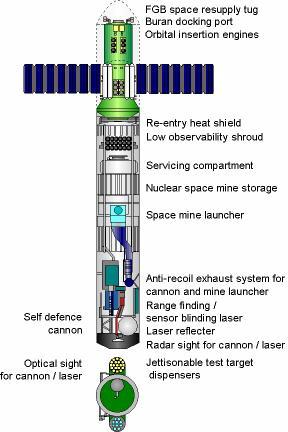 | Polyus Combat Sat - Cutaway of the Polyus 1 space weapons platform. Credit: © Mark Wade. 24,576 bytes. 288 x 432 pixels. |
The Ministry of Defence did manage to retire some old launch vehicles. 1974 saw the last launch from KRK Raduga using the Kosmos 63S1M launch vehicle an on 29 June 1976 the last Voskhod 11A57 booster was launched. As a result, by 1977 121 launches were made using only six types of launch vehicles and 16 types of spacecraft. Launch facilities at Kapustin Yar were limited to LC-5 and LC-53.
Conventional Third Generation Space Systems
The development of satellites taking advantage of the new design principles and technologies could not be delayed for development of third generation boosters. Therefore most space systems were to be developed in two phases: Phase 1 for launch using existing launch vehicles (tsyklon-3, Soyuz 11A511U, or Proton 8K82K) and Phase 2 for launch by Zenit-2. Due to delays in development of the Zenit booster, very few of the Phase 2 systems reached flight stage before the collapse of the Soviet Union.
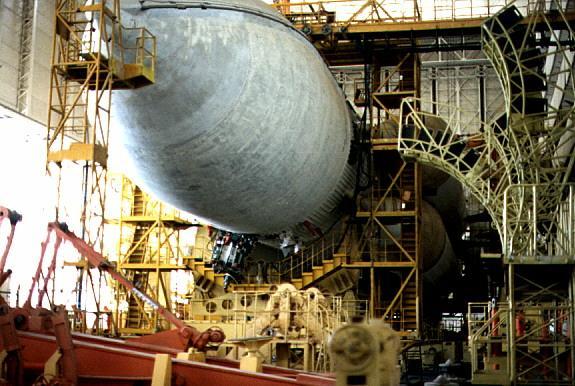 | Fwd view of Energia - Forward view of Energia launch vehice in assembly hall at MIK Credit: © Mark Wade. 56,386 bytes. 575 x 386 pixels. |
This plan ran into immediate problems when the May 1977 Yantar-6KS draft project indicated weight growth beyond the payload capabilities of the Soyuz booster. So instead a less-capable spacecraft based on the Yantar-4K bus was designed. The first phase spacecraft, the Yantar-4KS1, would begin flight trials in 1979, with the more capable Yantar-4KS2, launched by Zenit, to begin flight trials in 1983.
Development was slow because of the state of Soviet digital electronics technology. Yantar-4KS1 flight trials did not begin until the end of 1982. It proved impossible for the Yantar-4KS2 to match the performance of the KH-11. Therefore a 'clean sheet of paper' approach was taken. Studies were begun in 1980 and in June 1983 a decree was issued for a constellation of new-design third generation electro-optical military reconnaissance satellites. These would be orbited in two groups of ten satellites at varying altitudes. This swarm would provide almost complete coverage of the earth's surface at a range of photographic resolutions. Competitive designs were undertaken by NPO Lavochkin and Kozlov's TsSKB. Flight trials were to begin by 1987.
But work again was slow, and the telescope had weight problems, delaying the start of flight trials. The mid-1980's put huge demands on the spacecraft design bureaux. They were attempting to test and put into production third generation systems while at the same time responding to government 'star wars' crash programs. By January 1989 a new government resolution set 1991 as the date for the start of flight trials. But this was almost immediately followed by the disintegration of the Soviet Union and the attendant financial crisis. Trials were again delayed to 1996-1997. TsSKB finally dropped out of the competition and turned to continued production of the proven Yantar-4KS1 system.
 | Glonass 11,344 bytes. 236 x 217 pixels. |
 | Okean-O Credit: Dmitry Pieson. 14,545 bytes. 383 x 345 pixels. |
 | Okean-O1 - Okean-OE was similar. Credit: NASA. 35,252 bytes. 299 x 304 pixels. |
The Parus / Tsikada navigation system continued in service in parallel. Some of these satellites were upgraded with international emergency distress signal detectors (Nadezhda).
 | Yantar-2K Cutaway Credit: Dmitry Pieson. 49,419 bytes. 600 x 550 pixels. |
The Mir-2 space station was to have represented Phase 2, and utilise the capabilities of the Buran orbiter and Zarya and Progress M2 resupply spacecraft. It would undergo many changes over the years, with only one thing remaining constant: the starting point was always the DOS-8 base block space station core module, built as a back-up to Mir's DOS-7. Eventually Mir-2 would be merged with the International Space Station, and DOS-8 was finally scheduled to be launched by the end of 2000 as the Alpha SM Service Module of the ISS. The planned Mir-Buran docking module instead entered service on joint American-Russian missions as the Mir-Shuttle Docking Module. A variant of the TKS was purchased by the Americans and, as the Zarya FGB, became the first part of the ISS orbited.
 | Yantar E1 Credit: � Carsten Wiedemann. 31,641 bytes. 473 x 307 pixels. |
The Prognoz-M was developed for the international Interbol project to further measure the earth's magnetosphere. It's flight was delayed until the 1990's.
TKS derivatives were offered as earth resources and material processing platforms (Tellura, Teknologia). Military communications systems were proposed for civilian use (Gonets). Many proposals were made that took advantage of the heavy payload capability of the Energia booster. These included Multipurpose Satellite Gals, Energia Control Satellite, Energia Geostationary Platform, Energia Heavy Comsat, Energia Nuclear Waste Disposal, Energia Orbital Debris Remover, Energia Ozone Replenishment Satellite, Energia Polar City Illuminator, and Skif-DM.
 | Soviet Reconnsats - Soviet reconnaissance satellites. Top row: Zenit-2, Zenit-4, Advanced Zenit with aerodynamic orientation; Middle Row: Yantar 1K, Yantar 2K, Orlets-1 with multiple return capsules; bottom row, Buran-serviced pallet-based satellite; Yantar 4KS electrooptical 21,799 bytes. 340 x 332 pixels. |
At the end of the 1960's and the beginning of the 1970's the United States began research in the use of spacecraft for the destruction of military targets in and from space. In the late 1960's development began at Lawrence Livermore Laboratory of a space-based nuclear weapon-pumped laser. This was originally envisioned as a fearsome weapon, consisting of several dozen independently-aimed lasing rods arranged around the bomb. When the bomb exploded, a large percentage of its force would be conducted down the lasing rods toward the targets at which they pointed (in the microsecond before the rods themselves vaporised).
At the same time the Air Force and NASA were studying reusable space shuttles. A single shuttle payload bay of such weapons had the potential of destroying the entire Soviet ICBM force - not just in launch phase but in a first strike, frying them right through the silo covers. One of the most heavily classified projects of the time, it still came to the attention of Soviet intelligence.
During this same period NASA was struggling to justify a post-Apollo space program. The Nixon administration decided that the USAF shuttle project would be dropped, and their requirements incorporated into the NASA design. One of these requirements was a mission involving a launch into polar orbit from Vandenberg Air Force base, release of unspecified payloads into orbit, and return to Vandenberg after a single orbit of the Earth. This requirement forced NASA to drop their preferred straight-wing design for a heavier double-delta wing that had the necessary cross range. The Soviet leadership saw their worst fears confirmed. This was a modern version of the first-strike multiple-warhead UR-500 and N1 super heavy rockets which they had developed but then abandoned in the early 1960's.
America was beginning work on other directed energy approaches that did not require use of nuclear detonations. In 1968, a gas dynamic laser was reviewed in a study to see if it would be a viable as a satellite anti-missile system. In 1971, the Aerospace Corporation developed a prototype infrared fluorine-hydrogen laser. By 1975, Lockheed put together the first concept of a satellite armed with a laser and a deployable mirror.
Parallel work began in the Soviet Union in the same period. One direction was advocated by the Ministry of Radio Industry, which managed the development of the Soviet ABM system since the late 1950's. Another approach was the use of neutral particle beam weapons, advocated by Gersh Budker at a secret institute in Novosibirsk.
During the late 1960's and early 1970's numerous discussions and unofficial studies were conducted by Soviet research institutes, design bureaux, the Academy of Sciences, and the General Staff. Among these plans were the use of the Korolev MKBS space station as a platform for a neutral particle beam weapon and logistical support of a constellation of military interceptor vehicles. The MKBS approach was abandoned when the N1 launch vehicle was cancelled.
The 17 February 1976 decree began definitive project work on 'Star Wars' technology within the Soviet Union. In response to the shuttle, the Soviet clone, Buran, was initiated. The two-phase Fon program was undertaken. Fon-1 encompassed fundamental research and draft project work on a variety of technologies - laser weapons, neutral particle beams, electro-magnetic rail guns, new orbital interceptor missiles, new conventional and nuclear warhead technologies, new anti-ballistic missiles, and space platforms to support these weapons. Fon-2 would take the technologies selected as a result of Fon-1 and conduct flight trials of prototype systems. Fielding of operational space combat units would only come thereafter.
The Ministry of Defence Production set up a new Eighth Main Directorate to manage the work of the various institutes and bureaux. P S Pleshakov of the Ministry of Radio Industry oversaw the work of the design bureaux. In the 1970's and 1980's ambitious and complex research on space vehicles capable of destroying rockets in flight, airborne vehicles in the atmosphere, vessels at sea, and targets on land was conducted. These studies assessed both the feasibility and affordability of such spacecraft.
Early results were not encouraging. NPO Kometa (A I Savin), manufacturer of the existing IS-A anti-satellite system, was asked to study the feasibility of a conventional system to destroy 10,000 ballistic re-entry vehicles and cruise missiles within 5 to 25 minutes with an effectiveness of 99.8%. The study concluded that such a system was not practical technically or economically.
Directed energy weapons might have a better chance of engaging many targets in a surprise attack, but testing of charged practical beam technology at an immense facility at Semipalatinsk resulted in many technical problems that would take a long time to solve.
Laser technology was also pursued but also faced many technical and cost problems in achieving high energies. The principle centre for laser research was TsKB Luch, headed by Nikolai Ustinov, son of the Soviet Defence Minister. In the late 1970's this was reorganised into NPO Astrofizika. Astrofizika designed lasers for both tactical and strategic use and was receiving 1% of the Soviet Defence Budget during this period. A free electron laser was tested at Storozhevaya, and a 1 MW gas laser at Troitsk.
OKB Vympel was the systems integrator for ground-based laser systems. They built the major Terra-3 laser testing centre at Sary Shagan, which was eventually equipped with Astrofizika high power red ruby and carbon dioxide lasers. But the energies were not sufficient for anti-ballistic missile use. The first applications would have to be limited to anti-satellite, and then primarily to blind optical sensors.
Other institutes involved in research were NIITP (Research Institute for Thermal Processes) which handled high energy gas dynamic lasers, and the Scientific Institute for Radio Device Production, which worked on plasma weapons.
Meanwhile Livermore work on the nuclear-pumped laser had evolved into a space-based x-ray laser weapon which would destroy ICBM's during boost phase, after they had cleared the atmosphere. But in 1977 President Carter cancelled further development work on this weapon. The threat seemed to recede and by the early 1980's Fon-1 work had focused on the more achievable goal of improved interception and destruction of enemy satellites.
Then in 1983 Edward Teller dazzled Ronald Reagan with tales of desk-sized x-ray lasers that could be deployed within four years and create an invulnerable defence shield around the United States. Work on the x-ray laser was renewed with vigour as the Strategic Defence Initiative. The program quickly expanded to include research on a broad range of directed energy and rocket interceptor weapons.
The Soviet response was immediate. Yuri Andropov ordered additional funding and implementation of Fon-2. At the same time Soviet diplomatic initiatives were undertaken - a proposal to ban all space-based weapons and a unilateral moratorium on testing of the improved IS-MU ASAT. As a 'warning shot' the Terra-3 complex was used to track the STS-41-G space shuttle Challenger with a low power laser on 10 October 1984. This caused malfunction of on-board equipment and temporary blinding of the crew, leading to a US diplomatic protest.
A crash program was initiated to test in space a range of laser and rocket interceptor prototypes on the massive Polyus test bed, to be launched on the first test of the Energia launch vehicle. Polyus failed to achieve orbit in the 1987 launch.
As platforms for operational versions of these weapons NPO Energia designed a USB Universal Service Block, based on the Salyut DOS-7K space station. The USB was equipped with common service systems and rocket engines. In comparison to the DOS the USB had much larger propellant tanks to allow substantial orbital manoeuvring. The USB would be equipped with either a laser payload or a weapons bay consisting of ten miniature rocket homing vehicles. The Proton launch vehicle would be used to launch a 20 tonne version of the USB for experimental flight tests. Operational 30 tonne vehicles would be delivered to orbit by the Buran space shuttle. Buran would also bring crews for on-orbit servicing of the USB. For this purpose the USB had a life support capability of two crew for seven days.
The mass of the military payload depended on the amount of propellant loaded. The laser payload was heavy, with a resulting lower fuel fraction, and was limited to use against low earth orbit targets. The USB with the rocket homing vehicles had more propellant and could be used for attack of geostationary orbit targets.
A competing design by Chelomei used his TKS as a starting point. The Spektr - Original design was to be armed with Oktava interceptor rockets built by NPO Kometa. It was to be equipped with sensors to identify (Lira) and track (Buton) ballistic missile re-entry vehicles as well as discriminate decoys (Pion-K). A prototype of the Spektr would be docked with the Mir space station for systems tests.
To co-ordinate the actions of the multiple space combat units, NPO Energia proposed a KS space station. This would consist of a core built of targeting and base modules based on the USB, a command module based on the TKS, and a Zarya ballistic shuttle for crew rotation. Docked to the core would be military free-flying autonomous modules which would dispense nuclear warheads in re-entry vehicles of both ballistic and gliding types. The structure and various systems of these wingless autonomous modules would be based on the Buran space shuttle. Prototypes would be built from the various developmental Buran airframes. On command the military modules would separate from station and manoeuvre extensively before positioning themselves for attack of enemy targets on the ground or in space. On special command from the national authorities the enemy targets would be engaged with nuclear weapons.
For interception of enemy ICBM's during boost phase NPO Energia developed a space based rocket interceptor (RP) similar to American 'Brilliant Pebble' systems. This had a mass of only 10 kg and was powered by small but high energy rocket engines that gave the vehicle the same characteristic velocity as boosters that put payloads into orbit. The miniature vehicles used advanced technology and new scientific solutions. The engines were powered by non-traditional non-cryogenic propellants with high strength materials used for the propellant tanks.
In another seemingly mandatory response to US technology, a Soviet counterpart to the American X-30 National Aerospaceplane was initiated in 1988. Following evaluation of various competing proposals (VKS, Yakovlev MVKS) the Tu-2000 scramjet vehicle was selected for development.
Partly due to the cost of trying to match the American Star Wars program, the Soviet Union disintegrated. Ironically, underground nuclear tests of the x-ray laser in Nevada showed that the concept would not work. Other parts of the colossal Strategic Defence Initiative ran into similar technical and cost barriers.
In 1992, as directed by the Soviet Union's military and political leadership, all work on such projects was discontinued. The Spektr module was converted into a civilian platform. Its completion and docking with Mir was partially funded by the United States. The Buran shuttle, Mir-2 station, the space combat units, were all cancelled.