This page no longer updated from 31 October 2001. Latest version can be found at www.astronautix.com
 |
MKBS
MKBS - the immense earth orbit space complex planned in 1969-1974Credit: © Mark Wade. 18,707 bytes. 596 x 295 pixels. |
Other Designations: Multi-module orbital base. Manufacturer's Designation: 19K. Code Name: MOK. Class: Manned. Type: Space Station. Nation: Russia. Manufacturer: Korolev. The culmination of ten years of designs for N1-launched space stations, the MKBS would be cancelled together with the N1. But the technical legacy would live on in new designs for Soyuz and Progress space station logistics spacecraft used with Salyut and Mir.
In the second half of 1972 and first half of 1973, simultaneous with other work, TsKBEM began technical development of a Multi-module Orbital Complex (MOK). The MOK was designed to solve a wide range of tasks: astronomical and astrophysical research, materials research, navigation, communications , remote sensing for study of forestry, farming, geology, fisheries, etc., and military applications.
MOK was not a single spacecraft but an integrated collection of earth-based and near-earth orbital systems consisting of:
- Multi-module Cosmic Base Station (MKBS)
- Autonomous spacecraft, operating from the MKBS
- Transport systems, using at first expendable supply transport craft, to be replaced later by reusable systems
- Launch vehicle systems
- Launch sites
- Autonomous test systems
- Search and rescue complexes
The MKBS would control all of the linked orbital systems and provide base quarters for the crews, an orbital control centre, a supply base, and servicing facilities for on-orbit systems. Independently functioning spacecraft would dock with MKBS for repair, upgrade, and refuelling. The MKBS would co-ordinate all of the autonomous spacecrafts' activities and manoeuvres, resulting in a unified transport system.
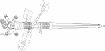 | MKBS Orbital Station - MKBS Multi-module Orbital Base Station Credit: © Mark Wade. 13,434 bytes. 1258 x 621 pixels. |
The MKBS consisted of two large core modules of 80 and 88 tonnes each, launched by the N1. These were powered by a 200 kW nuclear power plant derived from OKB-1's work on nuclear electric propulsion. Solar arrays totalling 140 square meters of area provided 14 kW of backup power. Two Proton-launched modules were connected to large arms which spun to provide artificial gravity for crew conditioning and experiments. Additional Soyuz and TKS-derived modules could be attached and detached to conduct special studies. Total mass of the station was to be up to 250 tonnes, with a basic core diameter of 6 m and a length of 100 m. The operational MKBS would be placed in a sun synchronous orbit of 400 to 450 km altitude at an inclination of 97.5 degrees. A basic crew of six, with a maximum of ten, would inhabit the station throughout its ten year life. Crews would serve two to three month tours, with overlapping crew member replacements four times a year. The station was to be equipped with a total of eight motor clusters consisting of orbital correction motors of 300 to 1,000 kgf, coarse orientation motors of 10 to 40 kgf, and ion engines for fine orientation and orbital altitude maintenance with a thrust of 100 to 300 grams.
The primary overall requirement was to define a MOK system which could perform a broad range of tasks while minimising expenditures in the creation of the system and its subsequent use. These requirements were met by the following technical decisions:
- It was desirable to minimise the quantity, cost, and crew size of orbital spacecraft while not making any single spacecraft too complex. This was solved by always considering that a particular part of a task might better be accomplished by another spacecraft, rather than having a single spacecraft accomplish everything.
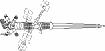 | MKBS Orbital Station - MKBS Multi-module Orbital Base Station Credit: © Mark Wade. 5,088 bytes. 630 x 312 pixels. |
- Communications and earth surveillance requirments of the base MOK would best be met by a sun-synchronous orbit of 97.5 degrees inclination
- The active life of the MOK would be for 7 to 10 years utilising continual replenishment of the spacecraft and in-flight repairs
- Consumption of fuel in moving from earth to orbit and from orbit to orbit would be reduced by having fuel dumps in a supporting orbit and using ion engines for spacecraft orientation
- Landing capsules would at first be used for imagery recovery, but digital downlink would be developed quickly to eliminate this comsumable item
- A special modification of the existing Soyuz 7K with manipulators would be used for inter-orbital ferry and regular repair service of autonomous spacecraft while being based at the MKBS
- The development cost would be minimized by use of existing or in-development systems:
- Soyuz 7K-T spacecraft and Soyuz launch vehicle as the basic transport craft
- Development of unpiloted modifications of Soyuz for use as MKBS visiting modules
- Development of the basic modules from the existing Salyut space station 17K, launched by the Proton booster
- Use of the N1 for launch of the MKBS core spacecraft
- Use of the N1 with the Block Sr upper stage for delivery of special modules to geostationary orbit
- Maximum use of existing and in-development facilities for support of MOK, such as launch complexes, command and control centres, etc.
- Reduction of the cost of transportation to and within the system, by putting all future satellites as much as possible in the same orbital plane of 97.5 degrees, and by development of new economical reusable transport systems
It was planned that ultimately the MOK would be supported by a reusable launch vehicle, which was to be a modification of the N1 Block A. This would use a combination of air-breathing LACE (Liquid Air Cycle Engines) booster engines and liquid hydrogen/oxygen propellants sustainer engines on the core.
The development of the MOK would been undertaken in two phases: An experimental phase (near earth orbit around 51.5 degrees) and an operational phase (sun-synchronous orbit of 97.5 degrees). In May 1974 the N1 was cancelled, and with it, the MOK.
Technical development of the MOK was the first large-scale space technology study which used combined , earth resources studies, economic analysis to determine the best engineering solutions. Various technical results obtained in the process of this work were used for a long time after. In particular the development of the Progress replenishment spacecraft, Soyuz space station ferries, and special-purpose modules of the Mir spacecraft can be traced directly to the concepts and designs for the MOK. Leading participants in the project were I N Sadovskiy, V V Simakin, B E Chertok, V S Ovchinnikov,, M V Melnikov, A P Abramov, V D Vachnadze, V K Bezberbiy, A A Rzhanov, I E Yurasov, V Z Ilin, G A Dolgopolov, N P Bersenev, K B Ivanov, V C Anfyrev, B G Sypryn , V P Zaitsev, E A Shtarkov, I V Gordeev, B V Korolev, V G Osipov, V N Lakeyev, V P Byrdakov, A A Kochkin.
It is interesting to note that American propulsion engineer Peter James described the MOK in considerable and accurate detail in his 1974 book Soviet Conquest from Space. The book was dismissed by many authorities because the systems described in it never appeared. Only in the last two years has it become apparent that the system described to Mr James was in development, but was cancelled at just about the same time his book appeared.
Specification
MKBS Chronology
23 February 1972
MOK technical proposal authorised. Launch Vehicle: N1F. Decree 'On work on the technical proposal for the creation of the MOK' was issued.
01 June 1972
Multi-module Orbital Complex (MOK) desugbed In the second half of 1972 and first half of 1973 TsKBEM began technical development of a Multi-module Orbital Complex (MOK). MOK was not a single spacecraft but an integrated collection of earth-based and near-earth orbital systems consisting of the Multi-module Cosmic Base Station (MKBS); autonomous spacecraft, operating from the MKBS; and logistics systems (expendable and reusable launch vehicles, interorbital tugs, earth launch sites, etc). MOK was dependent on the N1 launch vehicle, and was abandoned when this was cancelled in 1974.
Bibliography:- 89 - Semenov, Yu. P., S P Korolev Space Corporation Energia, RKK Energia, 1994.
Back to Index
Last update 12 March 2001.
Contact Mark Wade with any corrections or comments.
Conditions for use of drawings, pictures, or other materials from this site..
© Mark Wade, 2001 .

