5,494 bytes. 79 x 366 pixels.
| astronautix.com | N1F |
|
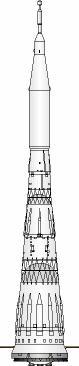
| N1F - 1974 - N1F - 1974 Configuration (N1 s/n 8L) 5,494 bytes. 79 x 366 pixels. |
The N1F would have been the definitive flight version of the N1, incorporating all changes resulting from the four flight tests of the vehicle, including the new Kuznetsov engines and 10% greater liftoff mass by using superchilled propellants in all stages. N1 8L would have been the first N1F configuration flight, with launch planned in the third quarter of 1975 at the time the project was cancelled.
LEO Payload: 105,000 kg. to: 220 km Orbit. at: 51.6 degrees. Liftoff Thrust: 4,530,000 kgf. Total Mass: 3,025,000 kg. Core Diameter: 17.0 m. Total Length: 105.0 m.
Full go-ahead to develop a liquid hydrogen/liquid oxygen high energy upper stage for the N1F. The multi-engine Block Sr would have a propellant mass of 66.4 tonnes. In July Kuznetsov was given authorisation to design substantially improved versions of the N1 lower stage rocket engines. The N1 that would utilise these engines was designated the N1F and would have a payload to a 225 km orbit of 105,000 kg.
Military-Industrial Commission (VPK) Decree 'On approval of work on the draft project for the N1-L3M two-launch lunar landing proposal' was issued.
Decree 'On work on the technical proposal for the creation of the MOK' was issued.
Council of Chief Designers Decree 'On approval of the N1-L3M proposal' was issued.
The N1 program was cancelled before the next test flight. Mishin was removed as head of NPO Energia. Kozlov is first asked to replace him, but he prefers to stay in Samara. Glushko is appointed as the second choice. Two fully assembled (serial numbers 8L and 9L), and four partially assembled rockets were available at time of cancellation. These would have been the first to use the new modernized series NK-33/NK-39 engines. 8L was planned for launch in the fourth quarter of 1974. Confidence was high that, based on the massive telemetry received on the 7L flight, that all problems would have been rectified. A total of 3.6 billion rubles was spent on the N1-L3 program, of which 2.4 billion rubles went into N1 development. Those on the project felt that they were within months of finally providing the Soviet Union with a heavy-lift booster. Instead the work was discarded, and Glushko began design of the RLA/Vulkan with entirely new configuration and engines.
Ministry of Defence Decree 'On suspension of further launches of the N1' was issued.
Energia Decree 'On suspension of work on the N1 -L3' was issued.
Central Committee of the Communist Party and Council of Soviet Ministers Decree 'On work on Energia-Buran, DOS-7K nos. 7 and 8, Gamma. Geyzer (Potok), and Altair (Luch) and cancellation of the N1' was issued. The design of an improved model of the Salyut DOS-17K space station was authorised as part of the third generation of Soviet space systems in a decree. At that time it was planned that the two stations (DOS-7 and DOS-8) would be equipped with two docking ports at either end of the station and an additional two ports at the sides of the forward small diameter compartment. Luch and Potok were elements of the second generation global command and control system (GKKRS) deployed in the first half of the 1980's. Luch satellites, analogous to the US TDRS, provided communications service to the Mir space station, Buran space shuttle, Soyuz-TM spacecraft, military satellites, and the TsUPK ground control center. They also served to provide mobile fleet communications for the Soviet Navy.