 |
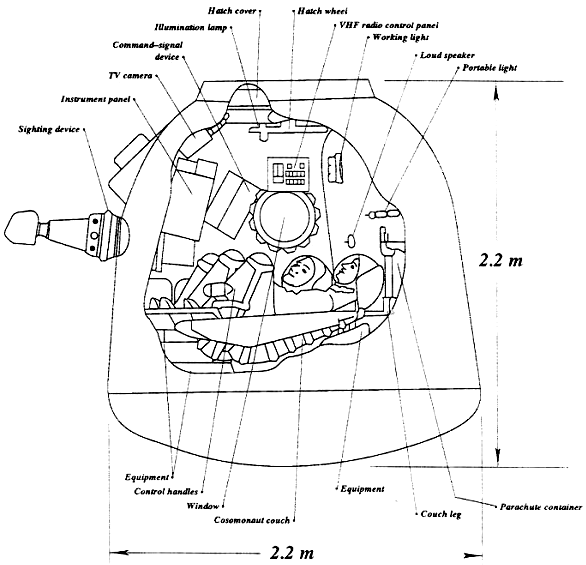
| Soyuz-TM Descent Mod Credit: NASA. 48,679 bytes. 586 x 565 pixels. |
| astronautix.com | Soyuz TM |
|
| Soyuz-TM Descent Mod Credit: NASA. 48,679 bytes. 586 x 565 pixels. |
Purpose-built for use with Mir and follow-on space stations. Kurs rendezvous and docking system permits Soyuz to maneuver independently of the station, without the station making "mirror image" maneuvers to match unwanted translations translations introduced by earlier models' aft-mounted attitude control. Lighter rendezvous system and improved launch escape tower permit higher payloads, more fuel, to be carried.
Craft.Crew Size: 3. Design Life: 14 days. Orbital Storage: 180.00 days. Total Length: 7.5 m. Maximum Diameter: 2.7 m. Total Habitable Volume: 9.00 m3. Total Mass: 7,250 kg. Total Propellants: 900 kg. Primary Engine Thrust: 400 kgf. Main Engine Propellants: N2O4/UDMH. Main Engine Isp: 305 sec. Total spacecraft delta v: 390 m/s. Electric system: 0.60 total average kW. Electrical System: Solar panels, span 10.60 m, area 10.00 sq. m.
Docking System: Lightweight. Probe: Flange-type. Tunnel: Yes. Collar Length (m): 0.22. Probe Length (m): 0.5. Base Diameter(m): 1.35. Ring Diameter(m): 1.35. Rendezvous System: Kurs. Antenna: Two Kurs. Tower: None. Orbital Module: Standard. Length (m): 2.26. Windows: One. OM Separation: Before retro.
 | Soyuz TM Credit: RKK Energia. 29,122 bytes. 495 x 277 pixels. |
Test of new Soyuz vehi cle. Recovered May 30, 1986 6:49 GMT. Unmanned test of Soyuz TM. Docked with Mir May 23 1987. Undocked 29 May.
Officially: Comprehensive experimental testing of spacecraft in independent flight and jointly with the Mir orbital station.
Mir Expedition EO-02. Docked with Mir 7 February 1987. Carried Yuri Romanenko, Aleksander Laveykin to Mir; returned Laveykin, crew of Soyuz TM-3 to Earth. Undocked from Mir 8:34 GMT 29 July. Orbital Module left in a 308 X 356 orbit. Recovered July 30, 1987 01:54 GMT.
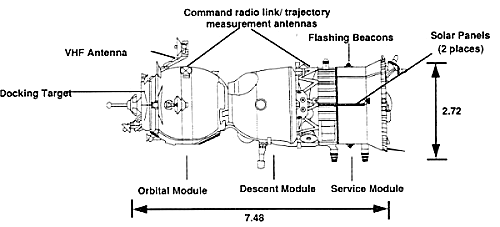 | Soyuz-TM Credit: NASA. 20,905 bytes. 500 x 227 pixels. |
Manned three crew. Transported to the Mir orbital space station a Soviet-Syrian crew comprising cosmonauts A S Viktorenko, A P Aleksandrov and M A Faris to conduct joint research and experiments with cosmonauts Y Romanenko and A Laveykin. Maneuvered from initial 231 X 217 km orbit to Mir's 311 X 359 km orbit. Docked with rear Mir port at 3:30 GMT 24 July. Undocked with rear port 30 July and docked to forward port. Undocked 05:55 GMT 29 December. Returned Aleksandrov, Yuri Romanenko (Soyuz TM-2), Anatoly Levchenko (Soyuz TM-4) to Earth. Recovered December 29, 1987 09:16 GMT. Landed near Arkalyk.
Mir Expedition EO-03. Carried Musa Manarov, Anatoly Levchenko, Vladimir Titov to Mir; returned crew of Soyuz TM-5 to Earth. Orbits 168 x 243 km, 255 x 296 km, 333 x 359 km. Docked with Mir 12:51 GMT 23 December. 30 December moved to forward port. Undocked 06:18 GMT 17 June 88. Recovered June 17, 1988 10:13 GMT. Landed 202 km from Dzehezkazgan.
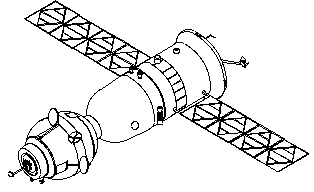 | Soyuz TM Credit: © Mark Wade. 2,741 bytes. 314 x 192 pixels. |
Transported to the Mir orbital station a Soviet-Afghan crew comprising the cosmonauts V A Lyakhov, V V Polyakov and A A Momand (Afghanistan) to conduct joint research and experiments with the cosmonauts V G Titov and M K Manarov. Returned Manarov, Titov (Soyuz TM-4), Chretien (Soyuz TM-7) to Earth. Initial orbit 195 X 228 km at 51. 57 deg. Maneuvered to a 235 x 259 km orbit, then docked with Mir at 05:41 GMT on 31 August at its 339 x 366 km orbit. Moved from aft to forward port 8 Sept 88. Undocked 03:33 GMT 21 December 1989. Revised software installed as a result of TM-5 abort overloaded computer. Landing planned for 06:48 aborted. Backup program used. Orbital Module retained through retrofire. Recovered December 21, 1988 09:57 GMT. Landed 180 km SE Dzhezkazgan.
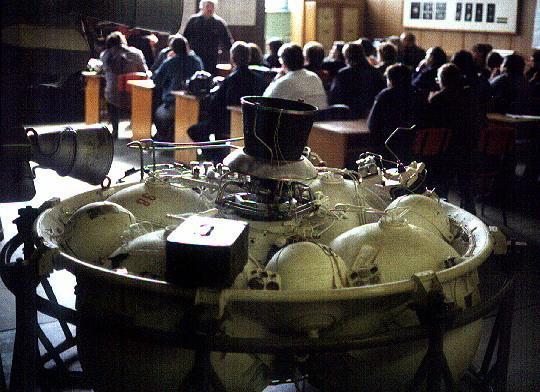 | Soyuz T engine - The Soyuz T introduced a new service module with unitary translation/attitude control thrusters as part of a single bipropellant system with the main pump-fed engine. Credit: © Mark Wade. 49,222 bytes. 540 x 392 pixels. |
Mir Expedition EO-04. Carried Alexander Volkov, Sergei Krikalev, Jean-Loup Chretien to Mir; returned Volkov, Krikalev to Earth. Initial Orbit: 194 X 235 km. Thereafter maneuvered to rendezvous orbit 256 X 291 km before docking with Mir in 337 X 369 km at 17:16 GMT 28 November.
Planned flight to ensure continuous occupation cancelled due to budget cutbacks and delay in launching Kvant 2 and Kristall modules.
Manned two crew. Mir Expedition EO-05. Docked with Mir 8 September. Transported to the Mir orbital station a team consisting of A S Viktorenko, commander of the spacecraft, and A A Serebrov, on-board engineer, to carry out scientific and technological research and experiments. Flight cost 80 million rubles. Expected return 25 million rubles net profit.
 | Panel Soyuz TM - Control panel of the Soyuz T/TM later version of the space station ferry vehicle.. Credit: © Mark Wade. 15,023 bytes. 763 x 287 pixels. |
Manned two crew. Docked with Mir. Mir Expedition EO-07. Transported to the Mir manned orbital station the crew consisting of the cosmonauts G M Manakov and G M Strekalov for the purpose of carrying out a programme of geophysical and astrophysical research, biological and biotechnological experiments, and work on space-materials science. Recovered December 10, 1990 06:08 GMT. Landed 69 km NW Arkalyk.
Docked with Mir. Mir Expedition EO-08. Transported to the Mir manned orbital station the international crew consisting of the cosmonauts V M Afanasyev, M Kh Manarov, and T Akiyami (Japan) for the purpose of carrying out joint work with the cosmonauts G M Manakov and G M Strekalov. Launched jointly with the private Japanese company TBS. The Japanese television network ended up paying $ 28 million for the first commercial flight to Mir to put Akiyama, the first journalist in space aboard Soyuz TM-11. Akiyama made daily television broadcasts.
 | Interior of Soyuz TM Credit: © Mark Wade. 52,266 bytes. 574 x 395 pixels. |
Docked with Mir. Mir Expedition EO-09. Carried Anatoli Artsebarski, Sergei Krikalev, Helen Sharman to Mir; returned Artsebarski, crew of Soyuz TM 8 to Earth. Second commercial flight with paying British passenger. Sponsoring British consortium was not quite able to come up with money, however. Flight continued at Soviet expense with very limited UK experiments.
Soyuz TM-13 and TM-14 crews were reshuffled extensively due to commercial considerations and necessity of flying a Kazakh cosmonaut. This was the original crew assignment. Kaleri and Avdeyev were replaced by Kazakh researchers in the final crew.
Manned three crew. Docked with Mir. Mir Expedition EO-10. Transported to the Mir manned orbital station an international crew comprising the cosmonauts A Volkov (USSR), T Aubakirov (USSR) and F. Viehbock (Austria), to conduct joint scientific and technical research with the cosmonauts A. Artsebarsky and S Krikalev. Austria paid $ 7 million for mission. Kazakh cosmonaut added at last minute. On March 25, Volkov, Krikalyov and Flade undocked from the front port in Soyuz TM-13 and landed in Kazakhstan at 08:51 GMT on March 25.
 | Interior of Soyuz TM Credit: © Mark Wade. 46,851 bytes. 534 x 362 pixels. |
Soyuz TM-13 and TM-14 crews were reshuffled extensively due to commercial seat bookings by Austria and Germany and the necessity of flying a Kazakh-born cosmonaut as part of the Baikonur rental agreement. This was the original crew assignment. The Kazakh researchers were moved to the earlier Soyuz TM-13 flight.
Planned Soyuz flight to Mir. Main purpose was to provide spaceflight experience to Bachurin and Borodai, who had been selected as back-up crew of the first manned Buran flight (the original back-up crew of Levchenko and Shchukin both died in 1988). Cancelled in cut-backs after fall of the Soviet Union.
Mir Expedition EO-11. Joint flight with Germany. Docked at the Kvant rear port at 12:33 GMT on March 19. The Soyuz TM-14 crew, Aleksandr Viktorenko and Aleksandr Kaleri, returned to Earth together with French astronaut Michel Tognini. The Soyuz TM-14 undocked from Mir at 21:47 GMT on Aug 9, and landed in Kazakhstan at 01:07 GMT on August 10.
 | Soyuz TM Icon Credit: © Mark Wade. 1,060 bytes. 173 x 126 pixels. |
Manned two crew. Mir Expedition EO-13. Transported to the Mir manned orbital station a crew of the thirteenth main expedition comprising the cosmonauts G M Manakov and A F Poleschuk.The Soyuz carried the APAS androgynous docking system instead of the usual probe system. Soyuz TM-16 landed at 06:42 GMT on July 22.
Mir Expedition EO-14. Carried Vasili Tsibliyev, Alexander Serebrov, Jean-Pierre Haignere to Mir; returned Serebrov, Tsibliyev to Earth. Progress M-18 undocked from Mir's front port at around 17:25 GMT on July 3, and Soyuz TM-17 docked at the same port only 20 minutes later at 17:45 GMT. The EO-14 crew landed at 08:18 GMT on Jan 14 in the Soyuz TM-17 spaceship. The EO-14 expedition lasted 196 days 18hr 45 m, the 7th longest spaceflight.
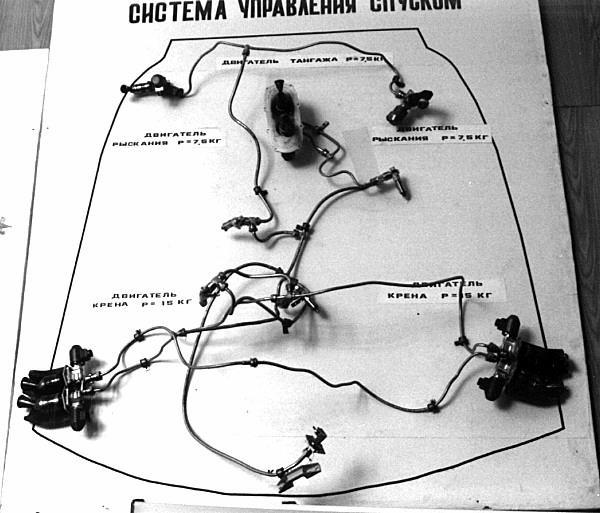 | Soyuz TM Descent Mod - Soyuz TM Descent Module Reaction Control System Credit: © Mark Wade. 52,898 bytes. 600 x 513 pixels. |
Mir Expedition EO-15. Docked at the Kvant module on January 10 at 11:15 GMT. Transported to the Mir orbital station of a crew comprising the cosmonauts V M Afanasev, Y V Usachev, and V V Polyakov for the fifteenth main expedition. The Soyuz TM-18 descent module landed 110 km north of Arkalyk in Kazakhstan at 10:32:35 GMT on July 9.
Mir Expedition EO-16. Soyuz TM-19 docked at the rear port of the Kvant module (vacated by Progress M-23 on July 2) at 13:55:01 GMT on July 3. Soyuz TM-19 undocked from Mir at 07:29 GMT on November 4. The Soyuz instrument module (PAO, priborno-agregatniy otsek) fired its deorbit engine, and was jettisoned together with the orbital module (BO, bitovoy otsek) at 10:51 GMT, with entry interface for the descent module (SA, spuskaemiy apparat) at 10:54. It landed 170 km north-east of Arkalyk in Kazakhstan on 1994 November 4 at 11:18 GMT.
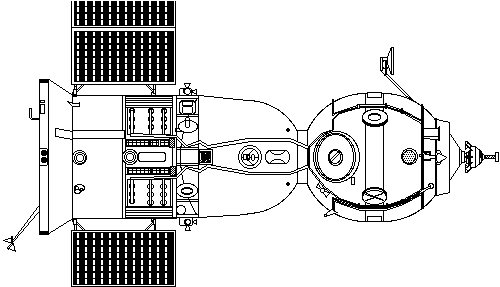 | Soyuz TM Credit: © Mark Wade. 6,267 bytes. 500 x 287 pixels. |
Mir Expedition EO-18. Soyuz TM-21 carried the EO-18 Mir crew and American Norman Thagard. Thagard was the first American to be launched in a Soyuz. Soyuz docked with Mir at 07:45:26 GMT on March 16 . On July 4 Soyuz TM-21 undocked and backed off to a distance of 100 m from Mir. The US space shuttle Atlantis, with the EO-18 crew aboard, then undocked and began a flyaround at a distance of 210 m, while the EO-19 crew aboard Soyuz took pictures before redocking with the station. Soyuz TM-21 again undocked with the EO-19 crew on September 11 from the Kvant rear port on Mir and landed at 50 deg 41'N 68 deg 15'E, 108 km northeast of Arkalyk in Kazakhstan, at 06:52:40 GMT . Additional Details: Soyuz TM-21.
Mir Expedition EO-20. Crew commander was Yuriy Pavlovich Gidzenko of the Russian Air Force. Flight engineer was Sergey Vasilyevich Avdeev of RKK Energiya, and cosmonaut-researcher was Thomas Reiter of the European Space Agency. Soyuz TM-22 docked with Mir's front (-X) port at 10:29:54 GMT on September 5 and the hatch was opened at 11:01:23. On February 29 the crew undocked from Mir in Soyuz TM-22, and at 10:42 GMT they landed in Kazakhstan.
Mir Expedition EO-21. Soyuz TM-23 docked with Mir at 14:20:35 on February 23. The spacecraft undocked on September 2 at 04:20 GMT, and made a small seperation burn at 04:24:40 GMT. Deorbit was at 06:47:20 GMT . The three modules separated at 07:14:36 and the parachute deployed at 07:26 GMT. The landing was at 07:41:40 GMT, 100 km SW of Akmola in Kazakstan with Yuri Onufrienko, Yuriy Usachyov and Claudie Andre-Deshays. This concluded the French 'Cassiopee' mission.
Mir Expedition EO-22. Valeriy Korzun and Aleksandr Kaleri of the Russian Space Agency (RKA) Claudie Andre-Deshays of the French space agency CNES. This launch was the first of the Soyuz-U booster with a crew aboard following two launch failures of on unmanned flights. Soyuz docked with Mir's front port at 14:50:21 GMT on August 19; Mir was in a 375 x 390 km x 51.6 deg orbit.
On Feb 7 at 16:28:01 GMT the EO-22 crew and American astronaut Linenger undocked the Soyuz TM-24 ferry from the front docking port, flew it around to the far side of the complex and redocked at the rear Kvant port at 16:51:27 GMT. This cleared the forward port for the arrival of the EO-23 crew, who brought with them German astronaut Reinhold Ewald on Feb 12. Korzun, Kaleri and Ewald undocked from Mir in the Soyuz TM-24 spaceship at 03:24 GMT on March 2 and landed at 06:44 GMT near Arkaylk in Kazakstan.
Mir Expedition EO-23. Soyuz TM-25 docked with Mir at the forward port on February 12 at 15:51:13 GMT.
Following a mission that seemed to consist of an endless series of collisions, breakdowns, fires, and other emergencies, the EO-23 handed over the station and on August 14 entered Soyuz TM-25 landed in Kazakstan at 12:17 UTC, 170 km SE of Dzezkazgan. The Soyuz landing rockets failed to fire on touchdown, giving one of the roughest landings experienced by a returning Mir crew. Additional Details: Soyuz TM-25.
Mir Expedition EO-24. The Soyuz docked manually at 17:02 GMT August 7. Over the next six months the crew undertook seven internal and external spacewalks to repair the crippled space station. Solovyov and Vinogradov together with French astronaut Eyharts (launched aboard Soyuz TM-27) undocked from the forward port on Mir at 05:52 GMT on February 19, 1998, fired their deorbit engines at 08:16 GMT and landed in Kazakstan at 50 deg 11 N, 67 deg 31 E at 09:10 GMT. Additional Details: Soyuz TM-26.
Soyuz TM-27 carried the Mir EO-25 crew and French astronaut Leopold Eyharts. NASA and the Russian Space Agency had hoped Soyuz TM-27 could dock with Mir while Endeavour was still there, resulting in an on-board crew of 13, a record which would have stood for years or decades. But the French vetoed this, saying the commotion and time wasted would ruin Eyharts Pegase experimental programme. Soyuz TM-27 docked at the Kvant module port at 17:54 GMT on January 31, 1998, less than five hours before Endeavour landed in Florida.
Solovyov handed over command of Mir to EO-25 commander Musabayev, and the Mir EO-24 crew and Eyharts undocked from the forward port of Mir at 05:52 GMT on February 19 aboard the Soyuz TM-26 for their return home. On February 20, the EO-25 crew and Andy Thomas of the NASA-7 mission boarded Soyuz TM-27 and undocked from the Kvant port at 08:48 GMT. They redocked with the forward port on Mir at 09:32 GMT. This freed up the Kvant port for a test redocking of the Progress M-37 cargo ship, parked in a following orbit with Mir during the crew transfer.
Soyuz TM-27 undocked from Mir at 02:05 GMT on August 25, with Musabayev, Budarin and Baturin aboard. They landed on August 25 at 05:23 UTC near Arkalyk in Kazakstan.
Soyuz TM-28 docked at 10:56 GMT on August 15 with the rear (Kvant) port of the Mir space station, which had been vacated at 09:28 GMT on August 12 by Progress M-39. The EO-25 crew, Musabayev and Budarin, landed with Baturin on Aug 25, leaving the EO-26 crew of Padalka and Avdeyev on the station. As only one final Soyuz mission to Mir was planned, with two of the seats on that Soyuz pre-sold to Slovak and French experimenters, the return crew of Soyuz TM-28 was subject to constant replanning and revision. On February 8, 1999, at 11:23 GMT Padalka and Avdeyev undocked from Mir's -X port in Soyuz TM-28, and redocked at the +X Kvant port at 11:39 GMT, freeing up the front port for the Soyuz TM-29 docking. Finally on February 27, 1999 EO-26 commander Padalka and Slovak cosmonaut Bella undocked Soyuz TM-28 from the Kvant rear docking port at 22:52 GMT, landing in Kazakhstan on February 28 at 02:14 GMT. Avdeyev remained on Mir with the EO-27 crew delivered on Soyuz TM-29, heading for a manned space flight time record.
Soyuz TM-29 docked with Mir on February 22 at 05:36 GMT. Since two crew seats had been sold (to Slovakia and France), Afansyev was the only Russian cosmonaut aboard. This meant that Russian engineer Avdeyev already aboard Mir would have to accept a double-length assignment. After the February 27 departure of EO-26 crew commander Padalka and Slovak cosmonaut Bella aboard Soyuz TM-28, the new EO-27 Mir crew consisted of Afanasyev as Commander, Avdeyev as Engineer and French cosmonaut Haignere. Follwoing an extended mission and three space walks, the last operational crew aboard Mir prepared to return. The station was powered down and prepared for free drift mode. The hatch between Mir and Soyuz was closed for the last time at 18:12 GMT on August 27, 1999. Soyuz TM-29 undocked from Mir at 21:17 GMT with Afanasyev, Avdeyev and Haignere aboard. The Mir EO-27 crew landed in Kazakhstan at 00:35 GMT on August 28. Afanasyev had set a new cumulative time in space record, but for the first time since September 1989 there were no humans in space. The only crew that might return to Mir would be one to deorbit it, and beyond that budgets indicated that no more than one Soyuz crew per year could be sent to the International Space Station.
Soyuz TM-30 docked with Mir's forward (-X) port on April 6 at 0631 GMT. Zalyotin and Kaleri reactivated Mir and using Progress M1-1 and M1-2 resupplied the station and raised the orbit to 360 x 378 km x 51.6 deg. The orbital plane of Mir was then around 120 degrees away from that of ISS (making transport between the stations impossible, as desired by NASA). Soyuz TM-30 undocked from Mir on June 15 21:24 GMT. Retrofire came at 23:52 GMT, followed by a safe landing at June 16, 00:44 GMT near Arkalyk in Kazakkstan.