This page no longer updated from 31 October 2001. Latest version can be found at www.astronautix.com
 |
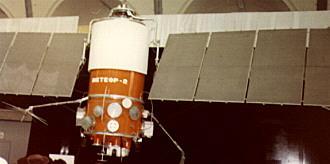
| Meteor-2 - 20,289 bytes. 230 x 315 pixels. |
|
Article Number: 11F632. Class: Earth. Type: Weather. Nation: USSR. Manufacturer: VNIIEM. Work began to develop solutions for second generation hydrographic and meteorological observation systems in 1967. Compared to Meteor-1, the Meteor-2 had a longer design operational life (one year vs. six months) and the capability to transfer data to automatically to military APPI stations (Autonomous Points of Information Collection). Prime contractor was VNIIEM Mineletrotekhprom (A G Yosifiyan). In 1969 the TTZ specification was issued by the Ministry of Defence and the Main Hydro - meteorological Office of the Soviet Ministers. Draft project was completed in 1971. Due to difficulties by NPO Geofizika in development of spectrometer equipment, the first test unit was not completed until 1975. Flight trials under Major General V I Sheulov commenced in July 1975.
Meteor-2 had higher tolerance dynamic characteristics and featured numerous sensors, including:
- 3 view optico-mechanical multi-spectral/infrared scanning television, with extended reception by ground stations at any point of each orbit
- Radiometric sensor for uninterrupted observation of electromagnetic fields in space
- Eight channel infrared radiometer for observation of global vertical temperature profiles
The Meteor-2 was checked out prior to launch by the first automatic digital spacecraft test system in the Soviet Union. Meteors were launched into 81.2 degree orbits, at 850 km altitude, allowing a revisit of every location at 6 and 12 hour intervals by a constellation of three satellites at 90 to 180 degree intervals. Each satellite could observe 30,000 sq. km at a time. Data was processed at hydro-meteorological offices at Moscow, Novsibirsk, and Khaborovsk.
The Meteor series served the Ministry of Defence by providing:
- Operational meteorological data for reconnaissance satellite scheduling
- Operational weather data for use by the Armed Forces in local and global operations
- Monitoring of radiation in near-earth space.
There were 50 APPI reception stations in the USSR, friendly Socialist countries, and in the equatorial regions of the earth. Each location could receive views from 3,000 to 5,000 km away.
Flight trials began reasonable well, but delays were encountered due to the technological base at VNIIEM and Istra. Therefore a resolution of 4 June 1970 ordered VNIIEM to develop a parallel design of another meteosat for the hydrology office alone. This was not put into production. In its place a resolution of 16 December 1972 ordered development of a third generation system. This used the Planeta-S sensor package in the non-co-orbital Meteor-3 system plus the geostationary system Elektro. There were only seven launches of Meteor-3, and a single launch of Elektro, in 1994. Meteor-2 remained in service throughout this period and Meteor-3 was finally cancelled.
SpecificationDesign Life: 2 years. Total Mass: 2,750 kg.
Meteor-2 Chronology
04 June 1970
Meteor-2 authorised. Central Committee of the Communist Party and Council of Soviet Ministers Decree 'On standardised weather satellite system' was issued. The resolution also ordered VNIIEM to develop a parallel design of another meteosat for the hydrology office alone. This was not put into production.
11 July 1975
Meteor 2-01 Launch Site: Plesetsk . Launch Vehicle: Vostok 8A92M. Mass: 2,750 kg. Perigee: 844 km. Apogee: 876 km. Inclination: 81.3 deg. Acquisition of meteorological information needed for use by the weather service.
07 January 1977
Meteor 2-02 Launch Site: Plesetsk . Launch Vehicle: Vostok 8A92M. Mass: 2,750 kg. Perigee: 875 km. Apogee: 893 km. Inclination: 81.3 deg. Acquisition of meteorological information needed for use by the weather service.
14 December 1977
Meteor 2-03 Launch Site: Plesetsk . Launch Vehicle: Vostok 8A92M. Mass: 2,750 kg. Perigee: 847 km. Apogee: 874 km. Inclination: 81.2 deg. Acquisition of meteorological information needed for use by the weather service.
26 October 1978
Cosmos 1045 Launch Site: Plesetsk . Launch Vehicle: Tsyklon 3. Mass: 2,670 kg. Perigee: 1,683 km. Apogee: 1,702 km. Inclination: 82.5 deg. Probable oceanographic. Investigation of the upper atmosphere and outer space.
01 March 1979
Meteor 2-04 Launch Site: Plesetsk . Launch Vehicle: Vostok 8A92M. Mass: 2,750 kg. Perigee: 835 km. Apogee: 873 km. Inclination: 81.2 deg. Acquisition of meteorological information required for use in the operational weather service with the aid of advanced equipment.
31 October 1979
Meteor 2-05 Launch Site: Plesetsk . Launch Vehicle: Vostok 8A92M. Mass: 2,750 kg. Perigee: 861 km. Apogee: 879 km. Inclination: 81.2 deg. Acquisition of meteorological information required for use in the operational weather service with the aid of advanced equipment.
09 September 1980
Meteor 2-06 Launch Site: Plesetsk . Launch Vehicle: Vostok 8A92M. Mass: 2,750 kg. Perigee: 833 km. Apogee: 886 km. Inclination: 81.2 deg.
 | Meteor 2 Credit: © Mark Wade. 9,484 bytes. 330 x 164 pixels. |
Gathering meteorological information and data on penetrating radiation fluxes in circumterrestrial space.
15 May 1981
Meteor 2-07 Launch Site: Plesetsk . Launch Vehicle: Vostok 8A92M. Mass: 2,750 kg. Perigee: 835 km. Apogee: 888 km. Inclination: 81.3 deg. Gathering meteorological information and data on penetrating radiation fluxes in circumterrestrial space.
25 March 1982
Meteor 2-08 Launch Site: Plesetsk . Launch Vehicle: Tsyklon 3. Mass: 2,750 kg. Perigee: 933 km. Apogee: 957 km. Inclination: 82.5 deg. Acquisition of meteorological information and data on fluxes of penetrating radiation in circumterrestrial space.
15 December 1982
Meteor 2-09 Launch Site: Plesetsk . Launch Vehicle: Vostok 8A92M. Mass: 2,750 kg. Perigee: 803 km. Apogee: 882 km. Inclination: 81.2 deg. Possible replacement for Meteor 2-6. Gathering meteorological information and data on penetrating radiation fluxes in circumterrestrial space.
26 October 1983
Meteor 2-10 Launch Site: Plesetsk . Launch Vehicle: Vostok 8A92M. Mass: 2,750 kg. Perigee: 742 km. Apogee: 876 km. Inclination: 81.2 deg. Gathering meteorological information and data on penetrating radiation fluxes in circumterrestrial space.
05 July 1984
Meteor 2-11 Launch Site: Plesetsk . Launch Vehicle: Tsyklon 3. Mass: 2,750 kg. Perigee: 937 km. Apogee: 955 km. Inclination: 82.5 deg. Gathering meteorological information and data on penetrating radiation fluxes in circumterrestrial space.
07 February 1985
Meteor 2-12 Launch Site: Plesetsk . Launch Vehicle: Tsyklon 3. Mass: 2,750 kg. Perigee: 931 km. Apogee: 956 km. Inclination: 82.5 deg. Gathering meteorological information and data on penetrating radiation fluxes in circumterrestrial space.
26 December 1985
Meteor 2-13 Launch Site: Plesetsk . Launch Vehicle: Tsyklon 3. Mass: 2,750 kg. Perigee: 933 km. Apogee: 955 km. Inclination: 82.5 deg. Gathering meteorological information and data on penetrating radiation fluxes in circumterrestrial space.
27 May 1986
Meteor 2-14 Launch Site: Plesetsk . Launch Vehicle: Tsyklon 3. Mass: 2,750 kg. Perigee: 935 km. Apogee: 954 km. Inclination: 82.5 deg. Gathering meteorological information and data on penetrating radiation fluxes in circumterrestrial space.
05 January 1987
Meteor 2-15 Launch Site: Plesetsk . Launch Vehicle: Tsyklon 3. Mass: 2,750 kg. Perigee: 936 km. Apogee: 954 km. Inclination: 82.5 deg. Gathering meteorological information and data on penetrating radiation fluxes in circumterrestrial space.
18 August 1987
Meteor 2-16 Launch Site: Plesetsk . Launch Vehicle: Tsyklon 3. Mass: 2,750 kg. Perigee: 938 km. Apogee: 955 km. Inclination: 82.6 deg. Gathering meteorological information and data on penetrating radiation fluxes in circumterrestrial space.
30 January 1988
Meteor 2-17 Launch Site: Plesetsk . Launch Vehicle: Tsyklon 3. Mass: 2,750 kg. Perigee: 932 km. Apogee: 955 km. Inclination: 82.5 deg. Gathering meteorological information and data on penetrating radiation fluxes in circumterrestrial space.
28 February 1989
Meteor 2-18 Launch Site: Plesetsk . Launch Vehicle: Tsyklon 3. Mass: 2,750 kg. Perigee: 935 km. Apogee: 956 km. Inclination: 82.5 deg. Gathering meteorological information and data on penetrating radiation fluxes in circumterrestrial space.
28 June 1990
Meteor 2-19 Launch Site: Plesetsk . Launch Vehicle: Tsyklon 3. Mass: 2,750 kg. Perigee: 935 km. Apogee: 956 km. Inclination: 82.5 deg. Gathering round-the-clock meteorological information.
28 September 1990
Meteor 2-20 Launch Site: Plesetsk . Launch Vehicle: Tsyklon 3. Mass: 2,750 kg. Perigee: 938 km. Apogee: 958 km. Inclination: 82.5 deg. Gathering round-the-clock meteorological information.
31 August 1993
Meteor 2-21 Launch Site: Plesetsk . Launch Vehicle: Tsyklon 3. Mass: 2,750 kg. Perigee: 934 km. Apogee: 966 km. Inclination: 82.5 deg. Obtaining meteorological data and information on the radiation status of geovicinal outer space. The satellite included the Temisat German small space facility, which was separated from Meteor-2 on the seventh transit of the flight. The Temisat facility w ill, in agreement the Kaiser-Threde Company (Munich), be registered by the Italian partner.
Bibliography:- 2 - McDowell, Jonathan, The United Nations Registry of Space Objects, Harvard University, 1997. HTML when accessed: http://hea-www.harvard.edu/QEDT/jcm/space/un/un.html
- 6 - JPL Mission and Spacecraft Library, Jet Propulsion Laboratory, 1997. HTML when accessed: http://msl.jpl.nasa.gov/home.html
- 102 - Voevodin, Sergey A, VSA072 - Space Apparatus, "Sergey A. Voevodin's Reports", . HTML when accessed: http://www.mcs.net/~rusaerog/sergeyv/VSA.html
- 445 - Melnik, T G, Voenno-Kosmicheskiy Siliy, Nauka, Moscow, 1997..
Back to Index
Last update 12 March 2001.
Contact Mark Wade with any corrections or comments.
Conditions for use of drawings, pictures, or other materials from this site..
© Mark Wade, 2001 .