 |
| Meteor 3 Meteor 3 exhibited at Hannover Expo 2000. Credit: © Mark Wade. 24,828 bytes. 578 x 238 pixels. |
| astronautix.com | Meteor-3 |
|
| Meteor 3 Meteor 3 exhibited at Hannover Expo 2000. Credit: © Mark Wade. 24,828 bytes. 578 x 238 pixels. |
Meteorological satellite. Flight trials of Meteor-2 began reasonably well, but delays were encountered due to the technological base at VNIIEM and Istra. Therefore a resolution of 4 June 1970 ordered VNIIEM to develop a parallel design of another meteosat for the hydrology office alone. This was not put into production. In its place a resolution of 16 December 1972 ordered development of a third generation system. This used the Planeta-S sensor package in the non-co-orbital Meteor-3 system plus the geostationary system Elektro. Flight trials of Meteor-3 did not begin until 1984, and there was only a single launch of Elektro, in 1994. After a long time it was not put into use. The whole project was finally cancelled, the reason being the incompetent head of development at VNIIEM. Meteor-3 was a 3-axis stabilized spacecraft using cold gas thrusters. Pointing accuracy was 20 arc-minutes. Swath width 3100 km; resolution 0.8 x 1.5 km.
Design Life: 2 years. Total Length: 6.5 m. Maximum Diameter: 2.4 m. Total Mass: 2,150 kg.
Military-Industrial Commission (VPK) Decree 'On establishment of the Planeta-S weather satellite system' was issued. The resolution ordered development of a third generation system. This used the Planeta-S sensor package in the non-co-orbital Meteor-3 system plus the geostationary system Elektro, which was to begin tests in 1982. Elektro suffered numerous delays due to equipment and software problems. Flight trials of Meteor-3 did not begin until 1984, and there was only a single launch of Elektro, in 1994.
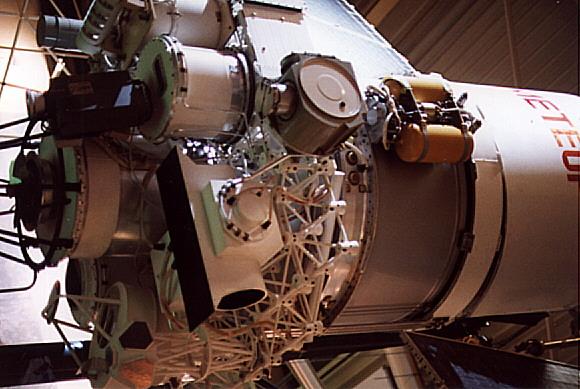 | Meteor 3 Detail - Instrument package of Meteor 3 exhibited at Hannover Expo 2000. Credit: © Mark Wade. 46,334 bytes. 580 x 389 pixels. |
Unusable orbit. First launch of new Meteor-3 spacecraft.
First successful launch of new Meteor-3 spacecraft. Further improvement of the meteorological system using artificial earth satellite, including development of informational and measurement apparatus and remote sensing methods.
Continued improvement of the meteorological system using artificial earth satellites, including the testing of information-gathering and measuring apparatus and of remote sensing methods.
Testing data-measuring equipment and methods for remote sensing of the atmosphere and Earth's surface to benefit the Soviet economy and science.
Testing data-measuring equipment and methods for remote sensing of the atmosphere and Earth's surface to benefit the Soviet economy and science.
Also carried US TOMS instrument. Gathering of hydrometeorological data; testing of data-gathering and measuring equipment, of optical and mechanical television and radiometric scanning apparatus, of instruments for geophysical research and of methods for the remote sensing of the atmosph ere and the Earth's surface for various branches of the USSR economy and science; charting the state of the ozone layer, using American TOMS equipment.
Also carried German geodetic package, French radiometer. Obtain meterological and solar-terrestrial data. The space object Meteor 3 included the small German satellite Tubsat which was separated from the space object Meteor 3 on the second orbit.