
Credit: Andy Salmon. 14,326 bytes. 320 x 338 pixels.
| astronautix.com | Venera |
|
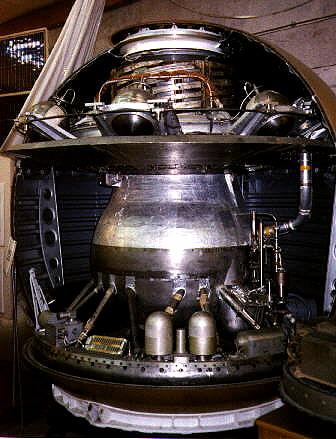
| Venera 8 lander - Venera-8/9 landing capsule Credit: Andy Salmon. 14,326 bytes. 320 x 338 pixels. |
The escape stage entered parking orbit but the main engine cut off just 0.8 s after ignition due to cavitation in the oxidiser pump and pump failure.. The payload attached together with escape stage remained in Earth orbit.
Venera 1 was the first spacecraft to fly by Venus. It was launched first into a 229 x 282 km parking orbit, then boosted toward Venus by the restartable Molniya upper stage. On 19 February, 7 days after launch, at a distance of about two million km from Earth, contact with the spacecraft was lost. On May 19 and 20, 1961, Venera 1 passed within 100,000 km of Venus and entered a heliocentric orbit. This failure resulted in only the following objectives being met: checking of methods of setting space objects on an interplanetary course; checking of extra-long-range communications with and control of the space station; more accurate calculation of the dimension of the solar system; a number of physical investigations in space.
Launched Venera 1 from low Earth orbit.
The motor burnt for only 45s of the planned 240s. The stage remained in Earth orbit.
The escape stage entered parking orbit but the main engine cut off just 0.8 s after ignition due to cavitation in the oxidiser pump and pump failure.
The launch was delayed due to malfunctions during prelaunch service.
The stage with payload remained in Earth orbit as Cosmos-27.
Failed Venus probe. Solar Orbit (Heliocentric). Elaboration of a long range space system and conduct of scientific research.
Venera 2 was launched towards the planet Venus and carried a TV system and scientific instruments. On February 27, 1966, the spacecraft passed Venus at a distance of 24,000 km and entered a heliocentric orbit. The spacecraft system had ceased to operate before the planet was reached and returned no data.
Venera 3 was launched towards the planet Venus. The mission was to land on the Venusian surface. The entry vehicle contained a radio communication system, scientific instruments, electrical power sources, and medallions bearing the coat of arms of the U.S.S.R. The station impacted Venus on March 1, 1966. However, the communications systems had failed before planetary data could be returned.
The escape stage Block L entered parking orbit tumbling and was not able to operate properly.
The launch attempt was abandoned due to a launch vehicle malfunction during pre-launch preparations.
Venera 4 was successfully launched towards the planet Venus with the announced mission of direct atmospheric studies. On October 18, 1967, the descent vehicle entered the Venusian atmosphere. Signals were returned by the spacecraft, which deployed a parachute after braking to subsonic velocity in the Venusian atmosphere, until it reached an altitude of 24.96 km.
Suggestions for the cause of the failure included incorrect soldering of wires in multiple pin plugs, wrong attachments of the plugs to the pyrotechnic connectors, or a mix-up of the pyrotechnic connectors during assembly.. Investigation of the upper atmosphere and outer space.
 | Vega lander - VeGa-1/2 Venus lander Credit: Andy Salmon. 33,243 bytes. 336 x 439 pixels. |
Venera 5 was launched from a Tyazheliy Sputnik (69-001C) towards Venus to obtain atmospheric data. The spacecraft was very similar to Venera 4 although it was of a stronger design. When the atmosphere of Venus was approached, a capsule weighing 405 kg and containing scientific instruments was jettisoned from the main spacecraft. During satellite descent towards the surface of Venus, a parachute opened to slow the rate of descent. For 53 min on May 16, 1969, while the capsule was suspended from the parachute, data from the Venusian atmosphere were returned. The spacecraft also carried a medallion bearing the coat of arms of the U.S.S.R. and a bas-relief of V.I. Lenin to the night side of Venus.
Venera 6 was launched towards Venus to obtain atmospheric data. When the atmosphere of Venus was approached, a capsule weighing 405 kg was jettisoned from the main spacecraft. This capsule contained scientific instruments. During descent towards the surface of Venus, a parachute opened to slow the rate of descent. For 51 min on May 17, 1969, while the capsule was suspended from the parachute, data from the Venusian atmosphere were returned. The spacecraft also carried a medallion bearing the coat of arms of the U.S.S.R. and a bas-relief of V.I. Lenin to the night side of Venus.
Venera 7 was launched from an earth parking orbit towards Venus to study the Venusian atmosphere and other phenomena of the planet. Venera 7 entered the atmosphere of Venus on December 15, 1970, and a landing capsule was jettisoned. After aerodynamic braking, a parachute system was deployed. The capsule antenna was extended, and signals were returned for 35 min. Another 23 min of very weak signals were received after the spacecraft landed on Venus. The capsule was the first man-made object to return data after landing on another planet.
Probable Venus probe failure.
Venus atmospheric probe. The spacecraft took 117 days to reach Venus, entering the atmosphere on 22 July 1972. Descent speed was reduced from 41,696 km/hr to about 900 km/hr by aerobraking. The 2.5 meter diameter parachute opened at an altitude of 60 km, and a refrigeration system was used to cool the interior components. Venera 8 transmitted data during the descent and continued to send back data for 50 minutes after landing. The probe confirmed the earlier data on the high Venus surface temperature and pressure returned by Venera 7, and also measured the light level as being suitable for surface photography, finding it to be similar to the amount of light on Earth on an overcast day.
Combined Venus orbiter/lander mission. After separation of the lander, the orbiter spacecraft entered Venus orbit and acted as a communications relay for the lander and explored cloud layers and atmospheric parameters. On October 20, 1975, the Descent Craft was separated from the Orbiter, and landing was made with the sun near zenith at 05:13 GMT on October 22. The Descent Craft included a system of circulating fluid to distribute the heat load. This system, plus precooling prior to entry, permitted operation of the spacecraft for 53 min after landing. The landing was about 2,200 km from the Venera 10 landing site. Preliminary results indicated: (A) clouds 30-40 km thick with bases at 30-35 km altitude, (B) atmospheric constituents including HCl, HF, Br, and I, (C) surface pressure about 90 (earth) atmospheres, (D) surface temperature 485 deg C, (E) light levels comparable to those at earth midlatitudes on a cloudy summer day, and (F) successful TV photography showing shadows, no apparent dust in the air, and a variety of 30-40 cm rocks which were not eroded. Venera 9 and 10 were the first probes to send back black and white pictures from the Venusian surface. They were supposed to make 360 degree panoramic shots, but on both landers one of two camera covers failed to come off, restricting their field of view to 180 degrees. Parameters are for Venus orbit.
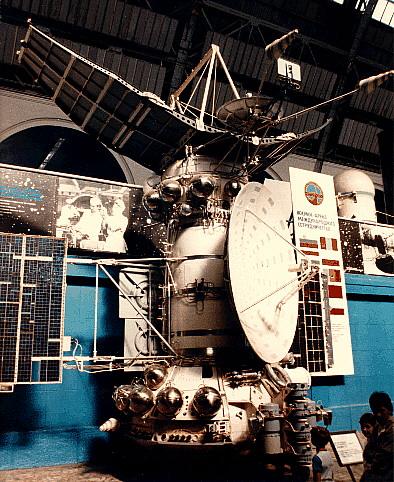 | Venera 15 - Venera-15 Venus radar lunar surface mapper Credit: Andy Salmon. 59,172 bytes. 394 x 482 pixels. |
Venera 11 was part of a two-spacecraft mission to study Venus and the interplanetary medium. Each of the two spacecraft, Venera 11 and Venera 12, consisted of a flight platform and a lander probe. Identical instruments were carried on both spacecraft. Venera 11 was launched into a 177 x 205 km, 51.5 degree inclination earth orbit from which it was propelled into a 3.5 month Venus transfer orbit. After ejection of the lander probe, the flight platform continued on past Venus in a heliocentric orbit. Near encounter with Venus occurred on December 25, 1978, at approximately 34,000 km altitude. The flight platform acted as a data relay for the descent craft for 95 minutes until it flew out of range and returned its own measurements on interplanetary space. The Venera 11 descent craft separated from its flight platform on December 23, 1978 and entered the Venus atmosphere two days later at 11.2 km/sec. During the descent, it employed aerodynamic braking followed by parachute braking and ending with atmospheric braking. It made a soft landing on the surface at 06:24 Moscow time on 25 December after a descent time of approximately 1 hour. The touchdown speed was 7-8 m/s.
Both Venera 11 and 12 landers failed to return colour television views of the surface and perform soil analysis experiments. All of the camera protective covers failed to eject after landing (the cause was not established) The soil drilling experiment was apparently damaged by a leak in the soil collection device, the interior of which was exposed to the high Venusian atmospheric pressure. The leak had probably formed during the descent phase because the lander was less aerodynamically stable than had been thought.
Two further experiments on the lander failed as well. Results reported included evidence of lightning and thunder, a high Ar36/Ar40 ratio, and the discovery of carbon monoxide at low altitudes.
Venera 12 was part of a two-spacecraft mission to study Venus and the interplanetary medium. Each of the two spacecraft, Venera 11 and Venera 12, consisted of a flight platform and a lander probe. Identical instruments were carried on both spacecraft. Venera 12 was launched into a 177 x 205 km, 51.5 degree inclination Earth orbit from which it was propelled into a 3.5 month Venus transfer orbit which involved two mid-course corrections, on 21 September and 14 December. After ejection of the lander probe on 19 December, two days before encounter, the flight platform continued on past Venus in a heliocentric orbit. Near encounter with Venus occurred on December 21, 1978, at approximately 34,000 km altitude. The flight platform acted as a data relay for the descent craft for 110 minutes until it flew out of range and returned to its own measurements on interplanetary space. The Venera 12 descent craft entered the Venus atmosphere at 11.2 km/sec two days after separation from the flight bus. During the descent, it employed aerodynamic braking followed by parachute braking and ending with atmospheric braking. It made a soft landing on the surface at 06:30 Moscow time on 21 December after a descent time of approximately 1 hour. The touchdown speed was 7-8 m/s.
Both Venera 11 and 12 landers failed to return colour television views of the surface and perform soil analysis experiments. All of the camera protective covers failed to eject after landing (the cause was not established) The soil drilling experiment was apparently damaged by a leak in the soil collection device, the interior of which was exposed to the high Venusian atmospheric pressure. The leak had probably formed during the descent phase because the lander was less aerodynamically stable than had been thought. Therefore the landing gear of the following two landers (Venera-13/14) were equipped with tooth-shaped stabilisers.
Results reported included evidence of lightning and thunder, a high Ar36/Ar40 ratio, and the discovery of carbon monoxide at low altitudes.
The Venera-12 flyby bus continued in solar orbit and successfully used its Soviet-French ultraviolet spectrometer to study Comet Bradfield on 13 February 1980 (one year and two months after its Venus encounter). At that time the spacecraft was 190,373,790 km from Earth.
Venera 13 and 14 were identical spacecraft built to take advantage of the 1981 Venus launch opportunity and launched 5 days apart. After launch and a four month cruise to Venus, the descent vehicle separated and plunged into the Venus atmosphere on 1 March 1982. As it flew by Venus the bus acted as a data relay for the brief life of the descent vehicle, and then continued on into a heliocentric orbit. After the descent vehicle braked to subsonic speed a parachute was deployed. At an altitude of 47 km the parachute was released and simple airbraking was used the rest of the way to the surface. Venera 13 landed about 950 km northeast of Venera 14 at 7 deg 30 min S, 303 E, just east of the eastern extension of an elevated region known as Phoebe Regio. The area was composed of bedrock outcrops surrounded by dark, fine-grained soil. After landing an imaging panorama was started and a mechanical drilling arm reached to the surface and obtained a sample, which was deposited in a hermetically sealed chamber, maintained at 30 degrees C and a pressure of about .05 atmospheres. The composition of the sample, as determined by the X-ray flourescence spectrometer, put it in the class of weakly differentiated melanocratic alkaline gabbroids. The lander survived for 127 minutes (the planned design life was 32 minutes) in an environment with a temperature of 457 degrees C and a pressure of 84 Earth atmospheres. The bus carried instruments built by Austrian and French specialists, as well as Soviet scientific equipment.
Venera 13 and 14 were identical spacecraft built to take advantage of the 1981 Venus launch opportunity and launched 5 days apart. After launch and a four month cruise to Venus, the descent vehicle separated and plunged into the Venus atmosphere on 5 March 1982. As it flew by Venus the bus acted as a data relay for the brief life of the descent vehicle, and then continued on into a heliocentric orbit. The parachute of the descent vehicle opened after the lander reached subsonic speed. At an altitude of about 50 km the parachute was released and simple airbraking was used the rest of the way to the surface. Venera 14 landed about 950 km southwest of Venera 13 near the eastern flank of Phoebe Regio at 13 deg 15 min S by 310 E on a basaltic plain. After landing an imaging panorama was started It has been reported that the surface analysis arm accidentally landed on one of the ejected camera covers and therefore didn't send back any data on the Venusian soil. This is visible in photographs sent back. On the other hand, the official account very specifically states that the mechanical drilling arm obtained a sample, which was deposited in a hermetically sealed chamber, maintained at 30 degrees C and a pressure of about .05 atmospheres. The composition of the sample was determined by the X-ray flourescence spectrometer, showing it to be similar to oceanic tholeiitic basalts. The lander survived for 57 minutes (the planned design life was 32 minutes) in an environment with a temperature of 465 degrees C and a pressure of 94 Earth atmospheres.
Venera 15 was part of a two spacecraft mission (along with Venera 16) designed to use side-looking radar mappers to study the surface properties of Venus. The two spacecraft were inserted into Venus orbit a day apart with their orbital planes shifted by an angle of approximately 4 degrees relative to one another. This made it possible to reimage an area if necessary. Each spacecraft was in a nearly polar orbit with a periapsis at 62 N latitude. Together, the two spacecraft imaged the area from the north pole down to about 30 degrees N latitude over the 8 months of mapping operations. Data is for Venus orbit.
Venus radar mapper; entered Venus orbit 10/14/83. Venera 16 was part of a two spacecraft mission (along with Venera 15) designed to use side-looking radar mappers to study the surface properties of Venus. The two spacecraft were inserted into Venus orbit a day apart with their orbital planes shifted by an angle of approximately 4 degrees relative to one another. This made it possible to reimage an area if necessary. Each spacecraft was in a nearly polar orbit with a periapsis at 62 N latitude. Together, the two spacecraft imaged the area from the north pole down to about 30 degrees N latitude over the 8 months of mapping operations.
Investigations of the planet Venus and Halley's Comet. The APV-V plasma antenna did not deploy until the first mid-course correction burn. Deployed lander and balloon at Venus on June 19 1985. Rendezvoused with comet Halley on March 6, 1986. Fitted with scientific apparatus and equipment built in the USSR, Austria, Bulgaria, Hungary, German Democratic Republic, Poland, France, Federal Republic of Germany and C zechoslovakia.
Investigations of the planet Venus and Halley's Comet. The APV-V plasma antenna did not deploy until the first mid-course correction burn. Deployed lander and balloon at Venus on June 14, 1985. The surface experiments of the lander failed to send back data because they were inadvertently switched on at an altitude of 20 km. Apparently high winds activated a G-force sensor that was to automatically switch on the surface package after the jolt of touchdown. The bus continued in heliocentric orbit and rendezvoused with comet Halley on March 9, 1986. The images of the comet were nearly lost when a television sensor failed shortly before the flyby. A back-up sensor was activated just in time. Fitted with scientific apparatus and equipment built in the USSR, Austria, Bulgaria, Hungary, German Democratic Republic, Poland, France, Federal Republic of Germany and C zechoslovakia.