Credit: NASA. 31,019 bytes. 248 x 333 pixels.
| astronautix.com | Venera 2V (V-69) |
|
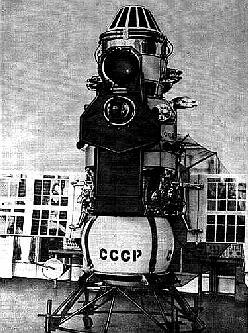
| Venera 5 - Credit: NASA. 31,019 bytes. 248 x 333 pixels. |
Spacecraft was very similar to Venera 4 / 1V (V-67) although the descent module was of a stronger design. When the atmosphere of Venus was approached, a capsule weighing 405 kg and containing scientific instruments was jettisoned from the main spacecraft. During descent towards the surface of Venus, a parachute opened to slow the rate of descent. For 53 min on May 16, 1969, while the capsule was suspended from the parachute, data from the Venusian atmosphere were returned. The spacecraft also carried a medallion bearing the coat of arms of the U.S.S.R. and a bas-relief of V.I. Lenin to the night side of Venus.
Total Mass: 1,128 kg.
Venera 5 was launched from a Tyazheliy Sputnik (69-001C) towards Venus to obtain atmospheric data. The spacecraft was very similar to Venera 4 although it was of a stronger design. When the atmosphere of Venus was approached, a capsule weighing 405 kg and containing scientific instruments was jettisoned from the main spacecraft. During satellite descent towards the surface of Venus, a parachute opened to slow the rate of descent. For 53 min on May 16, 1969, while the capsule was suspended from the parachute, data from the Venusian atmosphere were returned. The spacecraft also carried a medallion bearing the coat of arms of the U.S.S.R. and a bas-relief of V.I. Lenin to the night side of Venus.
Venera 6 was launched towards Venus to obtain atmospheric data. When the atmosphere of Venus was approached, a capsule weighing 405 kg was jettisoned from the main spacecraft. This capsule contained scientific instruments. During descent towards the surface of Venus, a parachute opened to slow the rate of descent. For 51 min on May 17, 1969, while the capsule was suspended from the parachute, data from the Venusian atmosphere were returned. The spacecraft also carried a medallion bearing the coat of arms of the U.S.S.R. and a bas-relief of V.I. Lenin to the night side of Venus.
Spacecraft was very similar to Venera 4 / 1V (V-67) although the descent module was of a stronger design. When the atmosphere of Venus was approached, a capsule weighing 405 kg and containing scientific instruments was jettisoned from the main spacecraft. During descent towards the surface of Venus, a parachute opened to slow the rate of descent. For 53 minutes, while the capsule was suspended from the parachute, data from the Venusian atmosphere were returned. The spacecraft also carried a medallion bearing the coat of arms of the U.S.S.R. and a bas-relief of V.I. Lenin to the night side of Venus.