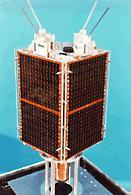
Credit: NASA. 7,398 bytes. 131 x 195 pixels.
| astronautix.com | Microsat SSTL |
|
| SSTL Microsatellite - Credit: NASA. 7,398 bytes. 131 x 195 pixels. |
Basic Surrey Microsat bus.
Total Mass: 50 kg.
University of Surrey research microsatellite. Radio science; also carried amateur radio package. Communication and geophysics research satellite. Launch time 1127 GMT. Also registered by the United States in ST/SG/SER.E/59, with category D and orbital parameters 95.3 min, 531 x 533 km x 97.5 deg. UoSAT-OSCAR 9 was launched piggyback with Solar Mesosphere Explorer satellite. Weight 52 kg. Box shaped 740 x 420 x 420 mm. Deployable gravity gradient boom. Firsts: First on-board computer (IHU - Integrated Housekeeping Unit) for battery and attitude management, remote control, and experiments. Built by the University of Surrey in the United Kingdom, UO-9 was UoSAT's first experimental satellite. It was a scientific and educational low-Earth orbit satellite containing many experiments and beacons but no amateur transponders. UO-9 was fully operational until it re-entered October 13, 1989 from a decaying orbit after nine years of service.
University of Surrey experimental microsatellite. Built in only 6 months, UoSAT-2 carried the first modern digital store and forward (S&F) communications payload and a prototype CCD camera. Also performed magnetospheric studies. Launch time 1759 GMT. Still operational in 2000.
University of Surrey experimental satellite. The first of Surrey Satellite Technology Ltd's modular microsatellites. Launched on the Ariane ASAP; carried an operational store and forward communications payload with extensive radiation monitoring experiments for SatelLife and Data Trax Inc (USA). Still operational in 2000. Owner/operator University of Surrey, Dept of Electronic and Electrical Engineering, Guildford, Surrey GU2 5XH.
Customer: SateLife. Carried store and forward communications and Earth observation payloads, replacing those lost on UoSAT-4. Still operational in 2000.
An industrial research microsatellite built by Surrey Satellite Technology Ltd (SSTL) for Matra and CNES to carry out 'Little LEO' communications service experiments. Still operational in 2000. S80/T was designed to investigate the technical feasibility of using a constellation of small satellites placed in near-Earth orbit to provide global communications and position location using only hand-held terminals. S80/T was the first fully commercial application of the SSTL multi-mission, modular microsatellite platform developed at the University of Surrey. The same basic platform was also used for the Korean KITSAT-A microsatellite, which accompanied S80/T into orbit on the same launch. The S80/T mission was completed, from concept to launch, within one year and SSTL delivered the platform, associated groundstation equipment and would be providing operations support during the mission within a contract of less than �1M.
Portugal's first satellite achieved through a technology transfer programme with Surrey Satellite Technology Ltd. Carried store and forward, DSP communications, GPS and Earth observation payloads. Still operational in 2000. Additional Details: Posat 1.
Chile's first satellite built through a technology transfer programme with Surrey Satellite Technology Ltd. Carried store and forward and Earth observation payloads. Decommissioned as of 2000.
Customer: Chilean Air Force (FACH). Chile's second satellite carrying store and forward and Earth observation payloads, replacing those lost on FASat-Alpha. Still operational as of 2000. Additional Details: Fasat-Bravo.
Tsinghua University of Beijing satellite equipped with an imager, communications payload, and momentum wheels for 3-axis stabilisation. The 50 kg, 0.69 x 0.36 x 0.36m box-shaped satellite used a standard Surrey SSTL microsat bus.
Customer: Astonautic Technology (M) SDN. BHD. Malaysia's first microsatellite built through a technology transfer programme with Surrey Satellite Technology Ltd Carried multi-spectral Earth imaging CCD cameras, meteorological Earth imaging CCD camera, digital store and forward communications, cosmic-ray energy deposition experiment (CEDEX)