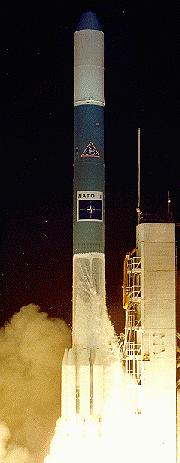
12,925 bytes. 180 x 463 pixels.
| astronautix.com | Delta 2914 |
|
| Delta 2914 no. 146 - Delta 2914 no. 146 - COSPAR 1978-106 12,925 bytes. 180 x 463 pixels. |
Launches: 45. Failures: 0. Success Rate: 100.00% pct. First Launch Date: 19 January 1974. Last Launch Date: 06 October 1981. Payload: 724 kg. to a: Geosynchronous transfer trajectory. Liftoff Thrust: 233,260 kgf. Total Mass: 130,392 kg. Core Diameter: 2.4 m. Total Length: 35.0 m. Flyaway Unit Cost $: 28.52 million. in 1985 unit dollars.
Partial Failure. Failed to reach planned orbit.
Spacecraft engaged in practical applications and uses of space technology such as weather or communication (US Cat C).
Synchronous Meteorological Satellite. Spacecraft engaged in practical applications and uses of space technology such as weather or communication (US Cat C).
Spacecraft engaged in practical applications and uses of space technology such as weather or communication (US Cat C).
AMSAT-OSCAR 7 was launched piggyback with ITOS-G (NOAA 4) and the Spanish INTASAT. The second phase 2 satellite (Phase II-B). Weight 28.6 kg. Octahedrally shaped 360 mm high and 424 mm in diameter. Circularly polarized canted turnstile VHF/UHF antenna system and HF dipole. Firsts: Satellite-to-satellite relay communication via AO-6; Early demonstrations of low-budget medical data relay and doppler location of ground transmitters for search-and-rescue operations were done using this satellite. AO-7 was operational for 6.5 years until a battery failure ceased operation in mid 1981. Additional Details: Oscar 7.
Spacecraft engaged in practical applications and uses of space technology such as weather or communication (US Cat C).
Military communications.
Experimental commsat. Jointly registered by the Federal Republic of Germany (A/AC.105/INF.305) and France (A/AC.105/INF.306). Symphonie flying model no. 1, constructed jointly by France and the Federal Republic of Germany. Description: Experimental teleco mmunications satellite. Orbit: geostationary.
Spacecraft engaged in practical applications and uses of space technology such as weather or communication (US Cat C).
Synchronous Meteorological Satellite. Spacecraft engaged in practical applications and uses of space technology such as weather or communication (US Cat C).
Geodynamics Experimental Ocean Satellite. The mission of GEOS 3 (Geodynamics Experimental Ocean Satellite) was to provide the stepping stone between the National Geodetic Satellite Program (NGSP) and the Earth and Ocean Physics Application Program. It provided data to refine the geodetic and geophysical results of the NGSP and served as a test for new systems. A major achievment was the flight of a radar altimeter. Further mission objectives: intercomparison of tracking systems, investigation of solid-earth dynamic phenomena through precision laser tracking, refinement of orbit determination techniques, determination of interdatum ties and gravity models, and support of the calibration and position determination of NASA Spaceflight Tracking and Data Network (STDN) S-band tracking stations.
Spacecraft engaged in practical applications and uses of space technology such as weather or communication (US Cat C).
Environmental research. The experiments selected for Nimbus-6 were the earth radiation budget (ERB), electrically scanning microwave radiometer (ESMR), high-resolution infrared radiation sounder (HIRS), limb radiance inversion radiometer (LRIR), pressure modulated radiometer (PMR), scanning microwave spectrometer (SCAMS), temperature-humidity infrared radiometer (THIR), tracking and data relay experiment (T+DRE), and the tropical wind energy conversion and reference level experiment (TWERLE). This complement of advanced sensors was capable of mapping tropospheric temperature, water vapor abundance, and cloud water content; providing vertical profiles of temperature, ozone, and water vapor; transmitting real-time data to a geostationary spacecraft (ATS 6); and yielding data on the earth's radiation budget.
Eighth CERS/ESRO satellite, first European Space Agency satellite. Launch time 0147:59 GMT. Argument of perigee 344.7 deg. Also registered by the United States in A/AC.105/INF.331 as 1975-72A, category B satellite with orbit 2203.9 min, 442 x 99002 km x 9 0.3 deg.
Jointly registered by the Federal Republic of Germany (A/AC.105/INF.329) and France (A/AC.105/INF.330). Symphonie flying model no II. Experimental telecommunications satellite. Orbit: geostationary. Also registered by the United Stat es in A/AC.105/INF.331 as 1975-77A, category C, with orbit 1427.4 min, 35364 x 35870 km x 0.0 deg
Atmospheric Explorer; atmospheric research. Spacecraft engaged in research and exploration of the upper atmosphere or outer space (US Cat B).
Geostationary Operational Environmental Satellite. Spacecraft engaged in research and exploration of the upper atmosphere or outer space (US Cat B).
Atmospheric Explorer. Spacecraft engaged in research and exploration of the upper atmosphere or outer space (US Cat B).
Spacecraft engaged in practical applications and uses of space technology such as weather or communication (US Cat C).
Maritime communications. Spacecraft engaged in practical applications and uses of space technology such as weather or communication (US Cat C).
Spacecraft engaged in practical applications and uses of space technology such as weather or communication (US Cat C).
LAGEOS (Laser Geodetic Satellite) was a very dense (high mass-to-area ratio) laser retroreflector satellite which provided a permanent reference point in a very stable orbit for such precision earth-dynamics measurements as crustal motions, regional strains, fault motions, polar motion and earth-rotation variations, solid earth tides, and other kinematic and dynamic parameters associated with earthquake assessment and alleviation. The performance in orbit of LAGEOS was limited only by degradation of the retroreflectors, so many decades of useful life can be expected. The high mass-to-area ratio and the precise, stable (attitude-independent) geometry of the spacecraft, together with the orbit, made this satellite the most precise position reference available. Because it is visible in all parts of the world and has an extended operation life in orbit, LAGEOS can serve as a fundamental standard for decades. Additional Details: Lageos.
Maritime communications. Spacecraft engaged in practical applications and uses of space technology such as weather or communication (US Cat C).
Palapa A1 and A2 were the initial elements of Indonesia's domestic communications satellite system. The spacecraft were identical to Canada's Anik and Western Union's Wasters except for a modified parabolic reflector, enlarged to give maximum illumination of the Indonesian land mass. Operational lives for Palapa A1 and A2 ended June 1985 and January 1988, respectively. Spacecraft: Based on Hughes HS-333 design.1.5 m diameter parabolic reflector with 12 transponders working through 125 Earth stations. Spin stabilised with despun antenna and feeds. Payload: Both satellites carried 12 transponders that provided 4000 voice circuits or 12 simultaneous TV channels to the country's 6000+ inhabited islands.
Spacecraft engaged in practical applications and uses of space technology such as weather or communication (US Cat C).
Maritime communications. Spacecraft engaged in practical applications and uses of space technology such as weather or communication (US Cat C).
Spacecraft engaged in practical applications and uses of space technology such as weather or communication (US Cat C).
Spacecraft engaged in practical applications and uses of space technology such as weather or communication (US Cat C).
Spacecraft engaged in research and exploration of the upper atmosphere or outer space (US Cat B).
Spacecraft engaged in practical applications and uses of space technology such as weather or communication (US Cat C).
Geostationary meteorological satellite.
Experimental commsat. SIRIO (Satellite Italiano Ricerca Industriale Orientata). Launch time 2350:00 GMT. Geographical longitude of geostationary orbit 15 deg W. SIRIO is a spin stabilized geostationary experimental communications satellite. Characteristics of satellite: Weight at launch 398 kg, in orbit 218 kg. Configuration - cylindrical, height 1.981m, diameter 1.433 m, nominal life two years.
International Sun-Earth Explorer.
International Sun-Earth Explorer. Spacecraft engaged in research and exploration of the upper atmosphere or outer space (US Cat B).
European Space Agency satellite. Launch time 0135 GMT. Reached definitive position, 0 deg longitude over the Gulf of Guinea, on 7 December. Launched by United States Delta rocket.
Medium-capacity Communications Satellite for Experimental Purposes . Launch vehicle Delta 2914-137. Launch time 0047 UT. Geographical longitude on geostationary orbit: 135 deg E. CS is a spin stabilized geostationary communications satellite. Characteris tics of satellite: Weight approx 340 kg at an early stage in orbit, configuration: cylindrical, height 3.48 m, diameter 2.18m, Expected life more than three years.
International Ultraviolet Explorer. Spacecraft engaged in practical applications and uses of space technology such as weather or communication (US Cat C).
Spacecraft engaged in practical applications and uses of space technology such as weather or communication (US Cat C).
AMSAT-OSCAR 8 was launched piggyback with LandSat 3 (ERTS 3) and PIX. The third phase 2 satellite (Phase II-D). Weight 27.2 kg. Box shaped, 33 cm high, 38 x 38 cm. Circularly polarized VHF canted turnstile, UHF quarter wave monopole, and HF half-wave dipole antenna system. Another cooperative international effort (United States, Canada, Germany and Japan). AO-8 had a similar store-and-forward service as AO-7 and carried Mode A (145.850-900 MHz uplink and 29.400-500 MHz downlink) and Mode J (145.900-146.000 MHz uplink and 435.100 MHz downlink (inverted)) linear transponders and telemetry beacons on 435.095 MHz and 29.402 MHz. AO-8's primary mission was for educational applications and amateur communications. It was in operation for six years until the battery failed on June 24, 1983.
Plasma Interaction Experiment. Space craft engaged in investigation of spaceflight techniques and technology (US Cat A).
Experimental comsat. Medium-scale broadcasting satellite for experimental purposes (BSE). Launch vehicle Delta 2914-140. Launch time 2201 GMT. Location 110 deg E. Characteristics of satellite: Weight approx 355 kg in an early stage in orbit. Configuration - box shaped satelli te with 2 solar array panels with overall span of 8.95m. Height 3.09m, width 1.32m, length 1.19m. 3-axis stabilized attitude control. Expected life 3 years.
Spacecraft engaged in practical applications and uses of space technology such as weather or communication (US Cat C).
Magnetospheric research. European Space Agency satellite. Launch time 1043 GMT. Reached initial operational position of 6 deg East on 26 Jul 1978. During the two years of its mission, it will be maintained in position between longitude 0 and 35 deg east in geosynchronous orbit.
International Sun-Earth Explorer; later renamed the International Cometary Explorer. Measured interaction between solar wind and Earth; rendezvoused with comet Giacobini-Zinner September 11, 1985. After several passes through the Earth's magnetotail, with gravity assists from lunar flybys in March, April, September and October of 1983, a final close lunar flyby (119.4 km above the moon's surface) on December 22, 1983, ejected the spacecraft out of the Earth-Moon system and into a heliocentric orbit ahead of the Earth, on a trajectory intercepting that of Comet Giacobini-Zinner. A total of fifteen propulsive maneuvers (four of which were planned) and five lunar flybys were needed to carry out the transfer from the halo orbit to an escape trajectory from the earth-moon system into a heliocentric orbit. The primary scientific objective of ICE was to study the interaction between the solar wind and a cometary atmosphere. As planned, the spacecraft traversed the plasma tail of Comet Giacobini-Zinner on September 11, 1985, and made in situ measurements of particles, fields, and waves. It also transited between the Sun and Comet Halley in late March 1986, when other spacecraft (Giotto, Planet-A, MS-T5, VEGA) were also in the vicinity of Comet Halley on their comet rendezvous missions. ICE became the first spacecraft to directly investigate two comets. An update to the ICE mission was approved by NASA headquarters in 1991. It defined a Heliospheric mission for ICE consisting of investigations of coronal mass ejections in coordination with ground-based observations, continued cosmic ray studies, and special period observations such as when ICE and Ulysses are on the same solar radial line. As of January 1990, ICE was in a 355 day heliocentric orbit with an aphelion of 1.03 AU, a perihelion of 0.93 AU and an inclination of 0.1 degree. This will bring it back to the vicinity of the earth-moon system in August, 2014. Termination of operations of ISEE 3 was authorized May 5, 1997. Additional Details: ISEE 3.
Released barium cloud. Spent boosters, spent maneuvering stages, shrouds and other non-functional objects (US Cat D).
Environmental research. The experiments carried were a limb infrared monitoring of the stratosphere (LIMS), stratospheric and mesopheric sounder (SAMS), coastal-zone color scanner (CZCS), stratospheric aerosol measurement (SAM II), earth radiation budget (ERB), scanning multichannel microwave radiometer (SMMR), solar backscatter UV and total ozone mapping spectrometer (SBUV/TOMS), and temperature-humidity infrared radiometer (THIR). These sensors were capable of observing several parameters at and below the mesospheric levels. After 11 years in orbit, three experiments, SAM II, SBUV/TOMS, and ERB, were still functioning successfully.
Spacecraft charging experiments. Spacecraft engaged in practical applications and uses of space technology such as weather or communication (US Cat C).
Spacecraft engaged in practical applications and uses of space technology such as weather or communication (US Cat C).
Solar Mesosphere Explorer. Spacecraft engaged in practical applications and uses of space technology such as weather or communication (US Cat C).
University of Surrey research microsatellite. Radio science; also carried amateur radio package. Communication and geophysics research satellite. Launch time 1127 GMT. Also registered by the United States in ST/SG/SER.E/59, with category D and orbital parameters 95.3 min, 531 x 533 km x 97.5 deg. UoSAT-OSCAR 9 was launched piggyback with Solar Mesosphere Explorer satellite. Weight 52 kg. Box shaped 740 x 420 x 420 mm. Deployable gravity gradient boom. Firsts: First on-board computer (IHU - Integrated Housekeeping Unit) for battery and attitude management, remote control, and experiments. Built by the University of Surrey in the United Kingdom, UO-9 was UoSAT's first experimental satellite. It was a scientific and educational low-Earth orbit satellite containing many experiments and beacons but no amateur transponders. UO-9 was fully operational until it re-entered October 13, 1989 from a decaying orbit after nine years of service.