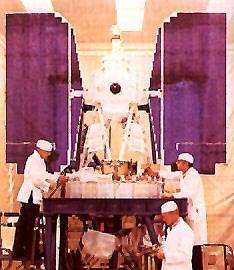
Credit: NASA. 16,995 bytes. 234 x 270 pixels.
| astronautix.com | Landsat 1-2-3 |
|
| Landsat 3 - Credit: NASA. 16,995 bytes. 234 x 270 pixels. |
The first 3 Landsat missions were also known as the Earth Resources Technology Satellite (ERTS) series. Images from Landsat 1 demonstrated the usefulness of remote sensing data for land surveys, land management, water resource planning, agricultural forecasting, forest management, sea ice movement, and cartography. When Landsat 1 was finally removed from service in January 1978 due to tape recorder faults, it had returned over 300000 images. Landsat 2 was removed from service on 2/25/82, and Landsat 3 was removed from service on 3/31/83. Archived images from these missions are available through EOSAT. Spacecraft: The spacecraft design had significant inheritance from the Nimbus program (also manufactured by General Electric).3-axis stabilised using 4 momentum wheels to 0.7 deg accuracy. Twin solar paddles (single-axis articulation) provided 1000 W (BOL peak), 515 W (BOL ave). NiCd batteries. S-Band and VHF communications with 1 W transponder. Hydrazine propulsion system with 3 thrusters. Data downlink rate of 15 Mbps. Payload: Carried Return Beam Vidicon (RBV) and Multi-Spectral Scanner (MSS) imaging sensors. The MSS covers 0.5 to 12.6 � m and provides 75 m resolution at best with a 185 km swath width. The RBV covers 0.5 to 0.75 � m and provides 40 m resolution with a 185 km swath width. Payload mass was about 150 kg.
Design Life: 1 year. Total Length: 3.0 m. Maximum Diameter: 1.5 m. Total Mass: 910 kg.
Earth Resources Technology Satellite. Spacecraft engaged in practical applications and uses of space technology such as weather or communication (US Cat C).
Spacecraft engaged in practical applications and uses of space technology such as weather or communication (US Cat C).
Landsat 1 was finally removed from service in January 1978 due to tape recorder faults. It had returned over 300,000 images.
Spacecraft engaged in practical applications and uses of space technology such as weather or communication (US Cat C).