16,652 bytes. 178 x 461 pixels.
| astronautix.com | Delta 100 |
|
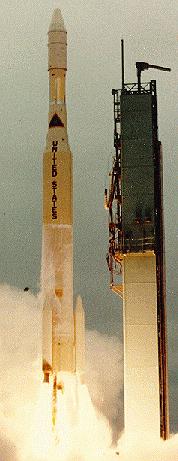
| Delta 0300 no. 96 - Delta 0300 no. 96 - 1973 16,652 bytes. 178 x 461 pixels. |
Launches: 5. Failures: 1. Success Rate: 80.00% pct. First Launch Date: 23 July 1972. Last Launch Date: 06 November 1973. Payload: 635 kg. to a: Geosynchronous transfer trajectory. Liftoff Thrust: 218,290 kgf. Total Mass: 116,573 kg. Core Diameter: 2.4 m. Total Length: 34.0 m. Flyaway Unit Cost $: 25.33 million. in 1985 unit dollars.
Earth Resources Technology Satellite. Spacecraft engaged in practical applications and uses of space technology such as weather or communication (US Cat C).
Spacecraft engaged in practical applications and uses of space technology such as weather or communication (US Cat C).
AMSAT-OSCAR 6 was launched piggyback with ITOS-D (NOAA 2). AO-6 was the first phase 2 satellite (Phase II-A). Weight 16 kg. Box shaped 430 x 300 x 150 mm. Quarter-wave monopole antennas (144 and 435 MHz) and half-wave dipole antenna (29 MHz). Firsts: complex control system using discrete logic; satellite-to-satellite relay communication via AO-7; demonstrated doppler-location of ground station for search and rescue; demonstrated low-cost medical data relay from remote locations. Equipped with solar panels powering NiCd batteries, AO-6 provided 24 V at 3.5 W power to three transponders. It carried a Mode A transponder (100 kHz wide at 1 W) and provided store-and-forward morse and teletype messages (named Codestore) for later transmission. AO-6 lasted 4.5 years until a battery failure ceased operation on June 21, 1977. Subsystems were built in the United States, Australia, and Germany.
Environmental research. Primary experiments included a temperature-humidity infrared radiometer (THIR) for measuring day and night surface and cloudtop temperatures as well as the water vapor content of the upper atmosphere, electrically scanning microwave radiometer (ESMR) for mapping the microwave radiation from the earth's surface and atmosphere, infrared temperature profile radiometer (ITPR) for obtaining vertical profiles of temperature and moisture, Nimbus E microwave spectrometer (NEMS) for determining tropospheric temperature profiles, atmospheric water vapor abundances, and cloud liquid water contents, selective chopper radiometer (SCR) for observing the global temperature structure of the atmosphere, and a surface composition mapping radiometer (SCMR) for measuring the differences in the thermal emission characteristics of the earth's surface.
 | Delta 100 Credit: © Mark Wade. 1,040 bytes. 54 x 301 pixels. |
Improved TIROS Operational System.
Spacecraft engaged in practical applications and uses of space technology such as weather or communication (US Cat C).