This page no longer updated from 31 October 2001. Latest version can be found at www.astronautix.com
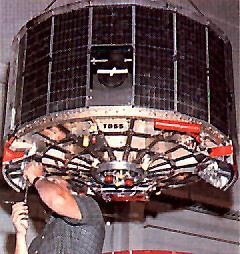 |
| Tiros-OTS - Credit: NASA. 20,208 bytes. 240 x 254 pixels. |
|
Other Designations: Improved TIROS Operational System. Class: Earth. Type: Weather. Nation: United States. Agency: ESSA, NASA, GSFC, NOAA. Manufacturer: RCA. ITOS was the follow-on to the TIROS series of polar-orbiting US weather satellites, and marked the beginning of the use of the NOAA designator. The program was initially managed by the ESSA (Environmental Science Services Administration). NOAA later became the managing organisation. Spacecraft: 3-axis stabilised. Two deployed solar panels. NiCd batteries. Payload: AVCS (Advanced Vidicon Camera System). APT (Automatic Picture Transmission system). FPR (Flat Plate Radiometer). SPM (Solar Proton Monitor). VTPR (Vertical Temperature Profile Radiometer). VHRR (Very High Resolution Radiometer). ITOS-1, ITOS-A, ITOS-B carried AVCS, APT, FPR, SPM. ITOS-D, ITOS-E, ITOS-F, ITOS-G, ITOS-H carried FPR, SPM, VTPR, VHRR.
SpecificationTotal Length: 1.2 m. Maximum Diameter: 1.0 m. Total Mass: 330 kg.
ITOS Chronology
23 January 1970
ITOS 1 Program: Tiros. Launch Site: Vandenberg . Launch Vehicle: Delta N. Mass: 309 kg. Perigee: 1,431 km. Apogee: 1,477 km. Inclination: 101.3 deg. Improved TIROS Operational Satellite. Spacecraft engaged in practical applications and uses of space technology such as weather or communication (US Cat C).
11 December 1970
NOAA 1 Program: Tiros. Launch Site: Vandenberg . Launch Vehicle: Delta N. Mass: 306 kg. Perigee: 1,421 km. Apogee: 1,470 km. Inclination: 101.3 deg. Built for NASA; operated by NOAA. Spacecraft engaged in practical applications and uses of space technology such as weather or communication (US Cat C).
21 October 1971
ITOS B Program: Tiros. Launch Site: Vandenberg . Launch Vehicle: Delta N. FAILURE: Failure. Mass: 308 kg. Perigee: 293 km. Apogee: 1,483 km. Inclination: 102.5 deg. Unusable orbit. Spent boosters, spent maneuvering stages, shrouds and other non-functional objects (US Cat D).
15 October 1972
NOAA 2 Program: Tiros. Launch Site: Vandenberg . Launch Vehicle: Delta 100. Mass: 344 kg. Perigee: 1,446 km. Apogee: 1,453 km. Inclination: 102.0 deg. Spacecraft engaged in practical applications and uses of space technology such as weather or communication (US Cat C).
16 July 1973
ITOS E Program: Tiros. Launch Site: Vandenberg . Launch Vehicle: Delta 100. FAILURE: Second stage failure. Mass: 345 kg. Improved TIROS Operational System.
06 November 1973
NOAA 3 Program: Tiros. Launch Site: Vandenberg . Launch Vehicle: Delta 100. Mass: 345 kg. Perigee: 1,499 km. Apogee: 1,508 km. Inclination: 102.2 deg. Spacecraft engaged in practical applications and uses of space technology such as weather or communication (US Cat C).
15 November 1974
NOAA 4 Program: Tiros. Launch Site: Vandenberg . Launch Vehicle: Delta 2914. Mass: 340 kg. Perigee: 1,442 km. Apogee: 1,457 km. Inclination: 101.9 deg. Spacecraft engaged in practical applications and uses of space technology such as weather or communication (US Cat C).
29 July 1976
NOAA 5 Program: Tiros. Launch Site: Vandenberg . Launch Vehicle: Delta 2914. Mass: 340 kg. Perigee: 1,504 km. Apogee: 1,519 km. Inclination: 102.1 deg. Spacecraft engaged in practical applications and uses of space technology such as weather or communication (US Cat C).
Bibliography:- 126 - Bramscher, Robert G, Spaceflight, "A Survey of Launch Vehicle Failures", 1980, Volume 22, page 351.
Back to Index
Last update 12 March 2001.
Contact Mark Wade with any corrections or comments.
Conditions for use of drawings, pictures, or other materials from this site..
© Mark Wade, 2001 .