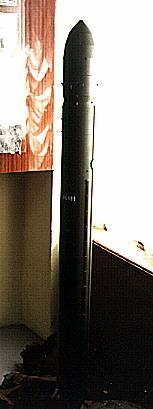
Credit: © Mark Wade. 10,490 bytes. 153 x 409 pixels.
| astronautix.com | Dnepr |
|
| R-36M1 model - Credit: © Mark Wade. 10,490 bytes. 153 x 409 pixels. |
Launch vehicle based on decommissioned 15A18 ICBMs. By the end of 1999, the R-36M2 ICBM had launched 168 times, with four anomalies related to the payloads, and no booster failures.
Launches: 2. Failures: 0. Success Rate: 100.00% pct. First Launch Date: 21 April 1999. Last Launch Date: 26 September 2000. LEO Payload: 4,500 kg. to: 200 km Orbit. at: 46.2 degrees. Payload: 3,200 kg. to a: Space station orbit, 407 km, 50.5 deg inclination trajectory. Liftoff Thrust: 461,000 kgf. Total Mass: 268,300 kg. Core Diameter: 3.0 m. Total Length: 34.3 m. Launch Price $: 20.00 million. in 1999 price dollars.
First launch of Russia's Dnepr launch vehicle, a converted R-36M2 ICBM. The Dnepr was launched from a silo. The third stage maneuvring bus (used on the ICBM for dispensing multiple warheads) placed UoSAT-12 into a 638 km x 652 km x 64.6 deg orbit. The third stage separated from the payload at 05:13 GMT and then made a burn into a 599 km x 1403 km x 64.6 deg orbit. UoSAT-12 was the first test of the Minibus platform, at 325 kg a larger spacecraft than earlier 50 kg Surrey UoSATs. It carried a mobile radio experiment (MERLION), a GPS receiver, and imaging cameras.
Customer: Astonautic Technology (M) SDN. BHD. Malaysia's first microsatellite built through a technology transfer programme with Surrey Satellite Technology Ltd Carried multi-spectral Earth imaging CCD cameras, meteorological Earth imaging CCD camera, digital store and forward communications, cosmic-ray energy deposition experiment (CEDEX)
Research satellite owned and built by MegSat Space Division, part of the Gruppo Meggiorin companies in Brescia, Italy.
Saudisat 1A and 1B were developed by the Saudi Institute for Space Research at KACST (King Abdulaziz City for Science and Technology), Riyadh, and carried amateur store-forward communications payloads.
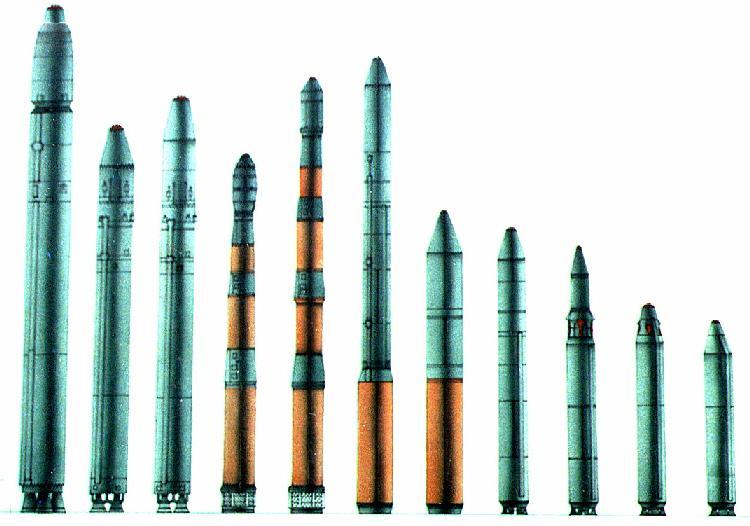 | ICBM-Derived LVs - The range of launch vehicles derived from decommissioned ballistic missiles offered for sale by Russia after the cold war. Credit: Mark Wade. 52,612 bytes. 750 x 526 pixels. |
Experimental satellite developed by the GAUSS (Gruppo di Astrodinamica dell' Universita degli Studi 'la Sapienza') in Roma. Unisat was financed by ASI and MURST (Ministero dell'Universtia e della Ricerca Scientifica e Tecnologica). It carried NiMH batteries, a magnetometer, and a payload consisting of a space debris sensor and a camera.