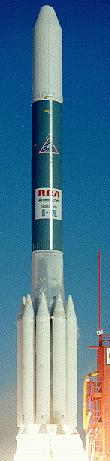
10,357 bytes. 110 x 461 pixels.
| astronautix.com | Delta 3925 |
|
| Delta 3924 no. 167 - Delta 3924 no. 167 - COSPAR 1983-030 10,357 bytes. 110 x 461 pixels. |
Launches: 14. Failures: 0. Success Rate: 100.00% pct. First Launch Date: 16 July 1982. Last Launch Date: 24 March 1989. LEO Payload: 3,451 kg. to: 185 km Orbit. Payload: 1,283 kg. to a: Geosynchronous transfer trajectory. Liftoff Thrust: 310,630 kgf. Total Mass: 192,360 kg. Core Diameter: 2.4 m. Total Length: 36.0 m. Flyaway Unit Cost $: 38.32 million. in 1985 unit dollars.
Spacecraft engaged in practical applications and uses of space technology such as weather or communication (US Cat C).
Telecommunications. Operating entity Telesat Canada. Longitude 104.5W. Anik D-1 Transmit frequencies (MHz): 3720, 3740, 3760, 3780, 3800, 3820, 3840, 3860, 3880, 3900, 3920, 3940, 3960, 3980, 4000, 4020, 4040, 4060, 4080, 4100, 4120, 4140, 4160, 4180. Power 8.9 watts on each frequency.
TV. Spacecraft engaged in practical applications and uses of space technology such as weather or communication (US Cat C).
Spacecraft engaged in practical applications and uses of space technology such as weather or communication (US Cat C).
Spacecraft engaged in practical applications and uses of space technology such as weather or communication (US Cat C).
University of Surrey experimental microsatellite. Built in only 6 months, UoSAT-2 carried the first modern digital store and forward (S&F) communications payload and a prototype CCD camera. Also performed magnetospheric studies. Launch time 1759 GMT. Still operational in 2000.
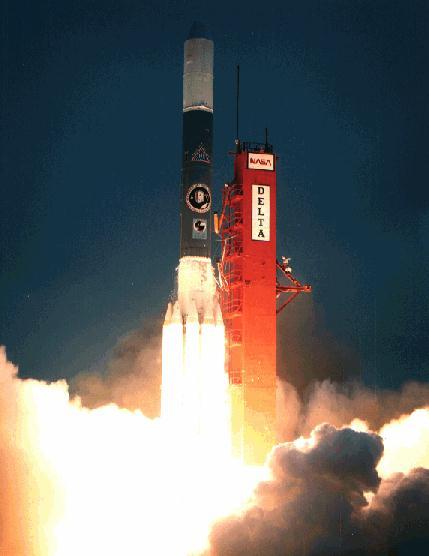 | Delta 3925 Credit: Boeing. 21,265 bytes. 429 x 556 pixels. |
Spacecraft engaged in practical applications and uses of space technology such as weather or communication (US Cat C).
Detected tracer ions released into magnetosphere by IRM. Magnetosphere research satellite. Launch time 1447 GMT. (Document quotes geocentric distances, which have been converted to orbital heights.)
Charge Composition Explorer; detected tracer ions released into magnetosphere by IRM. Spacecraft engaged in research and exploration of the upper atmosphere or outer space (US Cat B).
Released barium, lithium ions into magnetosphere for detection by CCE, UKS. AMPTE-Ion Release Module, reg. no. D-R 002. Scientific research on the Earth's magnetosphere and plasma physics, in particular active experimentation by releasing ion clouds of lithium or barium (total of 7) in and outside the magnetosphere. Creation of a n artificial comet (1 barium cloud inside the magnetosheath). Diagnosis and experimentation in conjunction with the simultaneously launched satellites CCE (United States) and UKS (United Kingdom).
Geostationary at 3.5 deg W. Spacecraft engaged in practical applications and uses of space technology such as weather or communication (US Cat C).
SDIO sensor tests. Spacecraft engaged in practical applications and uses of space technology such as weather or communication (US Cat C).
Stationed at 113 deg W.
Spacecraft engaged in practical applications and uses of space technology such as weather or communication (US Cat C).