Credit: NASA. 13,697 bytes. 263 x 323 pixels.
| astronautix.com | Landsat 4-5 |
|
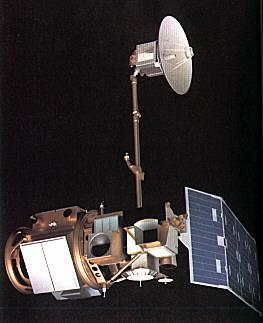
| Landsat 4 - Credit: NASA. 13,697 bytes. 263 x 323 pixels. |
The Landsat 4 and 5 spacecraft were placed into lower orbits than the previous Landsat spacecraft and carried improved instrument suites. Beginning in 1983, Landsat 4 began experiencing numerous spacecraft malfunctions which limited spacecraft functionality. This prompted the early launch of Landsat 5 to guarantee continued coverage. Management of the spacecraft was transferred from NASA to NOAA with Landsat 4. Spacecraft: Structure of aluminum with graphite struts. Hydrazine propulsion system. Single solar array with 1-axis articulation produces 1430 W (BOL), Two NiCd batteries provide 100 AHr total. Retractable boom (4 m long) with 2 powered joints supports the articulated HGA which downlinks data via TDRSS. Communications system uses S, X, L, and Ku-Bands.3-axis stabilised, zero momentum with control to 0.01 deg using reaction wheels. Shortly after launch, Landsat 4 lost use of half its solar power. Landsat 5 lost two of its primary communications systems (X-Band downlink and a Ku-Band TDRSS transponder) and backup systems were activated. Payload: Carried Multi-Spectral Scanner (MSS) and Thematic Mapper (TM) imaging sensors. TM provides 7 bands of coverage and the MSS has 4 bands. The MSS covers 0.5 to 12.6 � m and provides 80 m resolution with a 185 km swath width. TM covers 0.45 to 12.5 � m with resolution of 30 meters in the VIS/IR bands and 120 m in the thermal/IR bands.
Design Life: 5 years . Total Length: 4.3 m. Maximum Diameter: 2.2 m. Total Mass: 1,940 kg.
Spacecraft engaged in practical applications and uses of space technology such as weather or communication (US Cat C).
Spacecraft engaged in practical applications and uses of space technology such as weather or communication (US Cat C).