13,688 bytes. 108 x 439 pixels.
| astronautix.com | Ariane 4 |
|
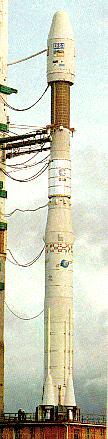
| Ariane 40 V44 - Ariane 40 V44 - COSPAR 1991-050 13,688 bytes. 108 x 439 pixels. |
As Ariane 2/3 with stretched first (61%) and third stages, strengthened structure, new propulsion bay layout, new avionics, Spelda dual-payload carrier. The basic 40 version uses no strap-on motors (see Ariane 42L, 44L, 42P, 44P, 44LP for figures on varous combinations of solid and liquid propellant strap-on motors). A fully fueled Ariane core cannot lift off the ground without strap-on liquid or solid motors. When Ariane 4 is launched in this configuration, the propellant tanks of the first and second stages are not completely filled. Development was authorised in January 1982, with the objective of increasing payload by 90%. Total development cost 476 million 1986 ECU's.
Launches: 7. Failures: 0. Success Rate: 100.00% pct. First Launch Date: 22 January 1990. Last Launch Date: 03 December 1999. LEO Payload: 5,000 kg. to: 200 km Orbit. at: 5.2 degrees. Payload: 2,175 kg. to a: Geosynchronous transfer, 7 deg inclination trajectory. Liftoff Thrust: 276,010 kgf. Total Mass: 240,000 kg. Core Diameter: 3.8 m. Total Length: 58.4 m. Launch Price $: 85.00 million. in 2000 price dollars.
The objective of was an increase in payload of 90%. Total development cost 476 million 1986 ECU's.
Remote sensing. Earth observation satellite. Registration 1990-1-B.
Spacecraft engaged in research and exploration of the upper atmosphere or outer space (US Cat B).
Carried Earth imaging camera. Spacecraft engaged in research and exploration of the upper atmosphere or outer space (US Cat B).
Technology demonstration mission carrying transponder, solar cell, CCD camera technology experiments. Customer: University of Surrey/European Space Agency. Launched alongside UoSAT-3, the microsatellite operated perfectly for 2 days before a failure occured in the downlink. Owner/operator University of Surrey, Dept of Electronic and Electrical Engineering, Guildford, Surrey GU2 5XH. Box shaped 350 x 350 x 650 mm. Four solar panels and 6 m gravity gradient boom.
Carried CCD camera.
University of Surrey experimental satellite. The first of Surrey Satellite Technology Ltd's modular microsatellites. Launched on the Ariane ASAP; carried an operational store and forward communications payload with extensive radiation monitoring experiments for SatelLife and Data Trax Inc (USA). Still operational in 2000. Owner/operator University of Surrey, Dept of Electronic and Electrical Engineering, Guildford, Surrey GU2 5XH.
Microwave, IR imaging of oceans, ice and land; SAR. ERS-1 is an Earth exploration satellite, using active and passive sensors for oceanography etc. Frequency plan: 2048.85/2225 MHz (TTC), 7225.2960/8489 MHz (PRARE), 8040, 8140 MHz (data transmission). Launch time 0146:31 UT. Designator ESA/91/02.
Radioastronomy.
Store and forward communication.
Store and forward communication.
Customer: SateLife. Carried store and forward communications and Earth observation payloads, replacing those lost on UoSAT-4. Still operational in 2000.
Remote sensing.
Laser reflectors.
 | Ariane 4 Credit: © Mark Wade. 2,847 bytes. 82 x 611 pixels. |
Customer: SateLife. Store and forward communications satellite operating in the SatelLife 'HealthNet' LEO satellite communications network for remote regions. Still operational as of 2000.
Healthsat - II joined UoSAT-3/HealthSat-I as the second microsatellite in the HealthNet global communications system of SatelLife, a U.S. not-for-profit organisation. HealthNet, which was licensed in eighteen countries in Africa and Latin America, was providing desperately needed low cost 'last mile' communication links between medical institutions and health programmes in the developing world.
The HealthSat-II mission was completed, from concept to launch, within one year. SSTL were responsible for all the programmatic aspects of the mission including procuring the launch slot on the Ariane ASAP and arranging suitable insurance for the launch and early commissioning phase - all within a total contract price of �1M. Additional Details: Healthsat 2.
ITAMsat was built by AMSAT-ITALY. Its mission was to store and forward amateur radio messages.
KITSAT-OSCAR 25 was a South Korean experimental microsatellite based on the SSTL UoSAT bus built by the Korean Advanced Institute of Science and Technology (KAIST). KO-25 was operated from The Satellite Technology Research Center (SaTReC) in South Korea. KO-25's mission was to take CCD pictures, process numerical information, measure radiation, and receive and forward messages. The Infrared Sensor Experiment (IREX) was designed to acquire I/V characteristics of IR sensors. A passive cooling structure was devised for this experiment. KO-25 was eventually operated purely as a packet store-and-forward satellite.
Portugal's first satellite achieved through a technology transfer programme with Surrey Satellite Technology Ltd. Carried store and forward, DSP communications, GPS and Earth observation payloads. Still operational in 2000. Additional Details: Posat 1.
deg E.uropean Remote Sensing; carried SAR; ocean, land, ice, and atmospheric observations.
Caracterisation de l'Environnement Radioelectrique par un Instrument Spatiale Embarque; examined Earth RF environment. Customer: Alcatel Espace/DME. French government research payload incorporated into an advance microsatellite platform. Still operational as of 2000.
Universidad Politecnia de Madrid Satellite; experimental communications, microgravity experiments.
Developed by Matra Marconi Space/Toulouse for CNES, the satellite provided 10-m resolution images with a wide field of view. SPOT 4 also carried a wide field 'vegetation' imager and a laser communications experiment. Launch was by an Arianespace Ariane 40 rocket, the base Ariane 4 model with no strap-on boosters. The liquid hydrogen fuelled third stage of the Ariane 40 entered an 800 km sun-synchronous orbit together with SPOT 4.
Customer: Alcatel Espace(France). French government military electronic intelligence research payload incorporated into an advance microsatellite platform. Based on CERISE with enhanced EMC subsystem. Still operational as of 2000.
French optical military reconnaisance satellite based on Spot 4.