This page no longer updated from 31 October 2001. Latest version can be found at www.astronautix.com
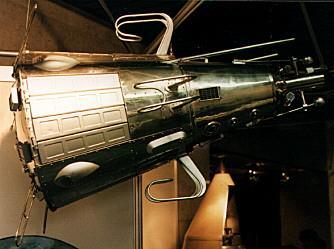 |
| Sputnik 3 - Credit: © Mark Wade. 17,455 bytes. 334 x 249 pixels. |
|
The Era of the Chief Designers
Korolev works for Tass, Chelomei works on crap, Yangel works for us
- Soviet space forces aphorism, ca. 1965.
The Foundations of the Space Age - the theoretical and ideological basis for spaceflight in Russia - were established by Tsiolkovskiy. Between 1883 and 1932 he worked out the basic theoretical concepts of rocketry and space flight. His visions of man leaving the earth and colonising space became a kind of space ideology that inspired and guided Soviet rocket engineers and space scientists. There was no real comparable ideological underpinning in the West.
Tsiolkovskiy's work led groups of enthusiasts to begin work on basic rocket technology. These young engineers - among them Korolev in Moscow, Glushko in Leningrad, and Tikhnoravov - would become the chief designers who led the Soviet Union into space. Many of these talents were caught up in Stalinist purges in 1937-1938 and ended up in work camps in Siberia. Wartime necessity drove Stalin to bring the survivors back into 'sharashkas' - prison engineering design bureaux. Soviet military rocket research during World War II concentrated mainly on Jet-Assisted Take-off (JATO) units for combat aircraft and the RP-318, BI-1, and Malyutka rocket interceptors. Only toward the end of the war was work begun on long range rockets (Tikhonravov MK 4-stage rocket and Korolev's D-1 and D-2).
The huge German technical advances in rocketry during the war rendered this indigenous work obsolete. Stalin was determined to leapfrog the West by assimilating this new technology as quickly as possible. A decree of 13 March 1946 set up a number of research institutes to exploit the technology, and several thousand Germans were brought to Russia for this purpose. Young engineers were named to head the institutes, and more future chief space designers - Keldysh, Isayev, Chelomei, Yangel, Reshetnev - began work on rocket technology. Keldysh pursued one of Stalin's pet projects - the Keldysh Bomber, an intercontinental rocket based on the German Saenger spaceplane design. This work eventually lead to the Buran / M-42 / M-44 and Burya intercontinental cruise missiles, but was a dead end as far as spaceflight was concerned. Similarly, tests were conducted with rocket-powered aircraft (LL, I-270, Samolyot 5, 346) but these did not lead to operational air or spacecraft.
 | Istrebitel Sputnik - I2P ASAT. As far as is known follow-on models (IS-P, IS-MU) and the R-36-launched targets had a similar appearance. Credit: © Mark Wade. 10,593 bytes. 251 x 213 pixels. |
Tikhonravov wrote a seminal paper on 15 March 1950 on the potential uses of artificial satellites. A decree of 26 May 1954 ordered preliminary studies of such systems. The technological basis was the N-3 project, which covered various engine and propulsion approaches. In August 1955 a unit was formed by Korolev to co-ordinate with Tikhonravov development of the first artificial satellite, for launch by the R-7 8K71 ICBM.
In two hours of key discussions in January 1956 the Soviet General Staff were briefed on the future uses of satellites - communications, reconnaissance, navigation, meteorology, geodesy. The fantastic vistas presented resulted in considerable scepticism. Nevertheless the first official plan for future Soviet spaceflight was contained in a decree of 30 January 1956. This set forth the following objectives:
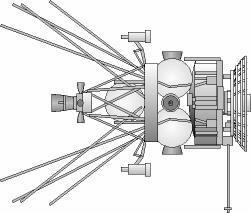
- Orbiting of satellites of 1.8 to 2.5 tonnes mass by 1958. This first artificial earth satellite (ISZ) was intended to be a physics laboratory that would characterise the space environment for design of future spacecraft. In July 1956 Tikhonravov completed the ISZ draft project. The go-ahead to build the spacecraft and the necessary KIK tracking system came in a decree of 3 September 1956. In the event, Tikhonravov's ISZ was not ready in time to beat the Americans into orbit, and small substitute satellites (Sputnik 1 and Sputnik 2) were hurriedly built to make the Soviet Union first in orbit. The ISZ was finally launched in 1958 as Sputnik 3.
 | PKA Isometric - PKA Isometric drawing Credit: © Mark Wade. 11,119 bytes. 371 x 248 pixels. |
- Unmanned reconnaissance satellite by 1970. Following the decree work began on a satellite for military reconnaissance, and throughout the year 1956 the Ministry of Defence issued a series of specifications for satellite manoeuvring, orientation, control, photographic, and ELINT systems. A decree in August 1956 authorised design of a military reconnaissance satellite (code named Zenit).
- One week flight of a manned spacecraft by 1964. In the spring of 1957 Tikhonravov began study of manned spacecraft. By April 1958 the preliminary design was completed, essentially the Vostok 3KA spacecraft that would put the first human being into space. The effort spent on this was at the expense of work underway on the Zenit reconnaissance satellite. After the success of Sputnik, Korolev advocated that manned spaceflight should have first priority. After bitter disputes with the military, a compromise solution was reached. Korolev was authorised to proceed with development of a spacecraft to achieve manned flights at the earliest possible date. However the design would be such that the same spacecraft could be used to fulfil the military's unmanned photo reconnaissance satellite requirement. In November 1958 the Council of Chief designers approved the combined Zenit/Vostok program. The official decree to begin development of the Vostok was issued only on 22 May 1959. This was followed by a decree of 25 May 1959 that authorised development of the Zenit-2 and Zenit-4 reconnaissance satellites based on the Vostok design.
In parallel with the ballistic capsule Vostok approach, the Myasishchev and Tsybin aeronautical design bureaux worked on designs for a manned spaceplane. This work began in 1957 and culminated in competing draft projects for the Tsybin PKA and Myasishchev M-48, VKA Myasishchev 1957, VKA-23 Design 1 and VKA-23 Design 2 in 1957-1960. These were found to be beyond the immediately-available technology and never reached the hardware stage.
- Rocket capable of 12 tonne escape velocity payload by 1970. This was pursued to the draft project stage as the nuclear powered Yakhr-2. Work on this was abandoned in 1959.
- Rocket with 100 tonne low earth orbit payload, capable of placing 2 to 3 men on the moon- no date set. This requirement was to be fulfilled by the nuclear powered Superraket, abandoned in 1959 in favour of the conventional propulsion N1.
A major objective of this period was military control of ballistic missiles and satellites, as well as development of specifications for launch vehicles and spacecraft. For this purpose the military co-operated with scientific institutes. The Fourth Scientific Research Institute of the Ministry of Defence (MO 4-NII) completed the first draft project for the KIK ground control system and use of satellites for military purposes. A combination of modest updates to selected PVO Air Defence sites and ICBM tracking stations made up the KIK network. Raw tracking information was fed into the 'Centre' for orbital calculations.
Sputnik-1's launch on October 4, 1957 caused a tremendous sensation throughout the world and marked the beginning of the space race. The casual plan of 1956 was accelerated, and Korolev was authorised to develop new upper stages for the R-7 that would allow launches of unmanned probes to the moon and planets.
Korolev was not only in competition with the Americans, but other Soviet Chief Designers who wanted a 'piece of the action' in the space race. Korolev's chief rival was Chelomei, a designer of naval cruise missiles. It was apparent that the ballistic missile was superior to the cruise missile as a weapon system at intercontinental ranges and also would allow the exploration and colonisation of space. Chelomei hired Nikita Khrushchev's son on March 8, 1958. This gave Chelomei sudden and immediate access to the highest possible patron in the hierarchy. He was rewarded with his own design bureau, OKB-52, in 1959. In this period Khrushchev was pursuing a major cutback of the military and consolidation of the defence industry. As part of this the Myasishchev and Tsybin aeronautical design bureaux were closed and the staff ended up being included Chelomei's organisation.
 | Kosmoplan - Mars - Kosmoplan - Mars reconnaisance version Credit: © Mark Wade. 7,357 bytes. 321 x 237 pixels. |
Chelomei's cruise missiles were designed for long-term storage in environmentally-controlled capsules. Chelomei saw that this technology could be applied to ballistic missiles and spacecraft as well. A whole family of unmanned spacecraft, dubbed Kosmoplans and Raketoplans, would be built using modular elements. The spacecraft would be launched by Chelomei's equally modular family of UR universal rockets, capable of both ICBM and space launch missions. The UR-200 would be used for launch of smaller earth orbital Kosmoplans, and the UR-500 Proton 8K82 would be used for launch of manned, lunar landing, and interplanetary Kosmoplan / Raketoplan designs.
In 1959, as Chelomei laid out these plans, he knew a tremendous struggle would be required to wrest any part of the space programme from Korolev. Korolev was interested in military projects only so far as they provided financing for his dreams of space exploration. He jealously wished to keep all manned, lunar, and planetary space projects to himself. In a letter to the Central Committee of the Communist Part in January 1960 he proposed an aggressive program for Communist conquest of space. He declared:
 | Vostok 1KP - Vostok 1KP Energia Museum Credit: © Mark Wade. 22,328 bytes. 194 x 398 pixels. |
- That the design bureaux of the Soviet Union must make a broad swift assault on space research
- That a new rocket of 1,000 to 2,000 tonnes gross lift-off mass with a 60 to 80 tonne payload must be developed at the earliest possible date
- That advanced propulsion systems - nuclear, Lox/LH2, low thrust liquid, ion, and plasma engines and correction rockets - be developed as quickly as possible
- That new automatic and radio guidance systems be developed to support these objectives
As payloads for this enormous rocket, Korolev proposed the following spacecraft be developed for launch in the period 1963 to 1965:
- Geostationary communications satellites of 2 to 3 tonnes mass for global communications
- Heavy OS manned space stations (25 to 70 tonnes) with a crew of 3 to 5, orbited at 350 to 400 km altitude. The station would conduct military reconnaissance, control other spacecraft in orbit, and undertake basic space research.
- Heliocentric satellite for solar studies of 1 to 2 tonnes mass
- Spacecraft with 2 to 3 men for flyby of the moon, entry into lunar orbit (L4-1960), and return to earth.
- MK interplanetary spacecraft with 2 to 3 crew on 2 to 3 year flyby missions to Mars and Venus. Automatic probes would be landed on the planets during the flyby manoeuvres.
- Group flight of eight crew aboard four 30 tonne spacecraft on expeditions to land on Mars and Venus. Crew per spacecraft would be 2 to 3.
- Global rockets that could bombard any point on earth with showers of nuclear warheads totalling 40 to 100 tonnes mass at ranges of 3,000 to 12,000 km
- Potential to establish a defensive space infrastructure that would annihilate any enemy satellites or rockets that flew over the territory of the USSR
- Photographic and electronic reconnaissance of every part of the earth
- Precision military navigation
 | Venera 1 Credit: NASA. 20,359 bytes. 320 x 222 pixels. |
For his part, Korolev and the other chief designers would pledge to support this overall effort by the development of draft projects and fundamental research work to validate and mature the necessary technologies. They would place before the Central Committee in the third quarter of 1960 comprehensive plans for development of the new projects. It was requested that that the Central Committee authorise the design bureaux to undertake these draft projects, and that the Ministry of Finance be directed to allow the bureaux to use reserve funds to finance the work.
This letter was followed by a meeting with Khruschchev on the subject on 3 March 1960. Korolev believed it would be truly possible with backing from the very top to have a large rocket in the USSR in a very short span of time. Unfortunately at the meeting Korolev made a slip of the tongue he would always regret, admitting that his plan had not been agreed among all of the Chief Designers. This resulted in Khrushchev throwing the matter back for a consensus plan.
By 30 May 1960 Korolev was back with a plan that now included participation of his rivals, Chelomei and Yangel. The military, however, had not been fully consulted or reached any final conclusions as to its needs. The consolidated plan was as follows:
Launch Vehicles
- R-7 - Four-stage version of R-7- (Korolev) - 300 tonne gross lift-off mass, available from 1960 for robotic lunar and interplanetary flights (this would be the Molniya 8K78 booster). Removal of the fourth stage resulted in the Voskhod 11A57 launch vehicle used for launch of later, heavier Zenit and Vostok spacecraft.
- R-7L - (Korolev) - Develop in 1960 to 1962 a 4 stage version of the R-7, utilising R-9 technology, with a 300 tonne gross lift-off mass and high specific impulse engines in the last stage. Payload 10 tonnes to low earth orbit and 3 tonnes to escape. Draft project to be completed in 1961 (this booster, later called the Molniya 8K78L, was never developed).
- UR-500 - (Chelomei) - Develop a 600 tonne gross lift-off mass rocket using new chemical propellants for sending spacecraft to nearby planets. Draft project to be completed in 1962. (This would become the UR-500 Proton booster)
- N-I - (Korolev) - to be developed in 1960 - 1962. Booster with 40 to 50 tonnes payload to low earth orbit and 10 to 20 tonnes to Mars. Draft project to be completed by second quarter 1961.
- N-II - (Korolev) - to be completed in 1963 - 1967. Booster of 60 to 80 tonne payload to low earth orbit and 20 to 40 tonnes to Mars. Draft project to be completed in 1962.
 | Elektron-B Credit: © Mark Wade. 20,710 bytes. 204 x 294 pixels. |
Manned Spacecraft
- Vostok recoverable spacecraft (Korolev) :
- Photo and electronic reconnaissance versions to be developed in 1960 to 1962 (these would be the Zenit-2 reconnaissance satellites. They would end up flying after, not before, the Vostok manned flights)
- Manned version to be developed in 1961 to 1963 (these flew on schedule)
- Scientific research version to be developed in 1960 to 1962 (these were designed but never flown)
- Maneuverable rendezvous and docking version to be developed in 1961 to 1963 (this was the Vostok-Zh - never flown, replaced by Soyuz)
- KS - (Korolev) - Heavy manned spacecraft, 2-3 crew, to demonstrate rendezvous, docking, and controlled flight. To be developed in 1961 to 1963 (this would become Soyuz A).
- KL - (Korolev) - Manned spacecraft for lunar flyby. To be developed in 1961 to 1964 (this would go through may design iterations and political intrigues - ranging from the L1-1962, L1-1963, to the Soyuz A. However Chelomei would be assigned the project (LK-1), only to have Korolev get it back in 1965 and finally reach flight status as the Soyuz 7K-L1). Korolev also studied lunar automatic crawlers (L2-1963), manned lunar landers (L3-1963), manned lunar orbiters (L3-1963), and manned lunar crawlers (L3-1963). The Lunar L3 lander project was authorized in 1964 and the L2 emerged as the Ye-8 Lunokhod.
- KMV - (Korolev) - Interplanetary manned spacecraft for 2-3 crew, flyby of Mars and Venus. To be developed in 1962 to 1965 (this was the TMK-1. This design would evolve into full-blown Mars landing expeditions during the course of the 1960's ( MPK, TMK-E, Mavr, KK).
 | Vostok spacecraft - Vostok spacecraft view 1 Credit: © Mark Wade. 34,176 bytes. 312 x 458 pixels. |
Scientific and Planetary Spacecraft
- M - (Korolev) - Launch of Mars 1M robot probes in September - October 1960 and 2MV probes in 1962 (these Mars flights were attempted on this schedule). These used the three stage Luna 8K72 version of the R-7 authorised in 1959.
- V - (Korolev) - Launch of Venera 1VA probes in January 1961 and 2MV probes in 1962 (these Venus flights were attempted on this schedule). These used the three stage Luna 8K72 rocket.
- E - (Korolev) - Launch to the moon (as per the decree of 10 December 1959) of Luna E-1 / Luna E-1A impacter probes in 1960 to 1961 and Luna E-3 orbiters in 1961. These used the three stage Luna 8K72 rocket. They were followed by heavier E-6 lunar soft landers launched by the Molniya 8K78 booster.
- K - (Chelomei) - Development of unpiloted Kosmoplans for flight to Mars and Venus with return to earth and landing at conventional airfields. These would use new exotic chemical systems, low thrust nuclear engines (nuclear-plasma, ion, atomic hydrogen). Sub-variants with a total mass of 10 to 12 tonnes and 25 tonnes would be developed in 1965-1966. Draft project to be completed in 1962.
- Elektron - (Korolev) - high apogee radiation belt research Elektron-A and Elektron-B satellites, developed according to decree of 10 December 1959, to be launched in 1960 to 1961 (these flew late to schedule)
Military Spacecraft
- US-A - (Chelomei) - Naval reconnaissance satellite using P6 nuclear reactor. Derivative of the Kosmoplan to be developed in 1962 to 1964 (these flew late to schedule)
- R - (Chelomei) - Manned Raketoplan spacecraft for orbital manoeuvring flight and recovery at conventional airfields. Total mass to be 10 to 12 tonnes, total gliding range during re-entry 2,500 to 3,000 km. Unpiloted version to be developed in 1960 to 1961, followed by piloted version in 1963 to 1965. Satellite interceptor operational version to be tested in 1962 to 1964 (only suborbital subscale tests were conducted on this program before it would be cancelled. One variant became the LK-1 manned circumlunar craft, cancelled in turn before it flew)
- Meteorological satellites - (Korolev) - Meteor R-7 launched satellites to be developed in 1961 to 1963 (these would fly, but behind schedule), to be followed by heavy-rocket satellites in 1963 to 1964 (designer not decided).
- Communications satellites - (Korolev) - R-7 launched satellites to be developed in 1961 to 1963 (these would fly, behind schedule, as the Molniya-1 series), to be followed by heavy rocket satellites in 1962 to 1964 (designer not decided).
- DS - Small satellites / launchers - (Yangel) to be developed in 1961 to 1965, together with the Kosmos-2 andKosmos-3 launch vehicles derived from the R-12 and R-14 ballistic missiles (this program flew on schedule - early flight tests included 1MS / 2MS prototypes from another design bureau).
- OS - (Korolev) - Space stations - the Ministry of Defence was to decide by the fourth quarter of 1960 whether it can utilise military stations with multiple independent rocket-warheads. This design was iterated through many versions - TKS Heavy Space Station, OP, OS-1 (1965), OS-1 (1969) into the MKBS space station during the course of the 1960's. The cancellation of th N1 in 1974 would finally kill further work on large space stations in Russia until later versions of Mir-2 in the mid-1980's.
- IS - Antisatellites - the Ministry of Defence was to decide by July 1960 whether to develop an R-7 launched system for annihilation of enemy reconnaissance satellites (this project was conducted, but given to Chelomei for launch on the UR-200. Eventually flew in the late 1960's, as the I2P ASAT, launched by Yangel Tsyklon 2 rockets)
- Military Communications Satellites - the Ministry of Defence was to decide by the fourth quarter of 1960 whether to proceed with development of military communications satellites (this was done - the Strela-1M and Strela-2 series).
The final government decree 715-296 of 23 June 1960 'On the Production of Various Launch Vehicles, Satellites, Spacecraft for the Military Space Forces in 1960-1967', authorised draft project work to begin on this massive agenda.
Meanwhile the projects authorised in the 1950's were underway, maintaining the Soviet lead in the space race. In January 1960 Star City, the Cosmonaut Training Centre, was founded by the Soviet Air Force and Kamanin was made the head. The first cosmonaut candidates arrived in March 1960. Following unmanned flight tests of Vostok 1KP, Vostok 1K and Vostok 3KA configurations, Yuri Gagarin made the first manned space flight on 12 April 1961. Five further manned Vostok flights maintained the Soviet lead in the space race. In order to keep up with the Americans, Korolev developed and flew a multi-crew version of Vostok (the Voskhod 3KV) and a Vostok with an airlock to accomplish the first spacewalk (the Voskhod 3KD). Further Vostok and Voskhod flights (such as the Voskhod 3KV Tether experiment) were planned but cancelled in order to concentrate on the more capable Soyuz spacecraft.
In parallel with Vostok the more sophisticated Zenit-2 and Zenit-4 photo-reconnaissance variants of the spacecraft reached service. Zenit-2 flights began in December 1961; 13 were flown in two years. The system was accepted into the military service in 1964. Zenit-4, the high resolution version, followed in 1965.
Continued in Soviet Space History - Generation 1.
Back to Index
Last update 12 March 2001.
Contact Mark Wade with any corrections or comments.
Conditions for use of drawings, pictures, or other materials from this site..
© Mark Wade, 2001 .