 |
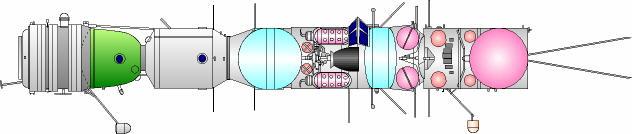
| L1-1963 Cutaway view of 1963 L1 circumlunar spacecraft. 14,806 bytes. 632 x 134 pixels. |
| astronautix.com | Soyuz A |
|
| L1-1963 Cutaway view of 1963 L1 circumlunar spacecraft. 14,806 bytes. 632 x 134 pixels. |
The 7K Soyuz spacecraft was initially designed for rendezvous and docking operations in near earth orbit, leading to piloted circumlunar flight. Soyuz continued the themes of the earlier Sever project. In the definitive December 1962 Soyuz draft project, the Vostok-Zh of the 1962 technical project was gone and Soyuz appeared as a complete two-place spacecraft. The design included two other spacecraft - the Soyuz B 9K rocket acceleration block and Soyuz V 11K tanker. All of these would be launched into orbit by Soyuz 11A511 boosters. A circumlunar mission would begin with launch of the Soyuz B 9K rocket block into a 225 km orbit. This would be followed by one to three Soyuz V 11K tankers (depending on the mission), which would automatically rendezvous and dock with the 9K. They would transfer up to 22 tonnes of propellant. Finally the 7K spacecraft with the cosmonauts aboard would be launched, dock with the 9K, and be propelled on a lunar flyby trajectory.
 | Soyuz A - Original Soyuz A manned spacecraft design as approved in 1963. The Soyuz 7K-LOK that would fly three years later was very similar, except the forward living module was changed from cylindrical to spherical in shape. 20,707 bytes. 475 x 262 pixels. |
The 7K would be equipped with cinema cameras and scientific sensors to record the lunar surface during the flyby, which would be at from 1,000 to 20,000 km from the lunar surface. Total flight time was 7 to 8 days. The SA would separate from the 7K at 120 to 150 km altitude and re-enter the earth�s atmosphere at 11 km/sec. After decelerating to subsonic speed, the SA�s parachute would open at 10-18 km altitude. Total mass of the L1 in low earth orbit was 23,000 kg and the flyby mass of the Soyuz alone was 5,100 kg.
 | Soyuz ABV Complex - Soyuz complex of 1963 as it would appear during tanker operations. From left to right: Soyuz A manned spacecraft; Soyuz B translunar injection stage; Soyuz V tanker spacecraft. 30,089 bytes. 801 x 178 pixels. |
The Soyuz draft project was submitted to the expert commission on 20 March 1963. However only the reconnaisance and interceptor applications of the Soyuz could be understood and supported by the military. Due to the press of other work it was decided that OKB-1 would concentrate only on development of the 7K spacecraft, while development of the 9K and 11K spacecraft would be passed to other design bureaux. The military projects Soyuz-P and Soyuz-R were �subcontracted� to OKB-1 Filial number 3, based in Samara.
 | L1 Complex 1961 - The earliest Sever project tackled such problems as manoeuvring in orbit, rendezvous and docking, use of manipulators to move station modules, and testing of lifting re-entry vehicles. Sever was 50% larger than Soyuz, which replaced it by late 1961 in OKB-1 studies. 7,438 bytes. 433 x 130 pixels. |
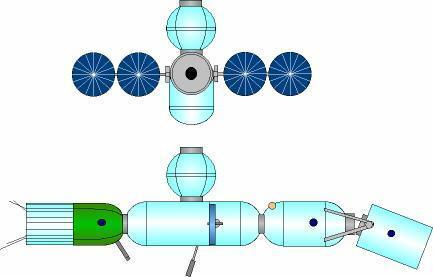 | L1 Complex 1961 - 2 view version. 14,127 bytes. 433 x 277 pixels. |
 | L1 Complex 1962 - The first 1961 draft of the Soyuz project was used a modernisation of the Vostok 3KA series (Vostok-Zh). Three rocket stages would be assembled in low earth orbit using a manned Vostok tug. They would then launch a Soyuz capsule on a lunar flyby and return to earth. 7,968 bytes. 399 x 153 pixels. |
Craft.Crew Size: 3. Design Life: 30 days. Orbital Storage: 30.00 days. Total Length: 7.4 m. Maximum Diameter: 2.5 m. Total Habitable Volume: 9.00 m3. Total Mass: 5,880 kg. Total Propellants: 830 kg. Primary Engine Thrust: 417 kgf. Main Engine Propellants: Nitric Acid/Hydrazine. Main Engine Isp: 282 sec. Total spacecraft delta v: 420 m/s. Electrical System: Batteries.
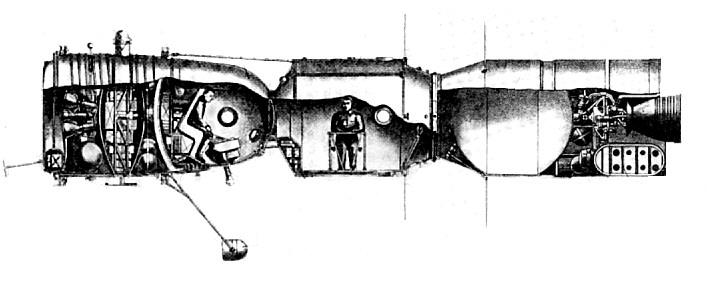 | Soyuz AB Circumlunar - Soyuz complex of 1963 as it would appear before boost into a circumlunar trajectory. 30,183 bytes. 707 x 283 pixels. |
Docking System: Conceptual. Probe: None. Tunnel: Yes. Collar Length (m): 0.64. Probe Length (m): n/a. Base Diameter(m): 2.1. Ring Diameter(m): 1.6. Rendezvous System: Proto-Igla. Antenna: None. Tower: Single Boom. Orbital Module: Cylindrical. Length (m): 2.36. Windows: Four. OM Separation: After retro.
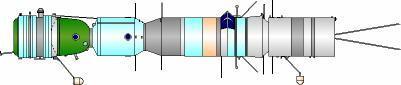 | Soyuz ABV Complex 6,651 bytes. 401 x 85 pixels. |
The Soyuz or Sever designs would utilize body lift to reduce G forces and allo the crew to make re-entries at hyperbolic speeds - when returning from the moon, or Mars. An associated design was a manned orbital tug version of the Vostok capsule to assemble spacecraft in low earth orbit.
The draft project for a versatile manned spacecraft included the Soyuz-A circumlunar spacecraft, the military Soyuz-P fighter and Soyuz-R reconn bird.
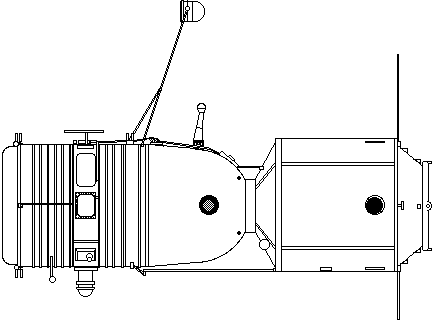 | Soyuz A Credit: © Mark Wade. 4,819 bytes. 433 x 328 pixels. |
Central Committee of the Communist Party and Council of Soviet Ministers Decree 'On approval of work on the Soyuz complex' was issued.
The plan included a series of lunar exploration vehicles: the L1, L2, L3, L4, and L5.
Decree 'On approval of work on the Soyuz 7K-9K-11K circumlunar complex' was issued. This elaborated on the Soyuz design made under the prior decree of 16 April 1962. Initial design work was authorised on the Soyuz 7K earth orbit basic version - capable of automatic rendezvous and docking with other spacecraft; and the 9K and 11K tanker / refuelable rocket blocks to put the 7K in high altitude or circumlunar orbits.
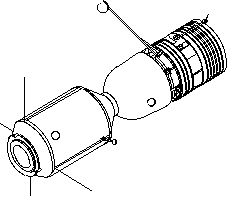 | Soyuz A Credit: © Mark Wade. 2,096 bytes. 233 x 198 pixels. |