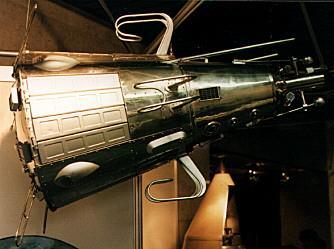
Credit: © Mark Wade. 17,455 bytes. 334 x 249 pixels.
| astronautix.com | Sputnik 3 |
|
| Sputnik 3 - Credit: © Mark Wade. 17,455 bytes. 334 x 249 pixels. |
In July 1956 OKB-1 completed the draft project for the first earth satellite, designated ISZ (Artificial Earth Satellite). The government go-ahead came in a decree of 3 September 1956. The Fourth Scientific Research Institute of the Ministry of Defence had meanwhile completed a draft project for the KIK ground control system. Tikhonravov's 1.4 tonne ISZ satellite was to have been launched by the new R-7 ICBM as the Soviet Union's first satellite, but the R-7 was ready before the satellite, so it was preceded by Sputnik 1 and Sputnik 2. The ISZ was a miniature physics laboratory, but was launched with a known faulty recorder, limiting data to that received when the spacecraft was over Soviet tracking stations. As a result, the Van Allen radiation belts were discovered by the United States rather than Russia.
Total Mass: 1,327 kg.
The Special Committee for the International Polar Year (later designated the International Geophysical Year), was established.
Central Committee of the Communist Party and Council of Soviet Ministers Decree 149882 'On creation of the Object D artificial satellite' was issued.
Tikhonravov's unit of OKB-1 completed the preliminary design of the ISZ satellite (launched as Sputnik 3). The Fourth Scientific Research Institute of the Ministry of Defence had meanwhile completed a draft project for the KIK ground control system. Tikhonravov's 1.4 tonne ISZ satellite was to have been launched by the new R-7 ICBM as the Soviet Union's first satellite, but the R-7 was ready before the satellite, so it was preceded by Sputnik 1 and Sputnik 2. The ISZ was a miniature physics laboratory, but was launched with a known faulty recorder, limiting data to that received when the spacecraft was over Soviet tracking stations. As a result, the Van Allen radiation belts were discovered by the United States rather than Russia.
Decree 1241-632 '0n creation or the Command Measurement Complex' was issued. The decree marked the beginning of development of the KIK satellite tracking system. This network was put together using a combination of PVO (Air Defence) and ICBM tracking systems. Trajectory information was fed into the KIK Centre for orbital calculations. The Centre was staffed by 680 officers and 151 civilian scientists of the Soviet Army in four sections.
Decree 'On approval of the draft project for Object D' was issued. The decree gave the go-ahead for Tikhonravov's 1.4 tonne ISZ physics satellite to be launched by the new R-7 ICBM during the International Geophysical Year . The ISZ, a miniature physics laboratory,.was to have been the first artificial satellite of the earth. In the event, it was preceded by Sputniks 1 and 2.
Variety of scientific data. Research in the upper atmosphere and outer space