 |
| Luna 17 25,520 bytes. 387 x 348 pixels. |
| Encyclopedia Astronautica |
Home | Ye-8 |
|
| Luna 17 25,520 bytes. 387 x 348 pixels. |
The basic Ye-8 was deigned to soft land on the Moon and deliver an automatic, self-propelled lunar vehicle, Lunokhod, for purposes of surveying sites for later manned landings and lunar bases. It was also intended that the spacecraft would provide a radio homing beacon for precision landings of later manned spacecraft. The design had its origins in Korolev�s L2 project of 1963. This evolved within OKB-1 to the globular Ye-8 of 1965 before further development of unmanned planetary spacecraft was passed to the Lavochkin bureau. There the design was refined and modified for a single launch by a Proton launch vehicle. By the time the spacecraft flew, America had won the manned moon race and mission objectives were to collect images of the lunar surface, examine ambient light levels to determine the feasibility of astronomical observations from the Moon, perform laser ranging experiments from Earth, observe solar X-rays, measure local magnetic fields, and study mechanical properties of the lunar surface material.
The lander had dual ramps by which the Lunokhod descended to the lunar surface. The lander and rover together weighed 1814 kg on the lunar surface.
The Lunokhod itself consisted of a tub-like compartment with a large convex lid on eight wheels. It stood 135 cm high, 170 cm long and 160 cm wide, with a mass of 840 kg. The 8 wheels each had an independent suspension, motor and brake. The rover had two speeds, ~1 km/hr and ~2 km/hr. Lunokhod was equipped with four TV cameras, three of them panoramic cameras. The fourth was mounted high on the rover for navigation, and could return high resolution images at different rates (3.2, 5.7, 10.9 or 21.1 seconds per frame). These images were used by a five-man team of controllers on Earth who sent driving commands to the rover in real time. Communications were through a cone-shaped omni-antenna and a highly directional helical antenna. Power was supplied by a solar panel on the inside of a round hinged lid which covered the instrument bay. A Polonium-210 isotopic heat source was used to keep the rover warm during the lunar nights. Scientific instruments included a soil mechanics tester, solar X-ray experiment, an astrophotometer to measure visible and UV light levels, a magnetometer deployed in front of the rover on the end of a 2.5 m boom, a radiometer, a photodetector (Rubin-1) for laser detection experiments, and a French-supplied laser corner-reflector. Lunokhod was designed to operate through three lunar days (three earth months) but greatly exceeded this in operation. References: 5 , 67 , 296 .
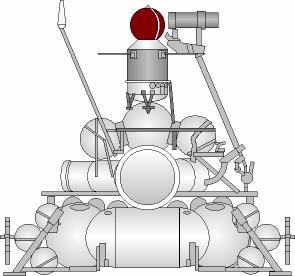 | Ye-8 Lunar Lander - Ye-8 robot lunar soil return spacecraft. 14,897 bytes. 295 x 276 pixels. |
19 February 1969 Launch Site: Baikonur . Launch Vehicle: Proton 8K82K / 11S824 . FAILURE: Inadvertent launch control-activated destruct of booster on pad due to apparent payload command.
Luna 17 was launched from an earth parking orbit towards the Moon and entered lunar orbit on November 15, 1970. Luna 17 landed on Moon 17 November 1970 at 03:47:00 GMT, Latitude 38.28 N, Longitude 325.00 E - Mare Imbrium (Sea of Rains). The payload, the Lunokhod 1 unmanned rover, rolled down a ramp from the landing stage and began exploring the surface. Lunokhod was intended to operate through three lunar days but actually operated for eleven lunar days (earth months). The operations of Lunokhod officially ceased on October 4, 1971, the anniversary of Sputnik 1. By then it had traveled 10,540 m and had transmitted more than 20,000 TV pictures and more than 200 TV panoramas. It had also conducted more than 500 lunar soil tests. Parameters are for lunar orbit. More details
 | Ye-8 lunar probe - Ye-8 lunar sample return spacecraft - detail of drill and reentry vehicle - Credit: © Mark Wade. 25,335 bytes. 313 x 440 pixels. |
The Proton / Block D launcher put the spacecraft into Earth parking orbit followed by translunar injection. On 12 January 1973, Luna 21 braked into a 90 x 100 km orbit about the Moon. On 13 and 14 January, the perilune was lowered to 16 km altitude. On 15 January after 40 orbits, the braking rocket was fired at 16 km altitude, and the craft went into free fall. At an altitude of 750 meters the main thrusters began firing, slowing the fall until a height of 22 meters was reached. At this point the main thrusters shut down and the secondary thrusters ignited, slowing the fall until the lander was 1.5 meters above the surface, where the engine was cut off. Landing occurred at 23:35 GMT in LeMonnier crater at 25.85 degrees N, 30.45 degrees E. The lander carried a bas relief of Lenin and the Soviet coat-of-arms. After landing, Lunokhod 2 took TV images of the surrounding area, then rolled down a ramp to the surface at 01:14 GMT on 16 January and took pictures of the Luna 21 lander and landing site. It stopped and charged batteries until 18 January, took more images of the lander and landing site, and then set out over the Moon. The rover would run during the lunar day, stopping occasionally to recharge its batteries via the solar panels. At night the rover would hibernate until the next sunrise, heated by the radioactive source. Lunokhod 2 operated for about 4 months, covered 37 km of terrain including hilly upland areas and rilles, and sent back 86 panoramic images and over 80,000 TV pictures. Many mechanical tests of the surface, laser ranging measurements, and other experiments were completed during this time. On June 4 it was announced that the program was completed, leading to speculation that the vehicle probably failed in mid-May or could not be revived after the lunar night of May-June. The Lunokhod was not left in a position such that the laser retroreflector could be used, indicating that the failure may have happened suddenly. More details
 | Ye-8 OKB-1 Rover - Ye-8 Lunokhod lunar rover - as designed by Korolev OKB-1 before project was handed over to Lavochkin. 14,886 bytes. 200 x 386 pixels. |