Credit: © Mark Wade. 15,499 bytes. 255 x 364 pixels.
| astronautix.com | Mars |
|
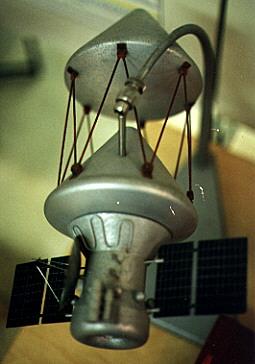
| Mars probe - Mars probe configuration with double reentry vehicles believed planned for the cancelled 1969 or 1975 launch series. Credit: © Mark Wade. 15,499 bytes. 255 x 364 pixels. |
This was the Soviet Union's first attempt at a planetary probe. Mars probe intended to photograph Mars on a flyby trajectory. The possible cause lay in resonance vibrations of upper stages during Stage 2 burning, which led to break of contact in the command potentiometer of the gyrohorizon. As a result a pitch control malfunctioned and the launcher began to veer off the desired ascent profile. On exceeding 7 degrees of veering in pitch, the control system failed. The upper stage with the payload reached an altitude of 120 km before burning up on re-entry into the atmosphere above East Siberia.
Mars probe intended to photograph Mars on a flyby trajectory. This was the Soviet Union's second attempt at a planetary probe. The upper stages and payload broke up on re-entry into the atmosphere.
Mars probe intended to photograph Mars on a flyby trajectory. The spacecraft broke into many pieces, some of which apparently remained in Earth orbit for a few days. This occurred during the Cuban missile crisis and was picked up by U.S. military radar installations, who originally feared it might by the start of a Soviet nuclear attack.
Mars probe intended to photograph Mars on a flyby trajectory. Sixty-one radio transmissions were held in which a large amount of data was collected. On March 21, 1963, when the spacecraft was at a distance of 106 million km communications ceased, possibly due to a malfunction in the spacecraft orientation system. Mars 1 closest approach to Mars occurred on June 19, 1963 at a distance of approximately 193,000 km, after which the spacecraft entered a heliocentric orbit. Announced mission: Prolonged exploration of outer space during flight to the planet Mars; establishment of inter-planetary radio communications; photgraphing of the planet Mars and subsquent radio-transmission to Earth of the photographs of the surface of Mars thus obtained.
Mars probe intended to make a soft landing on Mars. Although the escape stage and payload reached orbit, the strong third stage vibrations shook a fuse loose from its mount in the main nozzle of the escape stage Block L's engine. The engine could not be ignited and remained in Earth orbit. It decayed about two months after insertion.
The stage with payload remained in Earth orbit as Cosmos-51 and burnt up on re-entry.
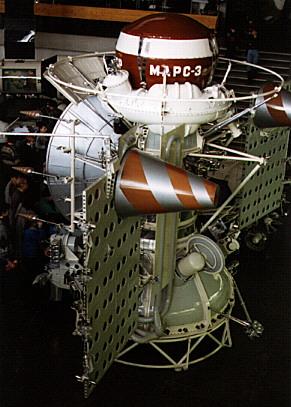 | Mars 3 spacecraft - Mars 3 spacecraft Aeroshell is removed to show lander payload. Credit: © Mark Wade. 27,989 bytes. 291 x 407 pixels. |
Mars probe intended to photograph Mars on a flyby trajectory. Zond 2 was launched from an earth parking orbit towards Mars to test space-borne systems and to carry out scientific investigations. Zond 2 carried six electric rocket engines of plasma type that served as actuators of the attitude control system. The communications system failed during April 1965. The spacecraft flew by Mars on August 6, 1965, at a distance of 1500 km.
Zond 3 was towards the moon and interplanetary space. The spacecraft was equipped with a TV system that provided automatic inflight film processing. On July 20, during lunar flyby, 25 pictures of very good quality were taken of the lunar farside from distances of 11,570 to 9960 km. The photos covered 19,000,000 km square of the lunar surface. Photo transmissions by facsimile were returned to earth from a distance of 2,200,000 km on July 29 and were retransmitted later from a distance of 31,500,000 km, thus proving the ability of the communications system. After the lunar flyby, Zond 3 continued space exploration in a heliocentric orbit. Those pictures showed clearly the heavily cratered nature of the surface. This mission dramatized the advances in space photography that the U.S.S.R. had made since its first far-side effort six years earlier.
Mars probe intended to enter Martian orbit and comprehensively photograph Mars, together with a landing probe.
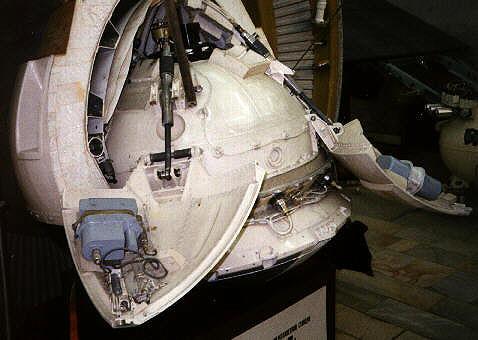 | Mars 2 / 3 lander - Mars 2 / 3 descent vehicle, cross section through heat shield, showing petals deployed. Credit: Andy Salmon. 28,389 bytes. 478 x 340 pixels. |
Mars probe intended to enter Martian orbit and comprehensively photograph Mars. Rocket block failed to reignite in Earth Orbit. It is widely believed this spacecraft was launched with the primary purpose of overtaking Mariner 8, which had been launched (unsuccessfully, as it turned out) two days earlier, and becoming the first Mars orbiter. The Proton booster successfully put the spacecraft into low (174 km x 159 km) Earth parking orbit with an inclination of 51.4 degrees, but the Block D stage 4 failed to function due to a bad ignition timer setting (the timer, which was supposed to start ignition 1.5 hours after orbit was erroneously set for 1.5 years.) The orbit decayed and the spacecraft re-entered Earth's atmosphere 2 days later on 12 May 1971. The mission was designated Cosmos 419.
Soft landed on Mars 11/27/71.
 | Mars 2 / 3 lander - Deployable instrument from Mars-2/3 Credit: Andy Salmon. 25,529 bytes. 436 x 326 pixels. |
Soft landed on Mars 12/2/71.
Mars probe intended to conduct of a series of scientific investigations of the planet Mars and the space around it. Parameters are for Mars orbit. The Mars 3 orbiter also carried a French-built experiment which was not carried on Mars 2. Called Spectrum 1, the instrument measured solar radiation at metric wavelengths in conjunction with Earth-based receivers to study the cause of solar outbursts. The Spectrum 1 antenna was mounted on one of the solar panels. A mid-course correction was made on 8 June. The descent module (COSPAR 1971-049F) was released at 09:14 GMT on 2 December 1971 about 4.5 hours before reaching Mars. Through aerodynamic braking, parachutes, and retro-rockets, the lander achieved a soft landing at 45 S, 158 W and began operations. However, after 20 sec the instruments stopped working for unknown reasons. Meanwhile, the orbiter engine performed a burn to put the spacecraft into a long 11-day period orbit about Mars with an inclination thought to be similar to that of Mars 2 (48.9 degrees). Data was sent back for many months. It was announced that Mars 2 and 3 had completed their missions by 22 August 1972.
 | Fobos Hopper - 'Hopper' surface probe that was to have been deployed on the surface of Phobos on the Fobos-1/2 missions Credit: Andy Salmon. 20,245 bytes. 240 x 406 pixels. |
Mars probe intended to enter Martian orbit and comprehensively photograph Mars. Parameters are for Mars orbit. Mars 5 reached Mars on 12 February 1974 and was inserted into a 1760 km x 32,586 km orbit. Due to computer chip failures the orbiter operated only a few days and returned atmospheric data and images of a small portion of the Martian southern hemisphere.
Mars probe intended to make a soft landing on Mars. Total fueled launch mass of the lander and orbital bus was 3260 kg. It reached Mars on 12 March 1974, separated from the bus, and entered the atmosphere, where a parachute opened, slowing the descent. As the probe descended through the atmosphere it transmitted data for 150 seconds, representing the first data returned from the atmosphere of Mars. Unfortunately, the data were largely unreadable due to a flaw in a computer chip which led to degradation of the system during its journey to Mars. When the retro-rockets fired for landing, contact was lost with the craft. Mars 6 landed at about 24 degrees south, 25 degrees west in the Margaritifer Sinus region of Mars. Bus ended up in a final heliocentric orbit 1.01 x 1.67 AU, 2.2 degree inclination, 567 day period.
Soft landed on Mars 3/12/74.
Mars probe intended to make a soft landing on Mars. Mars 7 reached Mars on 9 March 1974. Due to a problem in the operation of one of the onboard systems (attitude control or retro-rockets) the landing probe separated prematurely and missed the planet by 1,300 km. The early separation was probably due to a computer chip error which resulted in degradation of the systems during the trip to Mars. Ended up in a final heliocentric orbit 1.01 x 1.69 AU, 2.2 degree inclination, 574 day period.
Mars probe intended to make a soft landing on Mars. Solar Orbit (Heliocentric).
Second of two missions to Mars' moon Phobos; carried 2 landers; planned to enter Mars orbit. Phobos 1 operated nominally until an expected communications session on 2 September 1988 failed to occur. The failure of controllers to regain contact with the spacecraft was traced to an error in the software uploaded on 29/30 August which had deactivated the attitude thrusters. This resulted in a loss of lock on the Sun, resulting in the spacecraft orienting the solar arrays away from the Sun, thus depleting the batteries. Left in solar Orbit (Heliocentric).
First of two Mars missions to Mars' moon Phobos; carried two landers; entered Mars orbit 1/29/89; failed 3/27/89; extremely limited science data. Phobos 2 operated nominally throughout its cruise and Mars orbital insertion phases, gathering data on the Sun, interplanetary medium, Mars, and Phobos. Shortly before the final phase of the mission, during which the spacecraft was to approach within 50 m of Phobos' surface and release two landers, one a mobile 'hopper', the other a stationary platform, contact with Phobos 2 was lost. The mission ended when the spacecraft signal failed to be successfully reacquired on 27 March 1989. The cause of the failure was determined to be a malfunction of the on-board computer.
The Mars 96 spacecraft was launched into Earth orbit, but failed to achieve insertion into Mars cruise trajectory and re-entered the Earth's atmosphere at about 00:45 to 01:30 GMT on 17 November 1996 and crashed within a presumed 320 km by 80 km area which includes parts of the Pacific Ocean, Chile, and Bolivia. The Russian Mars 96 mission was designed to send an orbiter, two small autonomous stations, and two surface penetrators to Mars.