
Credit: © Mark Wade. 7,453 bytes. 60 x 469 pixels.
| astronautix.com | Proton 8K82K / 11S824F |
|
| Proton 8K82K/11S824 - Proton 8K82K / 11S824 Block D launch vehicle - cutaway drawing showing arrangement of N2O4 oxidiser tanks (green) and UDMH fuel tanks (orange) in Proton, and Liquid oxygen (blue) and kerosene (pink) tanks in the Block D stage. The Soyuz 7K-L1 spacecraft was mounted directly above the Block D liquid oxygen tank. For the Soyuz circumlunar flights a launch escape tower was fitted that pulled the capsule away in an emergency. Credit: © Mark Wade. 7,453 bytes. 60 x 469 pixels. |
This four stage version of the Proton was a modification of the original Block D / 11S824 for launch of late 1980's Lavochkin OKB probes on missions to Mars. Guidance to the Block D stage must be supplied by spacecraft. Unknown differences with original 11S824.
Launches: 3. Failures: 1. Success Rate: 66.67% pct. First Launch Date: 07 July 1988. Last Launch Date: 16 November 1996. Payload: 6,220 kg. to a: transmartian trajectory. Liftoff Thrust: 902,100 kgf. Total Mass: 710,710 kg. Core Diameter: 4.2 m. Total Length: 57.0 m. Launch Price $: 70.00 million. in 1994 price dollars.
Second of two missions to Mars' moon Phobos; carried 2 landers; planned to enter Mars orbit. Phobos 1 operated nominally until an expected communications session on 2 September 1988 failed to occur. The failure of controllers to regain contact with the spacecraft was traced to an error in the software uploaded on 29/30 August which had deactivated the attitude thrusters. This resulted in a loss of lock on the Sun, resulting in the spacecraft orienting the solar arrays away from the Sun, thus depleting the batteries. Left in solar Orbit (Heliocentric).
First of two Mars missions to Mars' moon Phobos; carried two landers; entered Mars orbit 1/29/89; failed 3/27/89; extremely limited science data. Phobos 2 operated nominally throughout its cruise and Mars orbital insertion phases, gathering data on the Sun, interplanetary medium, Mars, and Phobos. Shortly before the final phase of the mission, during which the spacecraft was to approach within 50 m of Phobos' surface and release two landers, one a mobile 'hopper', the other a stationary platform, contact with Phobos 2 was lost. The mission ended when the spacecraft signal failed to be successfully reacquired on 27 March 1989. The cause of the failure was determined to be a malfunction of the on-board computer.
 | Proton 8K82K / 11S82 - Proton 8K82K / 11S824F with Phobos payload - COSPAR 1988-058 14,397 bytes. 89 x 453 pixels. |
The Mars 96 spacecraft was launched into Earth orbit, but failed to achieve insertion into Mars cruise trajectory and re-entered the Earth's atmosphere at about 00:45 to 01:30 GMT on 17 November 1996 and crashed within a presumed 320 km by 80 km area which includes parts of the Pacific Ocean, Chile, and Bolivia. The Russian Mars 96 mission was designed to send an orbiter, two small autonomous stations, and two surface penetrators to Mars.
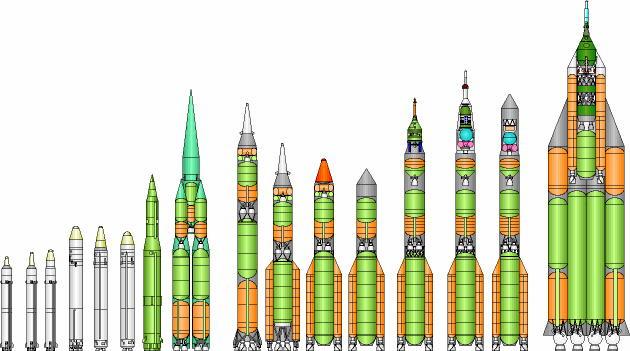 | Universal Rockets - Chelomei's Universal Rocket Family. From left to right: UR-200. Original UR-500 configuration, composed of clustered UR-200's. Conventional UR-500 monoblock configuration. Selected UR-500 polyblock configuration. UR-500 two-stage configuration as flown. UR-500K configuration with Block D upper stage. Credit: © Mark Wade. 36,031 bytes. 630 x 351 pixels. |
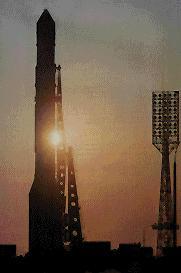 | Proton sunrise Credit: Lockheed Martin. 6,963 bytes. 181 x 273 pixels. |
 | Proton with Granat - Proton with Granat payload Credit: Lockheed Martin. 18,616 bytes. 356 x 446 pixels. |
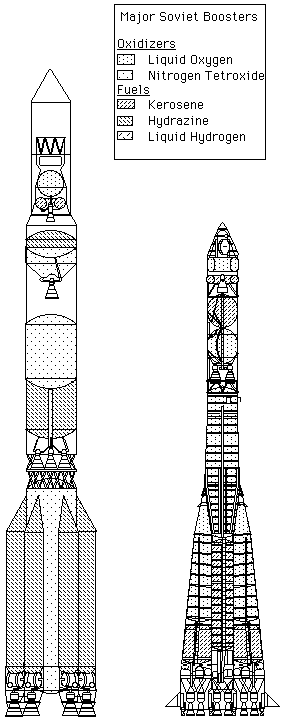 | R-7 vs Proton - R-7 / Proton LVs Cutaway Credit: © Mark Wade. 10,191 bytes. 287 x 720 pixels. |