 |
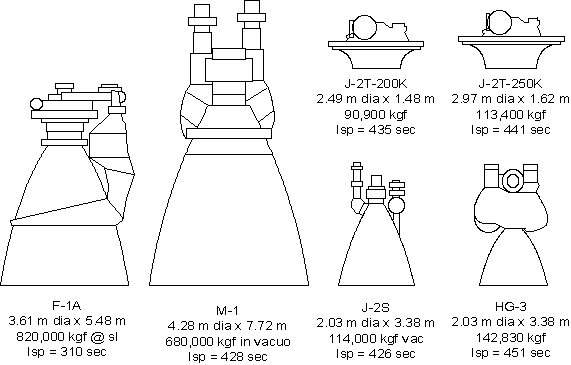
| Advanced Engines Advanced Engines planned for uprated Saturn and Nova boosters Credit: © Mark Wade. 6,664 bytes. 571 x 365 pixels. |
| astronautix.com | M-1 |
|
| Advanced Engines Advanced Engines planned for uprated Saturn and Nova boosters Credit: © Mark Wade. 6,664 bytes. 571 x 365 pixels. |
Aerojet, the perennial loser in NASA large engine competitions, finally felt itself a winner when it received the hotly contested contract to develop the M-l liquid oxygen/hydrogen engine for post-Saturn launch vehicles (Uprated Saturn and Nova). These would be used in the million-pound payload boosters required in the 1970�s to support manned Mars missions and lunar colonies. The $238 million contract for the M-l (NASA/LeRC number NAS 3-2555) was issued on April 30, 1962.
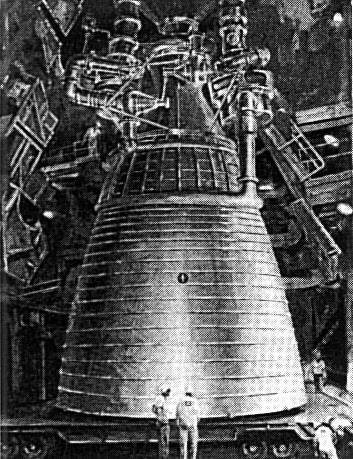 | M1 Engine Credit: NASA. 55,337 bytes. 353 x 459 pixels. |
Dan Price directed this remarkable program, which included Dr. John Moise, Hal Campen, and Ken Unmack in key roles. Unmack remembered, �The M-l size took months to get used to. We couldn't draw anything full-scale. We were just getting used to all this when the program started winding down�.
Work was slowed down by reduced funding levels within a year of the initial award, due to priority of the basic Saturn V for the Apollo moon landing. Within three years NASA�s hopes for a massive post-Apollo program had faded, and the M-1 contract was concluded on August 24, 1965. The last M-1 test was run in August 1966, with cleanup activities extending into 1968. The innovations and technology of the M-1 were helpful to NERVA, and 25 years later, to the STEP shuttle engine improvement programme.
The M-l was a single chamber LOX/LH, unit designed initially for 545,000 kgf vacuum thrust, and later uprated to 680,000 kgf. It used a simple gas generator cycle with separate hydrogen and oxygen turbopump assemblies. The nozzle expansion ratio of 40:1 was appropriate for altitude operations, and its relatively high chamber pressure of 1000 psi contributed to its vacuum specific impulse of 430 sec. Nominal duration was 400 seconds (with total operational qualified life of 3000 seconds), the unit weighed 9,000 kg and measured 8.15 m in height and 5.39m in diameter. A unique feature was that the nozzle exit cone was cooled by the turbine exhaust gases from the 14:1 area ratio point to the exit. The remainder of the nozzle and the thrust chamber were regeneratively cooled with the liquid hydrogen. Total turbopump shaft power was on the order of 100,000 horsepower. Although the M-1 never reached the phase of all-up engine test, it remains the largest hydrogen/oxygen thrust chamber assembly ever tested. Propellant consumption was over 100 tonnes (two tank car loads) per minute. During hydrogen pump testing it was totally impractical to recapture the pumped hydrogen. Therefore it was simply flared. The first test was at night produced what was the world's largest and most startling flare.
The Lox/LH2 LR87 had used impinging stream injectors and single stage pumps. The M-l had coaxial injectors and over ten stages in the fuel pump.
The hydrogen pump was rated at 75,000 horsepower and was operated at more than 90,000 HP during testing.
The M-l was a modular engine, and the development proceeded simultaneously on each module. The most significant hardware built and tested included:
The figures indicated in the specification are for the upper-stage version, which was the contract goal. In first stage applications the engine characteristics would have been:
Vacuum thrust: 544118 kgf / 5335.9 kN
Sea level thrust: 394104 kgf / 3864.8 kN
Mass: 9068 kg
Diameter: 4.28 m
Lenght: 7.72 m
Area ratio: 30
Chamber pressure: 28 atm
Vacuum specific impulse: 428 sec
Sea level specific impulse: 310 sec