
Credit: © Mark Wade. 1,685 bytes. 64 x 441 pixels.
| astronautix.com | Nova 8L |
|
| Nova NASA 8 F-1 - Credit: © Mark Wade. 1,685 bytes. 64 x 441 pixels. |
Most capable Nova studied just prior to selection of Saturn for moon landing. Used a three stage configuration of eight F-1 engines in stage 1, two M-1 engines in stage 2, and one J-2 engine in stage 3. Similar to the Saturn C-8 except in the use of M-1 engines. Unlike other modular Nova designs of the time, this one had the unitary stage construction of Saturn.
LEO Payload: 181,000 kg. to: 160 km Orbit. at: 0.0 degrees. Payload: 68,000 kg. to a: translunar trajectory. Liftoff Thrust: 5,504,850 kgf. Total Mass: 4,752,200 kg. Core Diameter: 17.4 m. Total Length: 128.0 m.
NASA Associate Administrator Robert C. Seamans, Jr., established the Ad Hoc Task Group for a Manned Lunar Landing Study, to be chaired by William A. Fleming of NASA Headquarters. The study was expected to produce the following information:
The engineering sketch drawn by John D. Bird of Langley Research Center on May 3, 1961, indicated the thinking of that period: By launching two Saturn C-2's, the lunar landing mission could be accomplished by using both earth rendezvous and lunar rendezvous at various stages of the mission.
NASA announced that further engineering design work on the Saturn C-2 configuration would be discontinued and that effort instead would be redirected toward clarification of the Saturn C-3 and Nova concepts. Investigations were specifically directed toward determining capabilities of the proposed C-3 configuration in supporting the Apollo mission.
NASA Associate Administrator Robert C. Seamans, Jr., requested Kurt H. Debus, Director of the NASA Launch Operations Directorate, and Maj. Gen. Leighton I. Davis, Commander of the Air Force Missile Test Center, to make a joint analysis of all major factors regarding the launch requirements, methods, and procedures needed in support of an early manned lunar landing. The schedules and early requirements were to be considered in two phases:
At NASA Headquarters, the first meeting was held of the Manned Lunar Landing Coordination Group, attended by NASA Associate Administrator Robert C. Seamans, Jr., Ira H. Abbott, Don R. Ostrander, Charles H. Roadman, William A. Fleming, DeMarquis D. Wyatt (part-time), and George M. Low (in place of Abe Silverstein). This Headquarters Group, appointed by Seamans, was to coordinate problems that jointly affected several NASA Offices, during the interim period while the manned space flight organization was being formed. Members of the steering group included NASA program directors, with participation by Wernher von Braun of Marshall Space Flight Center, Robert R. Gilruth of STG, and Wyatt and Abraham Hyatt of NASA Headquarters, as required. Fleming acted as Secretary of the Group. A list of decisions and actions required to implement an accelerated lunar landing program was drawn up as a tentative agenda for the next meeting:
Phase I of a joint NASA-DOD report on facilities and resources required at launch sites to support the manned lunar landing program was submitted to Associate Administrator Robert C. Seamans, Jr., by Kurt H. Debus, Director, Launch Operations Directorate, and Maj. Gen. Leighton I. Davis, Commander of the Air Force Missile Test Center. The report, requested by Seamans on June 23, was based on the use of Nova- class launch vehicles for the manned lunar landing in a direct ascent mode, with the Saturn C-3 in supporting missions. Eight launch sites were considered: Cape Canaveral (on-shore); Cape Canaveral (off- shore); Mayaguana Island (Atlantic Missile Range downrange); Cumberland Island, Ga.; Brownsville, Tex.; White Sands Missile Range, N. Mex.; Christmas Island, Pacific Ocean; and South Point, Hawaii. On the basis of minimum cost and use of existing national resources, and taking into consideration the stringent time schedule, White Sands Missile Range and Cape Canaveral (on-shore) were favored. White Sands presented serious limitations on launch azimuths because of first-stage impact hazards on populated areas.
James A. Chamberlin and James T. Rose of STG proposed adapting the improved Mercury spacecraft to a 35,000-pound payload, including a 5,000-pound "lunar lander." This payload would be launched by a Saturn C-3 in the lunar orbit rendezvous mode. The proposal was in direct competition with the Apollo proposals that favored direct landing on the moon and involved a 150,000-pound payload launched by a Nova-class vehicle with approximately 12 million pounds of thrust.
After considering Cape Canaveral, Cape Canaveral-Merritt Island, Mayaguana-Bahamas, Cumberland-Georgia, Brownville-Texas, Christmas Island, Hawaii, and White Sands, Merritt Island selected as launch site for manned lunar flights and other missions requiring Saturn and Nova class vehicles. Based upon national space goals announced by the President in May, NASA plans called for acquisition of 80,000 acres north and west of AFMTC, to be administered by the USAF as agent for NASA and as a part of the Atlantic Missile Range. Additional Details: Merritt Island selected for Saturn V launch site..
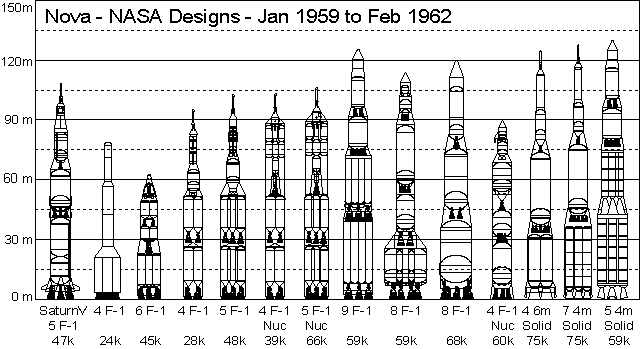 | Nova Concepts - NASA Credit: © Mark Wade. 13,422 bytes. 640 x 349 pixels. |
The MSFC-STG Advanced Program Coordination Board met at STG and discussed the question of the development of an automatic checkout system which would include the entire launch vehicle program from the Saturn C-1 through the Nova. It agreed that the Apollo contractor should be instructed to make the spacecraft electrical subsystems compatible with the Saturn complex.
In further discussion, Paul J. DeFries of Marshall Space Flight Center MSFC presented a list of proposed guidelines for use in studying early manned lunar landing missions:
NASA selected Pearl River site in southwestern Mississippi, 35 miles from Michoud plant in New Orleans, for static test facility for Saturn and Nova-class vehicles, completed facility to operate under direction of Marshall Space Flight Center.
In a memorandum to D. Brainerd Holmes, Director, Office of Manned Space Flight (OMSF), Milton W. Rosen, Director of Launch Vehicles and Propulsion, OMSF, described the organization of a working group to recommend to the Director a large launch vehicle program which would meet the requirements of manned space flight and which would have broad and continuing national utility for other NASA and DOD programs. The group would include members from the NASA Office of Launch Vehicles and Propulsion (Rosen, Chairman, Richard B. Canright, Eldon W. Hall, Elliott Mitchell, Norman Rafel, Melvyn Savage, and Adelbert O. Tischler); from the Marshall Space Flight Center (William A. Mrazek, Hans H. Maus, and James B. Bramlet); and from the NASA Office of Spacecraft and Flight Missions (John H. Disher). (David M. Hammock of MSC was later added to the group.) The principal background material to be used by the group would consist of reports of the Large Launch Vehicle Planning Group (Golovin Committee), the Fleming Committee, the Lundin Committee, the Heaton Committee, and the Debus-Davis Committee. Some of the subjects the group would be considering were:
Rosen Committee studies in November and December indicated that the most flexible choice for Apollo was the Saturn C-4, with two required for the earth orbit rendezvous approach or one for the lunar orbit rendezvous mission, with a smaller landed payload. The panel rejected solid motors again, but Rosen himself still pushed for Nova. An extra F-1 engine was 'slid in' for insurance, resulting in the Saturn C-5 configuration. The Manned Space Flight Management Council decided at its first meeting that the Saturn C-5 launch vehicle would have a first stage configuration of five F-1 engines and a second stage configuration of five J-2 engines. The third stage would be the S-IVB with one J-2 engine. It recommended that the contractor for stage integration of the Saturn C-1 be Chrysler Corporation and that the contractor for stage integration of the Saturn C-5 be The Boeing Company. Contractor work on the Saturn C-5 should proceed immediately to provide a complete design study and a detailed development plan before letting final contracts and assigning large numbers of contractor personnel to Marshall Space Flight Center or Michoud.
The preparation of schedules based on the NASA Fiscal Year 1962 budget (including the proposed supplemental appropriation), the Fiscal Year 1963 budget as submitted to Congress, and Fiscal Year 1964 and subsequent funding was discussed at the Manned Space Flight Management Council meeting. Program assumptions as presented by Wernher von Braun, Director, Marshall Space Flight Center (MSFC), were approved for use in preparation of the schedules :
The Manned Space Flight Management Council decided to delay the awarding of a Nova launch vehicle study contract until July 1 at the earliest to allow time for an in-house study of bids submitted and for further examination of the schedule for a manned lunar landing using the direct ascent technique.
D. Brainerd Holmes, NASA's Director of Manned Space Flight, requested the Directors of Launch Operations Center, Manned Spacecraft Center, and Marshall Space Flight Center (MSFC) to prepare supporting component schedules and cost breakdowns through Fiscal Year 1967 for each of the proposed lunar landing modes: earth orbit rendezvous, lunar orbit rendezvous, and direct ascent. For direct ascent, a Saturn C-8 launch vehicle was planned, using a configuration of eight F-1 engines, eight J-2 engines, and one J-2 engine. MSFC was also requested to submit a proposed schedule and summary of costs for the Nova launch vehicle, using the configuration of eight F-1 engines, two M-1 engines, and one J-2 engine. Each Center was asked to make an evaluation of the schedules as to possibilities of achievement, major problem areas, and recommendations for deviations.
After an extended discussion, the Manned Space Flight Management Council unanimously decided:
Following a long controversy NASA selected Lunar Orbit Rendezvous (LOR) as the fastest, cheapest, and safest mode to accomplish the Apollo mission. LOR solved the engineering problem of how to land. The EOR or Direct Landing approaches required the Apollo crew to be on their backs during the landing and having to use television or mirrors to see the lunar surface. A lunar crasher stage approach had finally emerged as lesser of evils but raised other issues. LOR allowed a purpose-built lander with a logical helicopter-like crew station layout. Studies indicated LOR would allow landing 6-8 months earlier and cost $9.2 billion vs $ 10.6 billion for EOR or direct. Direct flight by this time would not involve Nova, but a scaled-down two-man spacecraft that could be launched by the Saturn C-5. Additional Details: Selection of LOR as Apollo Mission Mode.
The Office of Systems under NASA's Office of Manned Space Flight summarized its conclusions on the selection of a lunar mission mode based on NASA and industry studies conducted in 1961 and 1962: