
Credit: © Mark Wade. 2,910 bytes. 326 x 190 pixels.
| astronautix.com | Soyuz T |
|
| Soyuz T - Credit: © Mark Wade. 2,910 bytes. 326 x 190 pixels. |
Soyuz T had a long gestation, beginning as the Soyuz VI military orbital complex Soyuz in 1967. It finally emerged as a complete redesign of the Soyuz in the late seventies. The Soyuz T introduced a revised Igla rendezvous system and a new service module with unitary translation / attitude control thrusters as part of a single bipropellant system with the main pump-fed engine. Solar panels were reintroduced; the fuel load was increased; and all new digital avionics were developed. Crew safety was improved with a new launch escape system and accomodation was provided for the first time for a three-man crew in spacesuits.
The USSR Defence Ministry issued a requirement for an "Orbital Research Station" (OIS) in March 1967 (reaffirmed in the decree of May 1968). This small station was to operate at an inclination of 51.6 degrees, an altitude of 250-270km, and have a flight duration of 30 days. Kozlov's Kuibyshev Branch of the former OKB-1 delivered a proposal for a Soyuz VI (7K-VI) complex in November 1967. (Not to be confused with the quite different Soyuz VI developed by Kozlov in the 1965-1967 period).
The new Soyuz was called by the OKB the 7K-S, and given the article number 11F732 by the military. The Soyuz-VI (abbreviation for military research) complex would consist of the OIS (with 700 to 1,000 kg of scientific equipment) and the Soyuz 7K-S. The Soyuz would have a crew if two, a probe-drogue docking system and an internal transfer tunnel.
The draft design for the OIS was released on 21 June 1968, followed by that for the 7K-S on 14 October 1968. Drawing release began in 1969. The OIS was cancelled in February 1970 after the start of the Salyut project. The Soyuz 7K-S, however continued in two parallel designs - the base variant, which was for special-purpose solo missions; and a space station transport variant 7K-ST. The revised designs for the 7K-S were completed on 11 August 1972.
The initial Soyuz 7K-S program was to consist of four unmanned, followed by two manned test flights, then two operational launches. Cosmonauts (among them Lyakhov and Voronov ) were assigned to the project in 1973. A State Commission was formed on 21 June 1974 to oversee the flight tests.
 | Soyuz-T interior Credit: © Mark Wade. 28,331 bytes. 340 x 296 pixels. |
After the fourth N1 launch failure, a major reorganization of Soviet space enterprises was undertaken. Mishin was fired as head of the former OKB-1. After Kozlov turned down the job, Glushko was made head of a newly formed NPO Energia, combining OKB-1 and Glushko�s Energomash engine production OKB. The 7K-S was cancelled; experiments planned for the 7K-S solo flights were transferred to the Salyut program.
Development of the launch escape system for 7K-S had run from 1968 to 1972. The new design was used for Soyuz Apollo-Soyuz Test Project version.
At the time the Soyuz 7K-S was cancelled, one of the uncrewed test vehicles was already at Tyuratam being prepared for launch. The first three were launched unmanned as technology tests - Cosmos 670 (7K-S No.1), Cosmos 772 (7K-S No.2), and Cosmos 869 (7K-S No.3).
The Soyuz 7K-ST transport project continued, except now being redesigned for a crew of three. The revised design for the new version was issued in 1975; and the first Soyuz T flew in 1978 as Cosmos 1001. The basic Soyuz T was adapted in the TM version for use with the Mir space station, and it will continue in use into the 21st Century as the Assured Crew Rescue Vehicle for the International Space Station.
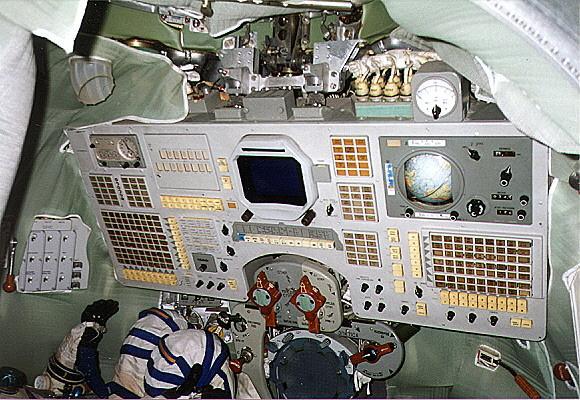 | Soyuz-T interior Credit: © Mark Wade. 70,082 bytes. 580 x 400 pixels. |
Craft.Crew Size: 3. Design Life: 14 days. Orbital Storage: 180.00 days. Total Length: 7.5 m. Maximum Diameter: 2.7 m. Total Habitable Volume: 9.00 m3. Total Mass: 6,850 kg. Total Propellants: 700 kg. Primary Engine Thrust: 400 kgf. Main Engine Propellants: N2O4/UDMH. Main Engine Isp: 305 sec. Total spacecraft delta v: 320 m/s. Electric system: 0.60 total average kW. Electrical System: Solar panels, span 10.60 m, area 10.00 sq. m.
Docking System: Lightweight. Probe: Flange-type. Tunnel: Yes. Collar Length (m): 0.22. Probe Length (m): 0.5. Base Diameter(m): 1.35. Ring Diameter(m): 1.35. Rendezvous System: Igla. Antenna: Lightweight. Tower: Lightweight. Orbital Module: Standard. Length (m): 2.26. Windows: One. OM Separation: Before retro.
 | Soyuz T Credit: © Mark Wade. 6,372 bytes. 501 x 288 pixels. |
The 7K-S was cancelled at the same time as the N1 and the reorganisation of the space industry. Experiments planned for the solo flights were transferred to the Salyut program. The first test vehicle was already at Baikonur being prepared for launch. It was decided to launch the first three unmanned as technology tests - Cosmos 670 (7K-S No.1), Cosmos 772 (7K-S No.2), and Cosmos 869 (7K-S No.3). The Soyuz 7K-ST transport project continued, except now being redesigned for a crew of three. The 7K-ST would eventually fly as the Soyuz T and Soyuz TM ferry to the Salyut 7 and Mir space stations.
 | Soyuz T panel - Soyuz T control panel Credit: © Mark Wade. 77,212 bytes. 577 x 395 pixels. |
Manned precursor. Recovered April 15, 1978 12:02 GMT. Unsuccessful mission. Soyuz T test -failure.
Maneuver Summary:
202 km X 231 km orbit to 195 km X 291 km orbit. Delta V: 19 m/s
195 km X 291 km orbit to 306 km X 322 km orbit. Delta V: 40 m/s
306 km X 322 km orbit to 308 km X 318 km orbit. Delta V: 1 m/s
Total Delta V: 60 m/s.
Officially: Investigation of the upper atmosphere and outer space.
Manned precursor. Recovered April 1, 1979 10:09 GMT. Soyuz T Test.
Maneuver Summary:
197 km X 240 km orbit to 255 km X 297 km orbit. Delta V: 33 m/s
255 km X 297 km orbit to 264 km X 306 km orbit. Delta V: 4 m/s
264 km X 306 km orbit to 309 km X 321 km orbit. Delta V: 17 m/s
309 km X 321 km orbit to 279 km X 357 km orbit. Delta V: 18 m/s
279 km X 357 km orbit to 352 km X 402 km orbit. Delta V: 32 m/s
352 km X 402 km orbit to 363 km X 384 km orbit. Delta V: 8 m/s
Total Delta V: 112 m/s
Officially: Investigation of the upper atmosphere and outer space.
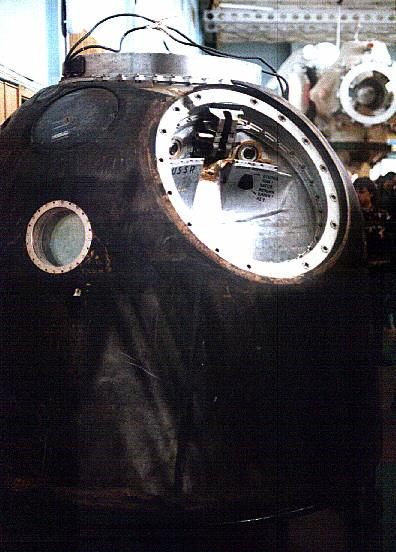 | Soyuz Descent Module Credit: © Mark Wade. 44,057 bytes. 396 x 552 pixels. |
New generation Soyuz capsule; unmanned flight to Salyut 6. Docked with Salyut 6. Recovered March 25, 1980 21:47 GMT. Unmanned test of Soyuz T design.
Officially: Complex experimental testing of new on-board systems and assemblies under various flight conditions and operation in conjunction with the Salyut-6 orbital station.
Test flight of new Soyuz T; docked with Salyut 6. Conducted testing and development of on-board systems in the improved Soyuz T series transport vehicle under piloted conditions. Recovered June 9, 1980 12:40 GMT.
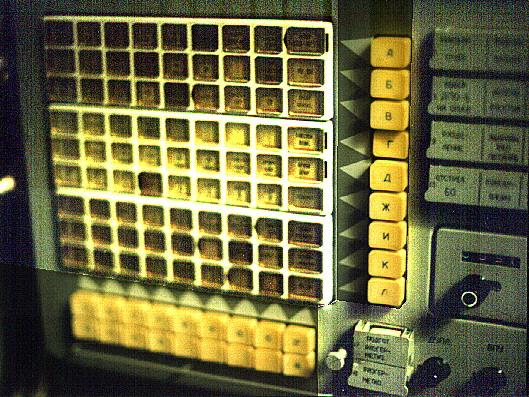 | Soyuz T panel - Soyuz T control panel 1 Credit: © Mark Wade. 67,857 bytes. 529 x 397 pixels. |
Planned but cancelled manned flight. Crew dissolved when Lazarev failed physical in early 1981.
Manned three crew. Docked with Salyut 6. Tested the improved transport ship of the 'SOYUZ T' series; transported to the Salyut-6 orbital station a crew consisting of L D Kizim, O G Makarov and G M Strekalov to carry out repair and preventive work and scientific and technical investigation and experiments. Recovered December 10, 1980 09:26 GMT.
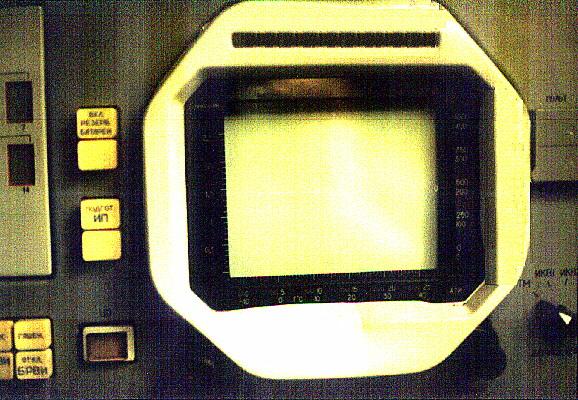 | Soyuz T panel - Soyuz T control panel 2 Credit: © Mark Wade. 62,856 bytes. 578 x 400 pixels. |
Manned two crew. Carried Anatoli Berezovoi, Valentin Lebedev to Salyut 7 to conduct scientific research and experiments; returned crew of Soyuz T-7 to Earth. Docked with Salyut 7. Recovered September 1, 1982 15:04 GMT.
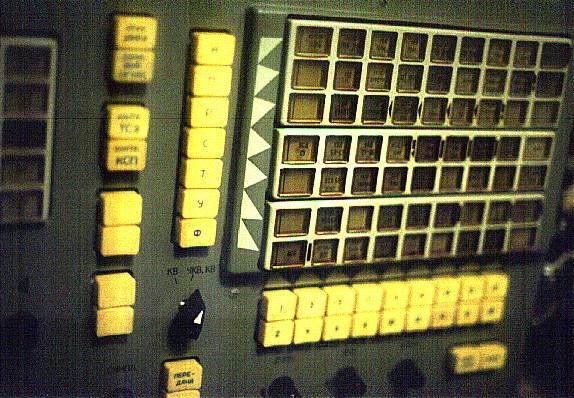 | Soyuz T panel - Soyuz T control panel 3 Credit: © Mark Wade. 64,244 bytes. 574 x 398 pixels. |
Docked with Salyut 7. Carried Svetlana Savitskaya, Leonid Popov, Alexander Serebrov to Salyut 7 to conduct scientific and technical research and experiments; returned crew of Soyuz T-5 to Earth. Recovered December 10, 1982 19:03 GMT. Landed 118 km E Dzhezkazgan.
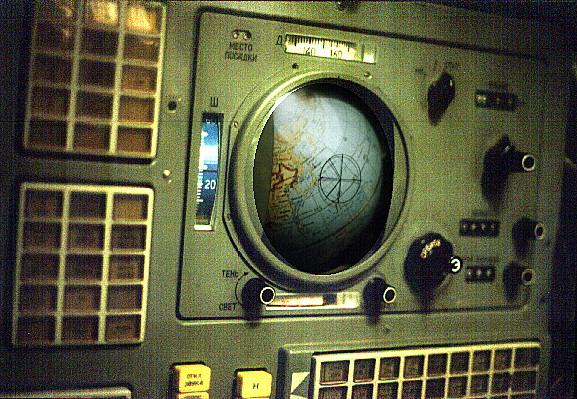 | Soyuz T panel - Soyuz T control panel 4 Credit: © Mark Wade. 67,678 bytes. 577 x 399 pixels. |
Manned two crew. Docked with Salyut 7. Transported to the Salyut-7 orbital station a crew consisting of V A Lyakhov, commander of the spacecraft, and A P Aleksandrov, flight engineer, to conduct scientific and technical research and experiments. Recovered November 23, 1983 19:58 GMT.
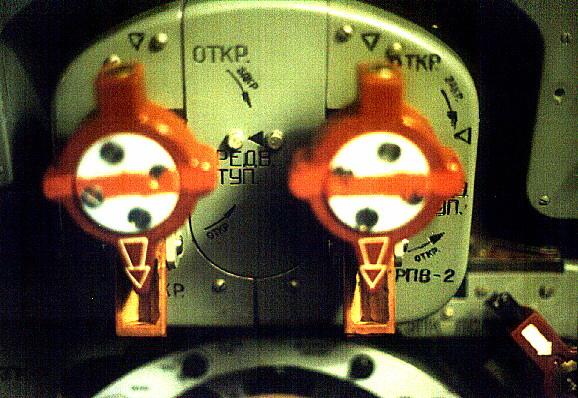 | Soyuz T panel - Soyuz T control panel 5 Credit: © Mark Wade. 53,990 bytes. 578 x 398 pixels. |
Manned three crew. Docked with Salyut 7. Transported a crew consisting of ship's commander L D Kizim, flight engineer V A Solovyov and cosmonaut-research O Y Atkov to the SALYUT-7 orbital station to conduct scientific and technical studies and experiments. Returned crew of Soyuz T-11 to Earth. Recovered April 11, 1984 10:50 GMT. Landed 160 km E Dzehezkazgan.
 | Panel Soyuz TM - Control panel of the Soyuz T/TM later version of the space station ferry vehicle.. Credit: © Mark Wade. 15,023 bytes. 763 x 287 pixels. |
Docked with Salyut 7. Transported a crew comprising ship's commander V A Dzhanibekov, flight engineer S E Savitskaya and cosmonaut-research I P Volk to the Salyut-7 orbital station to conduct scientific and technical studies and experiments. Recovered July 29, 1984 12:55 GMT.
Planned but cancelled manned flight to Salyut 7. Breakdown of Salyut 7 led to cancellation of this flight and its replacement by the Soyuz T-13 repair mission. Savinykh served on the repair mission while Vasyutin and Volkov flew on Soyuz T-14.
Docked with Salyut 7. Delivered to the Salyut-7 orbital station a crew consisting of flight commander V A Dzhanibekov and flight engineer V P Savinykh to carry out emergency repairs to inert Salyut 7 station and to conduct scientific and technical research and experiments. Returned crew of Soyuz T-14 to Earth. Recovered September 26, 1985 9:52 GMT.
Docked with Salyut 7. Transported a crew comprising ship's commander V V Vasyutin, flight engineer G M Grechko and cosmonaut-researcher A A Volkov to the Salyut-7 orbital station to conduct scientific and technical studies and experiments. Grechko returned in Soyuz T-13 on 25 September 1985 - emergency return.
Final expedition to Salyut 7 station was cancelled when control was lost.
Mir Main Expedition EO-01. Epic repair mission. Crew comprising ship's commander L D Kizim and flight engineer V A Solovyov first docked with the Mir orbital station to conduct scientific and technical studies and experiments. Mir then maneuvered 17 April to match Salyut 7 at 4000 km separation, then again on 4 May to catch up. After six weeks aboard Mir, Soyuz T-15 undocked on 5 May, then rendezvoused with the dead Salyut 7 station. Only docking to date by a single spacecraft with two space stations. After manual docking with inoperative Salyut 7, the station was found to be ice bound and without electrical power. Crew repaired the station, regaining power, heat, and environmental control. Removed experimental results left behind by last crew. Undocked Salyut 7 on 25 June, and redocked with Mir on 26 June. Landed 55 km NE Arkalyk. Recovered July 16, 1986 12:34 GMT. No crew ever revisited Salyut 7; it made an uncontrolled reentry over Argentina.
Planned flight to Salyut 7. Breakdown of Salyut 7, exhaustion of stock of Soyuz T spacecraft led to cancellation of mission.
To have docked with Mir. Cancelled all-female flight to be launched on International Woman's Day. Breakdown of Salyut 7, exhaustion of stock of Soyuz T spacecraft, and official resistance led to cancellation of the mission. Officially cancelled due to birth of Savitskaya's baby. No female cosmonauts would be in training again until a decade later.