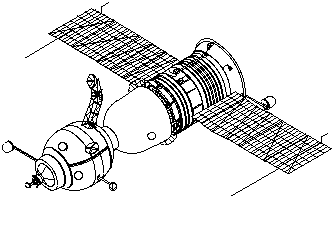
Credit: © Mark Wade. 3,937 bytes. 333 x 229 pixels.
| astronautix.com | Soyuz 7KT-OK |
|
| Soyuz 7K-OKS - Credit: © Mark Wade. 3,937 bytes. 333 x 229 pixels. |
This was a modification of Soyuz 7K-OK with a lightweight docking system and a crew transfer tunnel. This was evidently derived from work done by Kozlov for the Soyuz 7K-TK ferry craft. It flew only twice. The Soyuz 10 mission could not dock with the Salyut 1 station despite several attempts. Soyuz 11 was successful until return to earth. A valve between the descent and orbital modules jarred open when the OM separated. The DM cabin atmosphere vented into space, killing the three man crew, who flew without spacesuits. After this the Soyuz underwent a complete safety redesign to the Soyuz 7K-T configuration.
Craft.Crew Size: 3. Design Life: 10 days. Orbital Storage: 35.00 days. Total Length: 7.9 m. Maximum Diameter: 2.7 m. Total Habitable Volume: 9.00 m3. Total Mass: 6,790 kg. Total Propellants: 500 kg. Primary Engine Thrust: 417 kgf. Main Engine Propellants: Nitric Acid/Hydrazine. Main Engine Isp: 282 sec. Total spacecraft delta v: 210 m/s. Electric system: 0.50 total average kW. Electrical System: Solar panel span: 9.80 m, area: 14.00 sq. m.
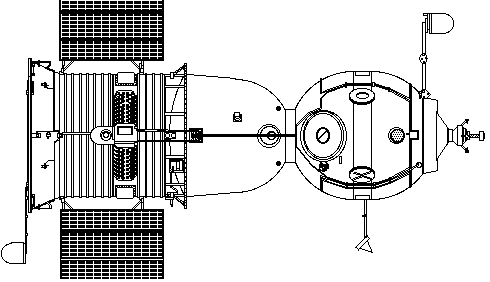 | Soyuz 7K-OKS Credit: © Mark Wade. 6,791 bytes. 490 x 282 pixels. |
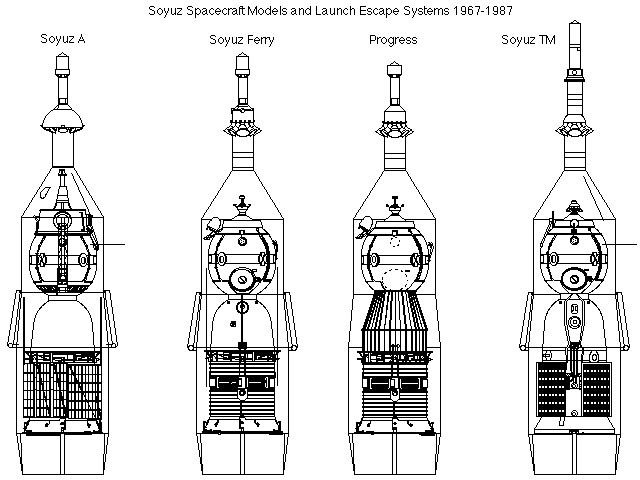 | Soyuz Shrouds - Comparison of payload shroud and launch escape system development over the life of the Soyuz/Salyut/Mir program. Credit: © Mark Wade. 13,942 bytes. 640 x 480 pixels. |
First space station flight, two years before the American Skylab. Soyuz 11 was guided automatically to 100 m, then hand-docked to the Salyut 1 scientific station. Equipment aboard Salyut 1 included a telescope, spectrometer, electrophotometer, and television. The crew checked improved on-board spacecraft systems in different conditions of flight and conducted medico-biological research. The main instrument, a large solar telescope, was inoperative because its cover failed to jettison. A small fire and difficult working conditions led to decision to return crew before planned full duration of 30 days. Capsule recovered June 29, 1971 23:17 GMT, but when the hatch was opened it was found that the crew had perished due to a loss of cabin atmosphere. A pressure equalization valve was jerked loose at the jettison of the Soyuz Orbital Module. The valve was not supposed to open until an altitude of 4 km was reached. The three-man crew did not have space suits. The Soyuz was thereafter redesigned to accomodate only two crew, but in spacesuits. The actual Soyuz 11 Prime Crew was Leonov, Kubasov, and Kolodin. Dobrovolskiy, Volkov, Patsayev were their backups (and support crew to Soyuz 10). Kubasov was grounded by physicians few days before launch, and the back-up crew ended up going instead.
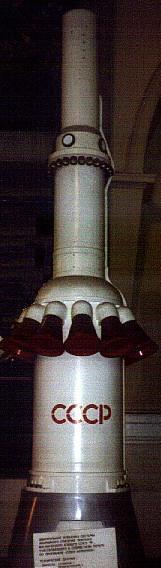 | Soyuz escape rocket - Soyuz launch escape system Credit: © Mark Wade. 17,452 bytes. 161 x 568 pixels. |
If the Soyuz 11 crew had not perished during return to the earth, a second crew would have been sent to the Salyut 1 space station. Further missions to Salyut 1 were cancelled after the disaster.
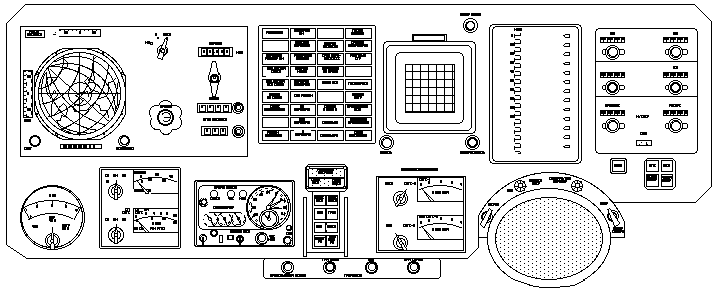 | Panel Soyuz 7K-OK - Control panel of the initial earth orbit version of Soyuz. Credit: © Mark Wade. 11,752 bytes. 723 x 288 pixels. |