| astronautix.com | Yeliseyev |
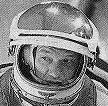
The first manned Soyuz flights were an attempt at an 'all up' manned rendezvous, docking, and crew transfer spectacular (eventually accomplished by Soyuz 4 and Soyuz 5). Komarov was the pilot for the Soyuz 1 active spacecraft, which would be launched first. Soyuz 2, with the crew of Bykovsky, Khrunov, and Yeliseyev would launch the following day, with Khrunov and Yeliseyev space-walking to Soyuz 1 and returning to earth with Komarov. Komarov's spacecraft developed serious problems after launch, including the failure of one of the spacecraft's solar panels to deploy. The Soyuz 2 crew were given the order to rendezvous with Soyuz 1 and to try during the planned EVA to unfold the undeployed solar panel. But the launch of Soyuz 2 was cancelled due to heavy rain at the cosmodrome. Low on power and battery reserves, Komarov made an attempt to land the following day. Parachute failure led to the crash of Soyuz 1 and the death of Komarov. After the disaster the Soyuz 2 spacecraft was checked, and the parachute system had the same technical failure. If Soyuz 2 had launched, the docking may have been successful, but then both spacecraft would have crashed on landing, killing four cosmonauts instead of one.
Commander Volynov shuttled the EVA crew of Yeliseyev and Khrunov into earth orbit. A day later Soyuz 4 docked with Soyuz 5. The Soyuz 4 active spacecraft was equipped with a long docking probe, designated 'Shtir'. The Soyuz 5 target spacecraft was equipped with the 'Konus' receptacle. The symbology lead Volynov to joke that he 'was being raped' when the hard docking was accomplished. Khrunov and Yeliseyev transferred to and returned in Soyuz 4, the feat they had hoped to accomplish in the cancelled Soyuz 2 flight almost two years earlier. Officially the flight conducted scientific, technical and medico-biological research, checking and testing of onboard systems and design elements of space craft, docking of piloted space craft and construction of an experimental space station, transfer of cosmonauts from one craft to another in orbit.
Volynov remained behind to live through the most unbelievable re-entry in the history of spaceflight. The service module of the Soyuz failed to separate after retrofire. Once the Soyuz started reaching the tendrils of the atmosphere, the combined spacecraft sought the most aerodynamically stable position - nose forward, with the heavy descent module with its light metal entry hatch at the front, the less dense service module with its flared base to the back. Luckily the struts between the descent and service modules broke off or burned through before the hatch melted through and the descent module righted itself, with the heat shield to the rear, before being consumed. Due to a failure of the soft-landing rockets the landing was harder than usual and Volynov broke his teeth. Recovered January 18, 1969 07:58 GMT.
Transfer of crew between two docked spacecraft; test of technique needed for Soviet lunar landing.
Tested spacecraft systems and designs, manoeuvring of space craft with respect to each other in orbit, conducted scientific, technical and medico-biological experiments in group flight. Carried Vulkan welding furnace for vacuum welding experiments in depressurized orbital module. Was to have taken spectacular motion pictures of Soyuz 7 - Soyuz 8 docking but failure of rendezvous electronics in all three craft due to new helium pressurization integrity test prior to mission did not permit successful rendezvous and dockings. Recovered October 16, 1969 9:52 GMT.
Tested spacecraft systems and designs, manoeuvring of space craft with respect to each other in orbit, conducted scientific, technical and medico-biological experiments in group flight. Was to have docked with Soyuz 8 and transferred crew while Soyuz 6 took film from nearby. However failure of rendezvous electronics in all three craft due to a new helium pressurization integrity test prior to the mission did not permit successful rendezvous and dockings. Recovered October 17, 1969 9:26 GMT.
Tested spacecraft systems and designs, manoeuvring of space craft with respect to each other in orbit, conducted scientific, technical and medico-biological experiments in group flight. Was to have docked with Soyuz 7 and transferred crew while Soyuz 6 took film from nearby. However failure of rendezvous electronics in all three craft due to a new helium pressurization integrity test prior to the mission did not permit successful rendezvous and dockings. Recovered October 18, 1969 10:19 GMT.
The Kontakt system designed for the lunar orbit rendezvous and docking of the LOK lunar orbiter and LK lunar lander was to be mounted on two Soyuz spacecraft and tested in earth orbit. The first Kontakt crews were established in February 1969. By April 1969, two separate docking missions were to be executed after the triple Soyuz-6/7/8 mission. The first crew of what would have been Soyuz 10/11 and Soyuz 12/13 would have piloted the active spacecraft, simulating the LOK. The second launch would have launched a passive spacecraft, simulating the LK.
Intended first space station mission; soft docked with Salyut 1. Soyuz 10 approached to 180 m from Salyut 1 automatically. It was hand docked after faillure of the automatic system, but hard docking could not be achieved because of the angle of approach. Post-flight analysis indicated that the cosmonauts had no instrument to proivde the angle and range rate data necessary for a successful manual docking. Soyuz 10 was connected to the station for 5 hours and 30 minutes. Despite the lack of hard dock, it is said that the crew were unable to enter the station due to a faulty hatch on their own spacecraft. When Shatalov tried to undock from the Salyut, the jammed hatch impeded the docking mechanism, preventing undocking. After several attempts he was unable to undock and land. During the landing, the Soyuz air supply became toxic, and Rukavishnikov (much like the case of Vance Brand during the Apollo ASTP return) was overcome and became unconscious. Recovered April 25, 1971 23:40 GMT. Landed 120 km NW Karaganda. Film and photos indicated that the docking system on the Salyut was not damaged, setting the stage for the Soyuz 11 mission.