 |
| N1 Late Versions Late versions of N1: from left: N1F; N1M; N1F with Block S, R upper stages; N1F with Block Sr upper stage; Airbreathing N1 for MOK support; Kistler 24,292 bytes. 485 x 366 pixels. |
| astronautix.com | The N1 Story - Part 2 |
|
| N1 Late Versions Late versions of N1: from left: N1F; N1M; N1F with Block S, R upper stages; N1F with Block Sr upper stage; Airbreathing N1 for MOK support; Kistler 24,292 bytes. 485 x 366 pixels. |
Nuclear N-I's - 1961 to 1963
Following abandonment of the nuclear-ammonia ICBM projects, the engine bureaux of Bondaryuk (OKB-670) and Glushko (OKB-456) continued study of nuclear propulsion, but using liquid hydrogen for upper stage applications. Engines of 200 tonnes and 40 tonnes thrust with a specific impulse of 900 to 950 seconds were being considered. At the end of 1961 both bureaux completed their draft projects and it was decided to continue work on development of an engine in the 30 to 40 tonne thrust range. In the following year Korolev was asked to study application of such engines, followed by a demand in May 1963 from the Scientific-Technical Soviet for specific recommendations.
Korolev considered three variants based on the N1:
 | Early model of N1 - Early model of N1 being erected by the Grasshopper carrier. A retouched version of this photo was the first one released to the West. Credit: RKK Energia. 15,672 bytes. 250 x 286 pixels. |
For a Mars expedition, it was calculated that the AF engine would deliver 40% more payload than a chemical stage, and the V would deliver 50% more. But Korolev's study also effectively killed the program by noting that his favoured solution, a nuclear electric ion engine, would deliver 70% more payload than the Lox/LH2 stage.
Further investigation of nuclear thermal stages for the N1 does not seem to have been pursued. Bondaryuk and Glushko turned to Chelomei and his competing UR-700 rocket for future application of such stages.
 | N1 second stage - N1 second stage undergoing dynamic test. This is believed to be the N1M version of the stage, showing the insulation panels to protect the cryogenic propellants. Credit: © Mark Wade. 17,301 bytes. 150 x 217 pixels. |
On 23 September 1963 Korolev submitted his plans for space projects in the period 1965 to 1975. He now saw a clear chance to again appeal to the leadership for a manned lunar landing program. He dusted off his rejected L-1 circumlunar project, but added four new spacecraft that would allow reconnaissance, followed by landing on the moon and extended exploration of its surface.
The first two projects, as before, would use R-7 based launch vehicles and extensive docking and refuelling operations in low earth orbit. But elements of these would be used in the last three, which would map the moon from lunar orbit, land men on its surface, and explore it with a manned crawler.
L-1
This revision to the original L1 project of 1962 had the same objective of sending two men on a circumlunar flyby trajectory. But now the Soyuz had a reverse configuration of that used earlier. From fore to aft, the modules were: the Descent Capsule (SA), Living Module (BO); Equipment Module (AO); Propulsion Module (AO); Rendezvous electronics module (NO) and Docking Unit (SU). This configuration would be important in the later N1-based projects. As before, the system consisted of the 7K manned spacecraft, the 9K rocket spacecraft, and the 11K tanker. A total of six launches of the 11A511 Soyuz booster would be required. The 9K rocket stage would be put in orbit first. It would be followed by four 11K tankers which would top off the tanks of the rocket block. Then, when all was ready, the 7K manned craft would be put into orbit and dock with the 9K stage. The stage would fire and put the manned spacecraft on a translunar trajectory.
 | N1 Early Design - Early design of N1 with aerospike first stage Credit: Gleb Aleksushin. 14,336 bytes. 124 x 689 pixels. |
L-2
The L2 was a project to land a remote-controlled self-propelled rover on the surface of the moon. It would use the same rocket stage and tanker elements developed for the L1 manned circumlunar project. It can be seen to be the direct ancestor of the Ye-8 Lunokhod lunar rovers of the 1970�s.
The objective of the L-2 would be to conduct scientific research on the lunar surface and to allow selection of a favourable landing point for later manned flights. A television system would send back panoramic television pictures. The rover would be nuclear-powered and equipped with a radio beacon for later manned expeditions to home on for precision landings. It would also investigate:
 | N-IM 1965 - N-IM version of 1965 11,880 bytes. 252 x 401 pixels. |
The L-2 system consisted of:
 | N-IF - 1965 - N-IF - 1965 design 5,408 bytes. 78 x 386 pixels. |
Total mass of the L-2 + 13K + 9K complex at ignition of the 9K for translunar injection was 23,000 kg. Total mass of the L-2 and 13K in their translunar cruise configuration was 5,000 kg. As was the case for the L-1, six launches of the Soyuz 11A511 booster would be required to assemble the L-2 in a 225 km low earth assembly orbit.
L-3
Korolev�s first version of the L-3 manned spacecraft was designed to make a direct lunar landing using the earth orbit rendezvous method. It was a 200 tonne spacecraft requiring three N1 launches and a single Soyuz 11A5ll launch to assemble in low earth orbit. The first N1 launch would place the 75 tonne partially-fuelled TLI stage and L3 spacecraft (except the L1 manned return craft) into low earth orbit. Two further N1 launches would orbit 75 tonne tankers which would rendezvous and dock with the first payload and top off its propellant tanks. Then the Soyuz would be launched for an automated rear-end docking with the entire L3 stack. The L3 spacecraft thereby assembled consisted of:
 | N-IF Variants - N-IF Versions, from left: N1-L3; N-IF; N-IUV-III; N-IFV-III; N-IFV-III,II 18,908 bytes. 344 x 402 pixels. |
 | N-IUV-III 5,217 bytes. 77 x 406 pixels. |
L-4
The L-4 Manned Lunar Orbiter Research Spacecraft would have taken two to three cosmonauts into lunar orbit for an extended survey and mapping mission. The L-4 complex, with a total mass of 75 tonnes, would be placed into orbit in a single N1 launch, and would consist of:
 | N-IMV-III 3,720 bytes. 59 x 402 pixels. |
The L-5 Heavy Lunar Self-Propelled Craft would be used for extended manned reconnaissance of the lunar surface. With a maximum speed of 20 km/hour, it would provide living accommodation for three cosmonauts and 3,500 kg of provisions. The crews themselves would be landed on the moon using the L-3 complex.
 | N-IFV-II, III - N-IFV-II, III of 1965 4,160 bytes. 61 x 402 pixels. |
At the beginning of 1964, despite hard work in the previous year, it was apparent that there were still one to two years of development and construction to go and the target dates set in the decree would not be met.
On 24 March 1964 Korolev managed another meeting with Khrushchev, where he again advocated an aggressive plan of lunar and interplanetary exploration. He dusted off his old L3 lunar landing scheme. Two variants of the L3 would be developed: the basic version would use Lox and Kerosene in Rocket Blocks G and D, with N2O4/UDMH in Block E. A later version would use Lox/LH2 in all of these upper stages. This would add 4 tonnes to the lunar surface payload. Korolev promised to have an L3 draft proposal completed in 1964 and the spacecraft in service by 1966. Development of the Lox/LH2 engines would take place from 1964 to 1967. He even pressed development of the TMK / TMK-E interplanetary manned spacecraft, using the newest designs from his bureau with nuclear electric engines. Khrushchev expressed some interest now in the lunar landing scheme, in the face of the American's evident determination to press on with project Apollo.
 | N1FV-III - N-IFV-III design of 1965 4,834 bytes. 73 x 401 pixels. |
It is not clear if this letter was sent; and if so, it certainly hurt Korolev with Brezhnev when he would ascend to power in a year's time. But he had convinced Khrushchev of the necessity for a high priority lunar landing project to beat the Americans.
 | N-IMV-II,III 3,372 bytes. 51 x 402 pixels. |
On 3 August 1964 Command number 655-268 issued by Central Committee of Communist Party for the first time set the objective for OKB-1 to put one man on the moon and return him safely to earth - ahead of the Americans (who had begun over three years earlier, in April 1961). To achieve this aim a large part of the industry had to be mobilised (though not the competing and dissenting Glushko, Yangel and Chelomei enterprises). This would require design of what was designated the L3 complex, with the combined launch vehicle/spacecraft termed the N1-L3. The L3 would utilise the same lunar orbit rendezvous method to achieve moon landing as was selected for the Apollo program. By upgrading the N1 from a 75 tonne to a 95 tonne payload capacity it was felt possible that a single N1 launch could accomplish the mission. The L3 complex itself, with a total mass of 95 tonnes, would consist of a fourth stage (Block G) for the N1 to take the L3 from low earth orbit to trans-lunar trajectory; a lunar orbiter with a Soyuz re-entry capsule for return to earth (LOK); a lunar lander (LK) for the landing of a single cosmonaut on the surface of the moon; and a deceleration stage (Block D) which would brake the L3 complex into lunar orbit and then take the LK lander to near zero velocity above the surface of the moon.
 | N1 6L liftoff Credit: RKK Energia. 12,810 bytes. 310 x 240 pixels. |
In what was only to be the first stage of a sustained campaign, single cosmonauts would land on the lunar surface. However this would be just part of a larger mission with the following objectives:
 | Cutaway of N1 Credit: RKK Energia. 5,227 bytes. 67 x 240 pixels. |
 | N1 Cutaway Credit: © Mark Wade. 5,579 bytes. 177 x 799 pixels. |
 | 2 N1s Mounted on Pad Credit: RKK Energia. 22,643 bytes. 337 x 239 pixels. |
 | N1 5L Explosion - Final explosion of N1 5L, destroying pad. Credit: RKK Energia. 15,200 bytes. 310 x 238 pixels. |
The original N1 with its payload of 75 tonnes to a 300 km, 65 degree inclination orbit would require two to three launches to assemble a lunar landing expedition in earth orbit. One result of the draft project was the decision to increase the N1 payload to 95 tonnes to allow the L3 to be launched toward the moon in one launch. The following measures would increase the N1 payload to 91.5 tonnes:
 | N1 5L Falls Back - Having just cleared the towr, N1 5L falls back onto the pad at a 45 degree agnle. Credit: RKK Energia. 9,379 bytes. 311 x 240 pixels. |
The 3 August 1964 decree foresaw completion of manufacture of the N1-L3 to the following schedule: 4 in 1966; 6 in 1967; and 6 in 1968. By September 1964 construction began of the first N1 launch pad (LC110R). Then on October 13, while Voskhod 1 was in orbit, Khrushchev was removed from power and Brezhnev's faction assumed control of Politburo. This immediately led to a shift of political forces. Chelomei lost his main patron and Korolev immediately again attempted to gain control of the L1 manned circumlunar project. Many of Chelomei's pet projects, such as the R Raketoplan, the K Kosmoplans, and their UR-200 booster, were cancelled.
Meanwhile the advance design project for the N1-L3 was completed in collaboration with Kuznetsov's OKB-586 on 30 December 1964. The decree for production of 16 shipsets of spacecraft and boosters was issued on 26 January 1965. After several skirmishes during the year, on 25 October 1965 the Chelomei circumlunar project was given to Korolev and Chelomei's LK-1 manned capsule was cancelled. The new scenario would use a stripped version of Korolev's Soyuz atop Chelomei's UR-500 Proton launch vehicle. While a victory for Korolev, it was an added project at a time that the N1-L3 was in serious technical and schedule problems. Korolev had begun to admit to his colleagues that the moon landing could not come until 1969 at the earliest. He also noted that while development of the Soyuz was proceeding on schedule, Chelomei�s LK-1 was badly lagging behind (although the Proton booster was on schedule).
 | N1 5L clears tower - N1 5L Clears the tower but falters as the KORD system incorrectly shuts down engines. Credit: RKK Energia. 10,577 bytes. 306 x 238 pixels. |
Advanced Versions of the N1 - 1965
After completing production drawing release, Korolev's design teams could consider future improved variants of the N1. On November 9, 1965 a four volume study was issued covering these variants. These were:
 | N1 5L liftoff - Engine ignition of N1 5L. Credit: RKK Energia. 13,195 bytes. 311 x 239 pixels. |
 | N1 7L liftoff - N1 7L rises over the apartment blocks of the workers that built it Credit: RKK Energia. 18,831 bytes. 306 x 240 pixels. |
 | N1 subassemblies - N1 tank sections were built in Samara, then shipped to Baikonur for assembly of the launch vehicle. Credit: RKK Energia. 15,820 bytes. 307 x 240 pixels. |
The Death of Korolev - the Race to the Moon - Advanced Upper Stages - 1966 to 1969
On January 14, 1966 Korolev died in Moscow during colon surgery. He had kept his illness a secret from his colleagues and his death at 56 came as a surprise to many. This is often cited as a blow from which the project never recovered. His successor, Mishin, did not have the forceful personality and political connections of the original Chief Designer. Korolev also had a legendary ability to motivate his staff and cajole co-operative design bureaux to prioritise work for OKB-1 that Mishin was never able to duplicate.
The project continued. In February 1966 construction started of the second N1 launch pad (LC 110L). By November the first N1 hardware arrived at Baikonur and construction of the 1M1 full-size mock-up of the launch vehicle began. On 16 November 1966 another Keldysh-headed expert commission considered the state of the programme. With Korolev dead, once again Glushko, Chelomei, and Yangel advocated development of the UR-700 or R-56 in lieu of the N1. While it was agreed that engine development and studies of these launch vehicles could continue, the government decree issued approved Mishin's draft plan for the first lunar landing. The first N1 launch was now to be in March 1968 (two years late to the very optimistic schedule set when the project was first full approved).
 | N1 stages - N1 stages in teh assembly hall Credit: RKK Energia. 24,949 bytes. 332 x 240 pixels. |
In February assembly of the first N1 began at the Progress plant in Samara. On March 10 1967 Cosmos 146 was launched in the first test of hardware (the Block D stage and L1 lunar spacecraft) to be used in the L1 and L3 projects. The boilerplate Soyuz 7K-L1 was launched by a Proton into the planned highly elliptical earth orbit. The Block D stage functioned correctly in its first test, putting the spacecraft into a translunar trajectory. The spacecraft was not aimed at the moon and no recovery was planned or attempted. This successful launch created a false confidence just before the string of failures that would follow. On April 8 Cosmos 154 reached earth orbit but the Block D translunar injection stage failed to fire (ullage rockets, which had to fire to settle propellants in tanks before main engine fired, were jettisoned prematurely). The spacecraft burned up two days later when its orbit decayed.
 | N1 tank assembly - Subassmeblies from Samara were built up into stage bulkheads on assembly jigs at Baikonur. Credit: RKK Energia. 16,696 bytes. 310 x 240 pixels. |
By the end of summer the first N1 launch pad (LC110R) was completed. In addition to the sixteen flight vehicles, two N1 mock-ups were being built to support pad compatibility tests. Assembly of the first 1M1 mock-up was nearing completion at the MIK assembly building at Baikonur. In September 1967 the EU-28and EU-29 test models of the second and third stages began hot firing tests on their test stands at Samara. On 25 November 1967 the 1M1 mock-up was first erected on LC-110R. After tests of electrical and hydraulic interfaces on the pad it was returned to the assembly building on 12 December.
A decree in November had recognised yet further slips in the schedule, with a first flight test of the vehicle not expected until the third quarter 1968. By March 1968 it was recognised that no Soviet manned lunar landing would take place until 1970. On May 7, 1968, eight months behind the 1966 schedule, N1 booster 4L was erected at launch complex 110R. Under its shroud was the 7K-L1S spacecraft. This modification of the 7K-L1 circumlunar Soyuz incorporated the Isayev forward propulsion module that would be used on the LOK and LK. A mass model representative of the LK lander was also included. These early test N1�s were limited to a lift-off mass of 2,735 tonnes and had an earth orbit payload of 70 tonnes. Even so it has taken 165 train wagon-loads of material to construct the vehicle, as against the 43 estimated in the 1962 draft project.
 | N1 boattail assembly - Base of N1 first stage in assembly jig Credit: RKK Energia. 23,032 bytes. 310 x 240 pixels. |
Returned to the MIK, the flight payload taken from 4L, the 7K-L1S, was integrated with the 1M1. The 1M1-L1S was moved back to the pad in November to conduct tests of the payload. It was joined by 3L, erected on launch pad without its payload (which was on the 1M1 mock-up). This was the first, but not the last, dual N1 roll-out. 3L was put through a series of engine system tests. In January 3L was returned to the MIK and the L1S payload was integrated to the launch vehicle. Also under the L3 payload shroud was an LZS functional test model of the LK.
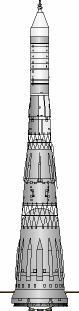 | N1F - Sr - N1F with Sr Lox/LH2 upper stage 5,291 bytes. 79 x 311 pixels. |
 | N1M 1974 - N1M of 1974 3,951 bytes. 60 x 310 pixels. |
Against this failure, the Apollo program was achieving success after success in bimonthly missions. While beating the Americans to a moon landing was now clearly impossible, a dual unmanned mission was devised, which, if successful, would have stolen a little of the American�s thunder. The plan was for the next N1 to launch an unmanned 7K-L1S spacecraft on a loop around the moon. It would take multi-spectral photographs of the lunar surface and far side. Meanwhile, a Proton rocket would launch an unmanned Ye-8 soil return spacecraft. This would soft land on the moon, deploy a core drill which would take a small sample of lunar regolith. Deposited in a small spherical re-entry capsule, this then would automatically be returned to earth.
 | N1M cutaway Credit: © Mark Wade. 2,087 bytes. 75 x 386 pixels. |
 | N1M - Sr 4,721 bytes. 79 x 304 pixels. |
With the moon race lost, the rationale for further development of the limited 7K-LOK and LK spacecraft for a dash to the moon disappeared. The LK would be test flown in the coming years, but the LOK never was. Mishin instead looked towards using the N1 to establish a moon base (LEK - Lunar Expeditionary Complex).
Redesign and New Missions - 1969 to 1974
The three-year job of rebuilding Pad 110R began on August 3, 1969. By September 24 an N1 was erected on launch pad 110L to test the launch pad interfaces. This all-white launch vehicle, with no payload, was either the N1 mock-up 1M1 or flight vehicle 6L. This was the first use of the all-white paint job - the previous grey and white scheme had resulted in summer temperatures of up to 60 degrees Centigrade in the intertank compartments.
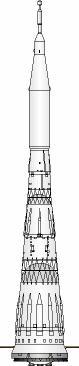 | N1F - 1974 - N1F - 1974 Configuration (N1 s/n 8L) 5,494 bytes. 79 x 366 pixels. |
Against these failures, development was already underway to develop more powerful versions of the N1 to launch heavier payloads to the moon. The N1 growth study S. P. Korolev had signed shortly before his death had foreseen the wide use of oxygen-hydrogen propellants in modified versions of the N1 launch vehicle.
It will be recalled that the 1965 study foresaw development of a Block V-II Lox/LH2 replacement for the Block B second stage of the N1. At OKB-276 N. D. Kuznetsov led a project to develop a liquid oxygen/liquid hydrogen version of the NK-15V engine with a flight thrust of 200 tonnes for use in this modernised version of the second stage of the N1. However Kuznetsov was having enough difficulty in completing satisfactory development of the conventional version of this engine for use in the basic N1 and his 200 tonne engine did not reach the hot firing test stage.
 | N1 and N-1M - N1 and N-1M Dynamic test models Credit: © Mark Wade. 29,402 bytes. 205 x 476 pixels. |
Isayev set about adapting the 11D56 engine, with a vacuum thrust of 7.5 tonnes, for the Block R. This engine had originally been designed in the early 1960's for use in the third stage of an uprated Molniya-L launch vehicle. The new Block R for the N1 was to have an empty mass of 4.3 tonnes, a maximum fuel load of 18.7 tonnes, and would have been 8.7 m long and 4.1 m in diameter.
 | N1-L3 Payload Shroud Credit: © Mark Wade. 18,935 bytes. 396 x 253 pixels. |
First hot firings of the 11D56 on the test stand began in June 1967. Both the 11D56 and 11D57 engines successfully completed their state development test series.
At the Tsniimash museum in Korolev a photograph is displayed of a dynamic test model of an N1 configuration that has been called N1M. This model shows an N1 first stage, with a Block V-III second stage, and Blocks S and R third and fourth stages. Calculations indicate that a two stage Block A / Block V-III N1 would have a low earth orbit payload comparable to that of the basic N1 (around 95 tonnes). Evidently this configuration was considered as an alternative to a conventional three stage N1 for launching the L3M complex into low earth orbit.
 | N1 on pad at night Credit: © Mark Wade. 5,950 bytes. 90 x 342 pixels. |
 | N1 5L Rollout Credit: © Mark Wade. 25,330 bytes. 406 x 287 pixels. |
The N1 that would utilise these engines was designated the N1F (this had no relation to the much more powerful N1F design of 1965 - it was more like the N1U 'perfected' N1 design of the same year). With a payload to a 225 km orbit of 105,000 kg, the N1F would use the new engines, higher density superchilled propellants in all stages, lighter stage structures and numerous detailed changes. Following extensive wind tunnel studies, the boat tail was again redesigned in detail to cope with gas dynamics problems. A cylindrical base reduced the vehicle maximum diameter from 16.9 m to 15.8 m. Four high-thrust roll 'steering' engines were later added to prevent the loss of control that would destroy the 6L launch vehicle. The KORD was completely redesigned, a fire extinguishing system was installed, improved isolation of cabling and electronics was introduced. The telemetry system was reduced in weight while increasing the number of points measured from 700 to 13,000.
 | N1 3L on pad Credit: RKK Energia. 16,703 bytes. 236 x 283 pixels. |
It was decided to incrementally test the planned changes for the N1F lower stages, but using the old engines. Vehicle 6L was substantially improved, incorporating filters in the propellant lines to prevent any foreign objects from getting into the pumps.. The shape of the tail of the booster was modified, and ventilation and refrigeration systems were added to keep the engine compartment cool. It was rolled out with the all-white paint scheme. A planned June 23, 1971 launch was delayed for three days by heavy rain. On June 27, almost two years after the last attempt, N1 serial number 6L thundered into the sky. After lift-off and ascent, the vehicle made the new evasive manoeuvre to move away from the pad. The axial rotation this started was aggravated by the by gas dynamics interactions of the thirty engines with the air slipstream. The launch vehicle developed a roll beyond the capability of the control system to compensate. 6L began to break up as it went through Max Q. Control was lost at 50.2 seconds into the flight and it was destroyed by range safety a second later. The main body of the rocket impacted 20 km downrange. However the engines functioned well and did not shut down up to the point of vehicle destruction. No functional payload was carried and this launch did not have a working launch escape system. Although still counted as a failure, the technical difficulties were being solved one-by-one.
 | N1 vehicle 7L Credit: Ed Cameron. 33,258 bytes. 271 x 475 pixels. |
 | N1 5L night launch Credit: RKK Energia. 9,417 bytes. 291 x 480 pixels. |
Ambitious articulated mobile nuclear-powered Lunokhod laboratories would take the cosmonauts from the landing sites on long-duration traverses of the lunar surface. The Lunokhods were equipped with core samplers and manipulators so that the crew could conduct collection of surface samples from within the pressurised cab without the need to always exit the ship and conduct surface operations in space suits. One of the main objectives of the base would be the location and mining of Helium-3 for use in nuclear fusion reactors on earth. Rare on the earth, Helium-3 was abundant on the moon, having collected in the regolith from the solar wind.
 | N1 Stage 1 - Views of computer model of N1 first stage Credit: new. 39,096 bytes. 544 x 431 pixels. |
The nine modules would be pre-equipped in the factory for specialised functions: command module, laboratory/warehouse module, workshop module, midpoint module, medical/gymnasium module, galley module with dining room, and three living modules.
In later versions, the manned elements apparently used the improved L3M complex (designed for the follow-on two man lunar landings) to ferry manned crews from earth orbit to lunar orbit and then from lunar orbit to the surface and back. The Block Sr LOX/LH2 stage would be used to insert the components of Zvezda into low lunar orbit.
 | N1 7L on pad - Note modified first stage fairings on N1 7L Credit: RKK Energia. 31,432 bytes. 413 x 283 pixels. |
In the second half of 1972 and first half of 1973 TsKBEM began technical development of a Multi-module Orbital Complex (MOK). This was an integrated earth orbit infrastructure of space stations, free-flying modules, and massive geostationary satellites. It harked back to Korolev�s �Orbital Belt� scheme of a decade earlier. The N1 would be used to launch the two main components of the MKBS Multi-module Cosmic Base Station into a sun synchronous 450 km orbit at 97.5 degrees inclination. The N1/Block Sr combination would be used to place enormous communications platforms into geosynchronous orbit. It was foreseen that in the later stages of the MOK the ultimate derivative of the N1 would provide reusable logistic support to the station. This would be a single-stage-to-orbit modification of the N1 Block A stage using a combination of air-breathing LACE (Liquid Air Cycle Engines) booster engines and liquid hydrogen/oxygen propellant sustainer engines on the core. This ultimate N1 was one of several versions sketched by Soviet engineers for US intelligence operative Peter N James in 1972-1973.
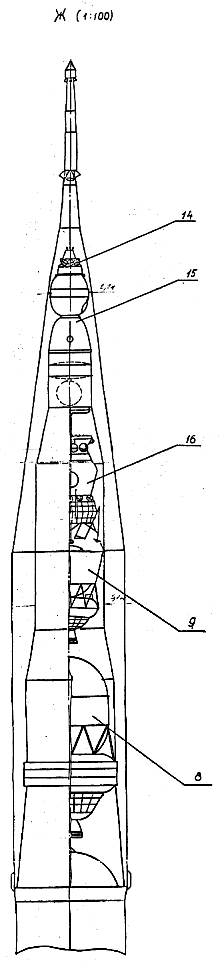 | L3 Cutaway - Dimensioned Russian cutaway drawing of L3 manned lunar landing complex. 15,454 bytes. 223 x 965 pixels. |
At this point, to reduce the G forces on the vehicle, a programmed shutdown of six engines occurred. Immediately thereafter, the oxidiser pump of engine number 4 exploded. The vehicle was destroyed by range safety before the second stage could separate and begin operation. The root cause was never determined. Mishin blamed the engine designers. Kuznetsov claimed that they were not at fault, saying the shutdown of the central engines had led to propellant line hammering, followed by rupture of propellant lines, resulting in the explosion of engine number 4. All agreed that if the N1 first stage had simply been shut down, and Stage 2 ignited, a successful mission could have followed.
N1 with Aerospike First Stage Engine
While the first N1F vehicle had yet to fly, studies continued on a number of improved N1�s. One of these contemplated the use of an aerospike engine in the first stage. Two variants were considered. In the first, the 30 x 151 tonne thrust NK-15 engines of the first stage were replaced with 24 x NK-15F engines of 188 tonnes thrust. This freed up the centre of the stage for a truncated aerospike. As in similar designs advocated by Philip Bono in the United States, hot gas would be bled off from the engines to produce an �aerospike� streaming behind the booster, which would contour the combined rocket exhaust into an optimum flow. The advantage of the aerospike was that it �auto-corrected� for altitude, providing optimum specific impulse over a range of conditions.
The second variant eliminated the NK-15�s completely and used a radical annular combustion chamber that surrounded the aerospike. Detailed mass calculations were made for each variant. The final study found that an improvement was achieved - but probably not one that justified the development expense and risk. The empty mass of the stage increased because the central body of the aerospike and the exhaust gas system were all additional features. Further, the NK-15�s were closed cycle engines. Bleeding hot gas from them for the aerospike actually reduced their inherent specific impulse.
For Variant A, a substantial development program would be required to increase the NK-15�s thrust by 24%. Variant B required an even bigger program, and learning how to vector the thrust of the annular engine (by diverting even more hot gas from the engines) for rocket steering would take a lot of flight test experience.
The final conclusion of the study was that the improvement in performance was not worth the development risk in three-stage, low specific impulse designs such as the basic N-1. Using the �standard� N1 second and third stages, payload was increased only 5.0% for Variant A and 6.9% for Variant B. It was concluded that the aerospike could provide bigger performance gains in single- or two- stage-to-orbit designs or in upper stages.
The final design comparison was as follows:
| Parameter | Basic Block A | Aerospike Variant A | Aerospike Variant B |
|---|---|---|---|
| Calculated Lift-off Thrust, kgf | 4,530,000 | 4,511,400 | 4,510,500 |
| Effective Lift-off Thrust, kgf | 4,117,000 | 4,420,000 | 4,480,000 |
| Vacuum Thrust, kgf | 5,065,500 | 5,334,400 | 5,379,000 |
| Fuel Consumption, kg/sec | 15,304 | 15,241 | 15,238 |
| Calculated Specific Impulse, Lift-off, sec | 296.0 | 296.0 | 296.0 |
| Effective Specific Impulse, Lift-off, sec | 269.0 | 290.0 | 294.0 |
| Specific Impulse, Vacuum, sec | 331.0 | 350.0 | 353.0 |
| Specific Impulse, Average, sec | 311.0 | 321.0 | 324.3 |
| Stage Empty Mass, kg | 112,230 | 120,250 | 124,700 |
| LEO Payload, kg | 92,700 | 97,350 | 99,090 |
The Last Days
Following the fourth N1 failure, Glushko and Kosberg were brought in to provide independent opinions on how the problems could be solved. Neither came up with inexpensive solutions. Kosberg wanted to equip the rocket with new-development 250,000 kgf engines using N2O4/UDMH. Glushko suggested using the RD-253 engines that he had developed for the UR-500 Proton launch vehicle. Interestingly, this very successful design was the final form of the RD-250 engine that Korolev had rejected for the N1 ten years earlier. But even Glushko had to admit that using the RD-253 would mean converting the N1 to N2O4/UDMH propellants, thereby lowering payload performance to unacceptable levels (just as Korolev had argued). Glushko was also rather dubious of successfully synchronising the operation of 30 engines.
The cash-starved project continued to limp along. Funding to proceed with design and construction of the L3M was not forthcoming. But Kuznetsov�s new series of engines had been subjected to huge amounts of ground testing. First/second stage engine testing was completed in September 1972 and third stage testing in November 1973. The next vehicles, 8L and 9L, would be the first to use these new modernised series engines and fully reflect the N1F configuration. The plan was that both 8L and 9L would be launched in the fourth quarter of 1974 in a demonstration of the N1F-L3M dual launch scenario. Confidence was high, based on the massive telemetry received on the 7L flight, that all problems had now been rectified.
On May 18, 1974 the Minister of Medium Machine Building Afanasyev attended a routine meeting of the management of OKB-1. In a few clipped sentences he informed the group that the Politburo had decided to remove Mishin, replace him with Korolev's old nemesis Glushko and combine the two OKB�s into a new entity known as NPO Energia. Afanasyev wished the stunned managers every success, and left the room. The N1 program was cancelled.
The N1- the Accounting
Two fully assembled (serial numbers 8L and 9L), and four partially assembled N1Fs were available at time of cancellation. In all, Kozlov�s Progress factory in Samara had delivered components for ten flightworthy N1�s, plus the two mock-ups, the engine test stand versions of the upper stages, and several other static test specimens. A total of 3.6 billion roubles was spent on the N1-L3 program, of which 2.4 billion roubles went into N1 development. Another 1.37 billion roubles would have taken the programme to completion, including construction of a final total of sixteen flight N-1�s, as laid out in the decree of 1964.
The Soviet Union had lost the moon race. In retrospect this seemed inevitable given a three-year later start and a funding level only a fraction that of the Apollo program. Those on the project felt that they were within months of finally providing the Soviet Union with a heavy-lift booster. Instead the work was discarded, and Glushko began design of the Vulkan launch vehicle with an entirely new configuration and engines. This was itself revised on 17 February 1976 when Glushko was directed to modify Vulkan to the Energia configuration to accommodate the Buran space plane (based on US Space Shuttle). Thirteen years and another 14.5 billion roubles later, the Energia flew, only to be cancelled in turn with the collapse of the Soviet Union.
Like a Phoenix, at least parts of the N1F may still fly. The 150 NK-33, NK-39, and NK-43 engines built by Kuznetsov were cocooned and secretly stored at the program's cancellation despite orders to the contrary. After Glushko's death, these were considered for use in the American Atlas IIIA launch vehicle, but eventually sold to Kistler Aerospace for its reusable US launch vehicle 22 years later. The 11D56 Lox/LH2 engines designed for the Block Sr RTB stage for the L3M also never flew, but the design was sold to India in 1994 for use in its GSLV launch vehicle.
The N1's themselves were broken up in 1975 and the payload shrouds and tank bulkheads used as carports, storage sheds, and sun shelters around the cosmodrome. Today the N1 worker�s city of apartment blocks is empty, and tumbleweeds grow among the N1 components at the abandoned recreation centre. The launch pads are crumbling, the desert slowly reclaiming the colossal works of the project. The rest is silence.