
Credit: © Mark Wade. 2,268 bytes. 59 x 568 pixels.
| astronautix.com | Atlas IIIA |
|
| Atlas 2AR - Credit: © Mark Wade. 2,268 bytes. 59 x 568 pixels. |
Development of Atlas using Russian engines in place of booster/sustainer group used on all previous models. First stage couples unique Atlas balloon tanks and high performance Glushko engines. The Atlas IIIA is the centerpiece of Lockheed Martin's strategy to remain the leader in the commerical launch services industry. Launch Sequence: In a typical Atlas IIIA launch, the vehicle's two RD-180 thrust chambers are ignited shortly before liftoff. Pre-programmed engine thrust settings are used during booster ascent to minimize vehicle loads by throttling back during peak transonic loads/high dynamic pressure region while otherwise maximizing vehicle performance. Just over two minutes into flight, as the vehicle reaches an axial acceleration of 4 g's, the engines begin to throttle back, eventually initiating a constant throttle rate to sustain acceleration at 5.5 g's. Booster engine cutoff occurs approximately three minutes into flight and is followed by separation of Centaur from Atlas. The first Centaur burn lasts about nine minutes after which the Centaur and its payload coast in a parking orbit. During the first burn, approximately ten seconds after ignition, the payload fairing is jettisoned. The second Centaur ignition occurs about 23 minutes into the flight, continues for about three minutes, and is followed several minutes later by the separation of the spacecraft from Centaur. Major Suppliers: NPO Energomash / Pratt & Whitney - Atlas RD-180 engines; Pratt & Whitney - Centaur engines; Honeywell - Inertial Navigation Unit; BF Goodrich - Digital acquisition system; SAAB - Payload Separation Systems.
LEO Payload: 8,640 kg. Payload: 4,055 kg. to a: Geosynchronous transfer trajectory. Liftoff Thrust: 265,000 kgf. Total Mass: 214,338 kg. Core Diameter: 3.1 m. Total Length: 52.8 m. Development Cost $: 300.00 million. in 1995 average dollars. Launch Price $: 105.00 million. in 1999 price dollars.
European Telecommunications Satellite Organization (Eutelsat) satellite equipped with 32 Ku-band transponders, and antennae covering Russia and Africa. It will be stationed at 36 deg E. This was the third of the high power Eutelsat W series to be launched (W1 was destroyed in a ground accident). Stationed at 36 deg E.
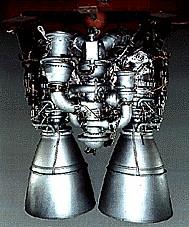 | RD-180 Credit: Lockheed Martin. 14,267 bytes. 189 x 227 pixels. |