
Credit: © Mark Wade. 2,448 bytes. 286 x 165 pixels.
| astronautix.com | Soyuz 7K-T |
|
| Soyuz 7K-T - Credit: © Mark Wade. 2,448 bytes. 286 x 165 pixels. |
Following the disastrous Soyuz 11 flight, when the crew was killed by cabin depressurisation, the 7K-OKS design was subjected to a complete redesign, resulting in the substantially safer 7K-T space station ferry. One crew position was eliminated, making it possible for the two crew members to wear pressure suits during dangerous phases of the flight. Batteries replaced the solar panels of the earlier configuration, to eliminate the chance of undeployed panels causing problems as was the case on Soyuz 1. Numerous minor changes were made to improve the basic safety and redundancy of the design. The 7K-T would safely fly 31 times until replaced by the Soyuz T in 1981.
Soyuz Guidance and Controls
The re-entry manoeuvre was normally handled automatically by radio command. Spacecraft attitude in relation to the local motion along the orbit was determined by sun sensors, infrared horizon sensors and ion gauges, which could detect the spacecraft's direction of motion by the greater velocity of ions impacting the spacecraft in the direction of motion.
The cosmonaut could however take manual control of the spacecraft and manually re-enter. This was done by using the ingenious Vzor periscope device. This had a central view and eight ports arranged in a circle around the centre. When the spacecraft was perfectly centred in respect to the horizon, all eight of the ports would be lit up. Alignment along the orbit was judged by getting lines on the main scope to be aligned with the landscape flowing by below. In this way, the spacecraft could be oriented correctly for the re-entry manoeuvre.
To decide when to re-enter, the cosmonaut had a little clockwork globe that showed current position over the earth. By pushing a button to the right of the globe, it would be advanced to the landing position assuming a standard re-entry at that moment.
This manual system would obviously only be used during daylight portions of the orbit. At night the dark mass of the earth could not have been lined up with the optical Vzor device. The automatic system would work day or night. However problems were found on Soyuz 1 when the ion gauges would not function in ion 'pockets' of low density in the re-entry manoeuvre portion of the orbit.
The Soyuz kept (to this day) the little globe and Vzor system. On the early model Soyuz, prior to the Soyuz T of the 1980's, there was no on-board inertial navigation system. To perform an orbital manoeuvre, the parameters for an orbital manoeuvre would be transmitted from the ground. When the time came for a manoeuvre, the spacecraft would align itself to the local vertical and direction of motion by the methods mentioned above (automatic or manual). Then three gyros would be spun up, the spacecraft manoeuvred automatically or manually to the required attitude for the manoeuvre, and the main engine would fire automatically at the prescribed time to make the orbit change. There is a simple delta-v gauge showing the velocity change. Since the Soyuz thrust to weight is so low (around 0.06, or only half a meter per second) this meant the manoeuvres could be handled manually without much error (on re-entry burns the practice was to count to five after the engine was supposed to shut off before overriding it!)
The Soyuz has always had very limited manoeuvre capability, a source of some embarrassment during the ASTP joint flight where the Apollo did most of the manoeuvring. Not until the Soyuz T version was enough manoeuvring fuel and the inertial navigation system available to allow rendezvous with non-co-operative objects (like the dead Salyut 7 station on the epic Soyuz T-15 flight) and to fly around objects for inspection (this is theoretically possible in the old models, but due to limited fuel or conservatism it was never demonstrated).
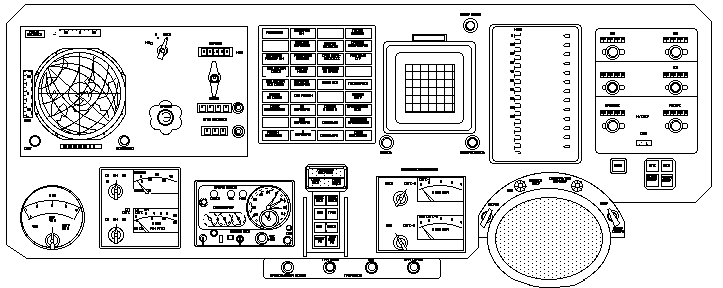 | Panel Soyuz 7K-OK - Control panel of the initial earth orbit version of Soyuz. Credit: © Mark Wade. 11,752 bytes. 723 x 288 pixels. |
Craft.Crew Size: 2. Design Life: 3 days. Orbital Storage: 110.00 days. Total Length: 7.5 m. Maximum Diameter: 2.7 m. Total Habitable Volume: 11.00 m3. Total Mass: 6,800 kg. Total Propellants: 500 kg. Primary Engine Thrust: 417 kgf. Main Engine Propellants: Nitric Acid/Hydrazine. Main Engine Isp: 282 sec. Total spacecraft delta v: 210 m/s. Electric system: 0.84 total average kW. Electrical System: Batteries.
Docking System: Lightweight. Probe: Roller-type. Tunnel: Yes. Collar Length (m): 0.22. Probe Length (m): 0.5. Base Diameter(m): 1.35. Ring Diameter(m): 1.35. Rendezvous System: Igla. Antenna: Lightweight. Tower: One-Dish. Orbital Module: Standard. Length (m): 2.26. Windows: Four. OM Separation: After retro.
Ministry of General Machine Building (MOM) Decree 105-41 'On creation of the DOS using Almaz as a basis' was issued.
Decree 57ss 'On creation of the DOS using Almaz as a basis' was issued.
Recovered July 6, 1972 13:54 GMT. Soyuz 7K-T redesign test.
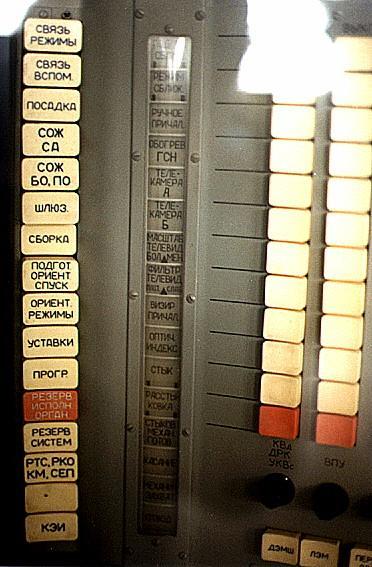 | Soyuz 7K-T Panel - Closeup of Soyuz 7K-T right sequencer panel Credit: © Mark Wade. 44,577 bytes. 372 x 567 pixels. |
Planned second crew to the first Almaz space station. Cancelled after the loss of control of Almaz OPS 1 (Salyut 2) in orbit.
Planned first mission to the Salyut DOS 2 space station. Cancelled after it was destroyed during launch.
Planned second mission to the Salyut DOS 2 space station. Cancelled after it was destroyed during launch.
Planned first mission to the Salyut DOS 3 space station (Cosmos 557). Cancelled after it failed in orbit.
Soyuz test flight. Recovered June 17, 1973 6:01 GMT. Soyuz 7K-T redesign test.
Planned second mission to the Salyut DOS 3 space station (Cosmos 557). Cancelled after it failed in orbit.
Experimental flight for the purpose of further development of manned space craft Soyuz 7K-T modifications. After the Soyuz 11 disaster, the Soyuz underwent redesign for increased reliability. Two solo test flights of the new design were planned. Crews for the first flight were those already planned for the deferred follow-on missions to the failed DOS 2 and DOS 3 space stations. Recovered September 29, 1973 13:14 GMT. Landed 400 km SW Karaganda.
 | Soyuz 7K-T Credit: © Mark Wade. 5,868 bytes. 495 x 287 pixels. |
A unique flight of the 7K-T/AF modification of the Soyuz spacecraft. The orbital module was dominated by the large Orion 2 astrophysical camera. The crew conducted astrophysical observations of stars in the ultraviolet range. Additional experiments included spectrozonal photography of specific areas of the earth's surface, and continued testing of space craft's on-board systems. Recovered December 26, 1973 8:50 GMT. Landed in snowstorm 200 km SW Karaganda. Additional Details: Soyuz 13.
Planned but cancelled third mission to the Salyut 3 space station.
Manned two crew. Docked with Salyut 4. Joint experiments with the Salyut scientific orbital station. Recovered February 9, 1975 11:03 GMT. Landed 110 km NE Tselinograd.
Carried Oleg Makarov, Vasili Lazarev for rendezvous with Salyut 4; but during second-third stage seperation third stage failed to separate from second stage but still ignited. The crew demanded that the abort procedures be implemented but ground control could not see the launch vehicle gyrations in their telemetry. Soyuz finally was separated from by ground control command at 192 km, and following a 20.6+ G reentry, the capsule landed in the Altai mountains, tumbled down a mountainside, and snagged in some bushes just short of a precipice. The crew was worried that they may have landed in China and would face internment, but after an hour sitting in the cold next to the capsule, they were discovered by locals speaking Russian. Total flight duration was 1574 km and flight time 21 minutes 27 seconds. Lazarev suffered internal injuries from the high-G reentry and tumble down the mountain side and never flew again. Both cosmonauts were denied their 3000 ruble spaceflight bonus pay and had to apeal all the way to Brezhnev before being paid.
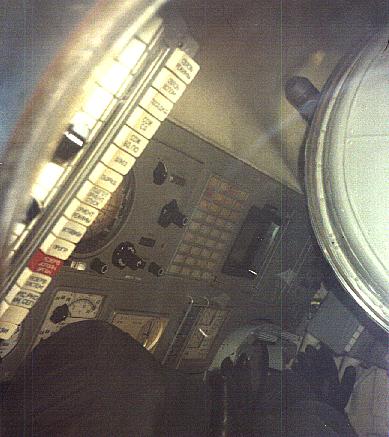 | Soyuz Interior - View of Soyuz interior. Credit: © Mark Wade. 33,593 bytes. 389 x 437 pixels. |
Manned two crew. Docked with Salyut 4. Joint experiments with the Salyut scientific orbital station. Recovered July 26, 1975 14:18 GMT. Landed 56 km E Arkalyk.
A Soyuz 25 mission to the Salyut 5 space station with the crew of Berzovoi and Lisun was to have followed Soyuz 24. However during the four months it took to prepare the Soyuz, Salyut 5 consumed higher than expected fuel in maintaining the station's orientation. As a result, the fuel reserves were 70 kg below those required for the planned 14 day mission and it was cancelled.
Planned mission to Salyut 6 that would make first docking with rear docking port and be the first crew to swap spacecraft and return in the spacecraft that ferried the Soyuz 25 crew. But Soyuz 25 failed to dock with Salyut 6. One result of the investigation of the failure of the mission was that all future crews would have to have at least one cosmonaut with previous space flight experience. Kolodin was replaced by Makarov, and Soyuz 26 as flown had quite a different profile. Kolodin never flew in space.
Manned two crew. Unsuccessful mission. Failed to dock with Salyut 6. Recovered October 11, 1977 3:25 GMT.
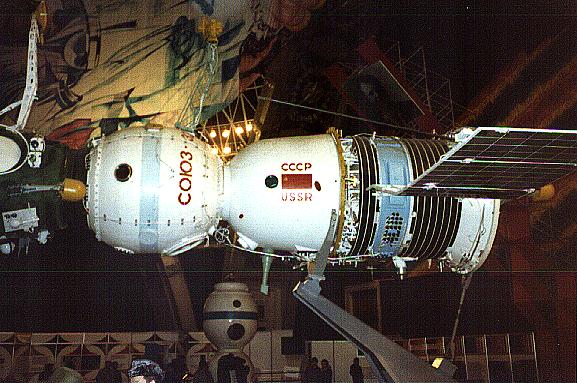 | Soyuz 7K-T Credit: © Mark Wade. 63,829 bytes. 577 x 383 pixels. |
Manned two crew. Carried Oleg Makarov, Vladimir Dzhanibekov to Salyut 6; returned crew of Soyuz 26 to Earth. Docked with Salyut 6. Recovered March 16, 1978 11:19 GMT.
Manned two crew. Docked with Salyut 6. Delivery to the Salyut-6 station of the first international 'Intercosmos' team consisting of A.A. Gubarev (USSR) and V. Remek (Czechoslovak Socialist Republic) to carry out scientific research and experiments jointly developed by Soviet a nd Czechoslovak specialists. Recovered March 10, 1978 13:45 GMT.
Manned two crew. Docked with Salyut 6. Placed on board the Salyut-6 station a crew consisting of V.V. Kovalenko and A.S. Ivanchenkov to conduct scientific and technological investigations and experiments. Recovered September 3, 1978 11:40 GMT.
Manned two crew. Docked with Salyut 6. Delivered to the Salyut-6 station the third international 'Intercosmos' crew consisting of V F Bykovsky (USSR) and S Jaehn (German Democratic Republic) to carry out scientific research and experiments.Recovered November 2, 1978 11:05 GMT.
Manned two crew. Docked with Salyut 6. Transported a team consisting of V A Lyakhov and V V Ryumin to the Salyut-6 space station to conduct scientific investigations and experiments and repair work. Recovered June 15, 1979 16:18 GMT. Returned unmanned.
Manned two crew. Flight under the Intercosmos programme of an international team consisting of N N Rukavishnikov (USSR) and G I Ivanov (Bulgaria). Unsuccessful mission. Failed to rendezvous with Salyut 6. Recovered April 12, 1979 16:35 GMT.
Docked with Salyut 6. Launched unmanned to provide return vehicle for Soyuz 32 crew of Lyakhov/Ryumin after Soyuz 33 primary propulsion system failure. Checked the operation of the spacecraft propulsion unit; transportated the crew of the Salyut-6 station back to earth. Recovered August 19, 1979 12:30 GMT.
Manned two crew. Docked with Salyut 6. Carried crew comprising L I Popov and V V Ryumin to the Salyut-6 station to carry out scientific and technical research and experiments. Returned crew of Soyuz 36 to Earth. Recovered June 3, 1980 15:07 GMT. Landed 140 km SE Dzehezkazgan.
Transported the fifth international crew under the INTERCOSMOS programme, comprising V N Kubasov (USSR) and B Farkas (Hungary) to the Salyut-6 station to carry out scientific research and experiments. Returned crew of Soyuz 37 to Earth. Recovered July 31, 1980 15:15 GMT.
Manned two crew. Transported to the Salyut-6 station the sixth international crew under the Intercosmos programme, comprising V V Gorbatko (USSR) and Pham Tuan (Viet Nam), to conduct scientific research and experiments. Returned crew of Soyuz 35 to Earth. Recovered October 11, 1980 9:50 GMT.
Manned two crew. Docked with Salyut 6. Transported to the Salyut-6 station the seventh international crew under the INTERCOSMOS programme, comprising Y V Romanenko (USSR) and A. Tomaio Mendez (Cuba), to conduct scientific research and experiments. Recovered September 26, 1980 15:54 GMT.
Manned two crew. Docked with Salyut 6. Transported to the Salyut-6 orbital station the eighth international crew under the INTERCOSMOS programme, comprising V A Dzhanibekov (USSR) and Z. Gurragchi (Mongolian People's Republic) to conduct scientific investigations and experiments. Recovered March 30, 1981 11:42 GMT.
Manned two crew. Docked with Salyut 6. Transported to the Salyut-6 orbital station the ninth international crew under the INTERCOSMOS programme, comprising L I Popov (USSR), and D. Prunariu (Romania), to conduct scientific research and experiments. Recovered May 22, 1981 13:58 GMT.
Planned Soyuz flight to a dock with the Almaz OPS 4 space station. The mission was cancelled together with the Almaz program in 1981.