12,491 bytes. 344 x 268 pixels.
| astronautix.com | Orlets-1 |
|
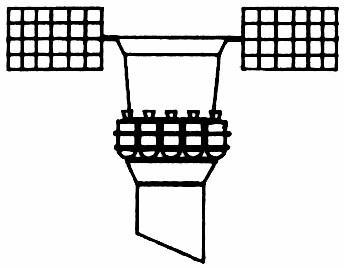
| Yantar multi-return - Yantar bus reconnaissance satellite with multiple re-entry capsules. This is believed to be layout of Orlets-1. Orlets-2 must have a considerably extended bus to accomodate even more capsules. 12,491 bytes. 344 x 268 pixels. |
Following evaluation of flight trials in April-May 1977 it was concluded that the Yantar-2K was not capable of providing strategic warning of attack. Therefore three additional variants were developed, one of them the wide-spectrum detail and survey satellite Orlets. This featured a panoramic camera and drew on features of an existing draft project designated Yantar-6K. The redesigned spacecraft would be expandable, with Phase 1 (Orlets-1) being launched by the Soyuz-U2 launch vehicle, equipped with 8 film return capsules and having a design life of 60 days. Phase 2 (Orlets-2) would be launched by the new, much more powerful Zenit launch vehicle, be equipped with 22 return capsules, and have a 180 day design life. The draft project was completed in the late 1980's; flight trials began in 1989 and system did not go into service until the 1990's. After the break-up of the Soviet Union, the satellite had to be switched to the less-capable Soyuz-U launch vehicle and the flight duration was extended to 100 to 120 days (presumably at the expense of fewer return capsules). As in the case of other Yantars, after returning multiple film capsules, the spacecraft is deorbited. Typical orbital profile was an inclination 64.9 degrees with an altitude of 207-323 km. Only six were flown between the first flight Cosmos 2031 (1989) and the latest (Cosmos 2343, 1997).
Total Mass: 6,530 kg.
Flight trials of the Yantar-2K indicated the satellite was not capable of providing strategic warning of attack. The planned Yantar-6K series, in development since 1969, were overweight and behind schedule. A meeting of the Council of Chief Designers at TsSKB reviewed alternative approaches. It was decided that three variants of the Yantar-2K were to be developed, one of them the high resolution Yantar-4K.
First launch of Orlets-1 long duration film return military reconnaissance satellite. After returning multiple film capsules, the spacecraft was deorbited.
Long duration film return military reconnaissance satellite. After returning multiple film capsules, the spacecraft was deorbited.
Long duration film return military reconnaissance satellite. After returning multiple film capsules, the spacecraft was deorbited.
Long duration film return military reconnaissance satellite. After returning multiple film capsules, the spacecraft was deorbited.
Long duration film return military reconnaissance satellite. After returning multiple film capsules, the spacecraft was deorbited. First launch that demonstrated doubled operational life.
Long duration film return military reconnaissance satellite. After returning multiple film capsules, the spacecraft was deorbited. This satellite provided Russia with the photo reconnaisance capability after a break of 7 1/2 months. This launch came on the 40th anniversary of the first successful launch of the R-7 rocket, from which the Soyuz-U was derived. It was the 250th launch of the Soyuz-U from Baikonur, the 350th launch from Launch Complex 31, and the 666th launch of a Soyuz-U.