 |
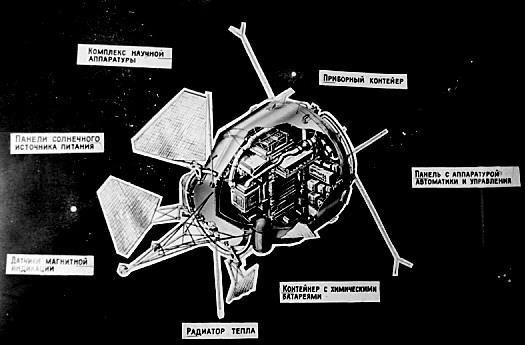
| N-4 Spacecraft Cutaway view of N-4 spacecraft. This heavy high-energy physics station was launched on the first four test launches of the Proton launch vehicle. Credit: Chelomei School, Leninsk. 30,376 bytes. 525 x 345 pixels. |
| astronautix.com | Proton |
|
| N-4 Spacecraft Cutaway view of N-4 spacecraft. This heavy high-energy physics station was launched on the first four test launches of the Proton launch vehicle. Credit: Chelomei School, Leninsk. 30,376 bytes. 525 x 345 pixels. |
The first launch of the Proton launch vehicle was not without problems. A leak in the oxidiser pipeline resulted in nitrogen tetroxide spilling on electrical wires. The question was: proceed with the launch or abort? Chelomei decided to go ahead, and on 16 July 1965 the first UR-500 successfully launched the Proton 1 satellite. In the first hours after launch specialists from OKB-52 could only receive signals in the first hours that indicated the satellite was �alive�. However it later functioned normally and provided physics data on ultra-high-energy cosmic particles for 45 days.
At the first launch the rocket was called �Gerkules� (other sources say �Atlantis�), as indicated by the large symbol on the second stage skin. This name was however was not taken up.
High energy physics laboratory. Investigation of ultra-high-energy cosmic particles.
Space station 'Proton 3'. Investigation of ultra high energy cosmic particles
First launch of the Proton three-stage variant. The satellite studied the nature of high and ultra-high energy cosmic rays and their interaction with atomic nuclei. Scientific payload 12,500 kg; operated for 100 days in orbit.