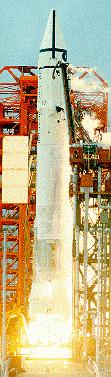
15,096 bytes. 111 x 377 pixels.
| astronautix.com | Atlas Centaur SLV-3C |
|
| SLV-3C Centaur - SLV-3C Centaur AC-17 - COSPAR 1968-068 15,096 bytes. 111 x 377 pixels. |
First test version of Atlas with Centaur upper stage.
Launches: 17. Failures: 3. Success Rate: 82.35% pct. First Launch Date: 08 September 1967. Last Launch Date: 21 August 1972. Payload: 1,800 kg. to a: Geosynchronous transfer trajectory. Liftoff Thrust: 197,753 kgf. Total Mass: 148,404 kg. Core Diameter: 3.1 m. Total Length: 38.0 m.
Air Force awarded contract Pratt & Whitney for Centaur vehicle with hydrogen-burning chamber based on research of Lewis Research Center between 1953 and 1957. Centaur project later transferred to NASA.
Under arrangements of the AACB (Aeronautics and Astronautics Coordinating Board), NASA will utilize existing NASA tracking stations for initial Centaur development vehicles and switch to the Advent network (which is to be planned, funded, and constructed by DOD) when Centaur is operational, perhaps as early as the fourth of 10 development launchings of Centaur.
NASA Aerobee-Hi successfully reached 96 miles above Wallops Station in test of behavior of liquid hydrogen in zero gravity for Lewis Research Center hydrogen propulsion development.
Meeting of NASA and contractor personnel held at NASA headquarters to review Centaur development program.
NASA directed Marshall Space Flight Center to enter contract negotiations with contractors for procurement of five operational Atlas-Centaur vehicles. These launchings were planned to begin in second quarter of 1964.
NASA announced that instrumented Venus probe to be launched next year would be launched by an Atlas-Agena B rather than a Centaur rocket as originally planned.
NASA announced the completion of the preliminary flight rating test of the Nation's first liquid-hydrogen rocket engine. The engine, the RL-10, was designed and developed by Pratt and Whitney, of United Aircraft, for the Marshall Space Flight Center, and 20 captive firings were competed within 5 days under simulated space conditions, consistently producing 15,000 pounds of thrust. RL-10, previously known as XLR-115, was initiated in October 1958 and over 700 firings were conducted in its development.
Soft lunar landing; returned 19,000 photos, soil data.
Soft landed on lunar Moon; photographed lunar surface; sampled lunar soil; used propulsion system to briefly lift off of lunar surface.
Soft landed on lunar Moon; photographed lunar surface; sampled lunar soil.
Applications Technology Satellite; Centaur oxidizer leak. No restart. Launch vehicle was to have put payload into geosynchronous transfer orbit, instead was left in useless LEO orbit. Carried ion engine.
Orbiting Astronomical Observatory; carried 11 telescopes; performed X-ray, UV, IR observations of stars. Spacecraft engaged in research and exploration of the upper atmosphere or outer space (US Cat B). Launch vehicle put payload into geosynchronous transfer orbit
Mars flyby 31 July 1969; returned 75 images of Martian surface. Ten days before the scheduled launch, a faulty switch opened the main valves on the Atlas stage. This released the pressure which supported the Atlas structure, and as the booster deflated it began to crumple. Two ground crewman started pressurizing pumps, saving the structure from further collapse. The two ground crewman, who had acted at risk of the 12-story rocket collapsing on them, were awarded Exceptional Bravery Medals from NASA.
The Mariner 6 spacecraft was removed, put on another Atlas/Centaur, and launched on schedule. The main booster was jettisoned 4 min. 38 sec. after launch, followed by a 7.5 minute Centaur burn to inject the spacecraft into Mars direct trajectory. After Mariner 6 separated from the Centaur the solar panels were deployed. A midcourse correction involving a 5.35 second burn of the hydrazine rocket occurred on 1 March 1969. A few days later explosive valves were deployed to unlatch the scan platform. Some bright particles released during the explosion distracted the Canopus sensor, and attitude lock was lost temporarily. It was decided to place the spacecraft on inertial guidance for the Mars flyby to prevent a similar occurrence.
On 29 July, 50 hours before closest approach, the scan platform was pointed to Mars and the scientific instruments turned on. Imaging of Mars began 2 hours later. For the next 41 hours, 49 approach images (plus a 50th fractional image) of Mars were taken through the narrow-angle camera. At 05:03 UT on 31 July the near-encounter phase began, including collection of 26 close-up images. Due to a cooling system failure, channel 1 of the IR spectrometer did not cool sufficiently to allow measurements from 6 to 14 micrometers so no infrared data were obtained over this range. Closest approach occurred at 05:19:07 UT at a distance of 3431 km from the martian surface. Eleven minutes later Mariner 6 passed behind Mars and reappeared after 25 minutes. X-band occultation data were taken during the entrance and exit phases. Science and imaging data were played back and transmitted over the next few days. The spacecraft was then returned to cruise mode which included engineering and communications tests, star photography TV tests, and UV scans of the Milky Way and an area containing comet 1969-B. Periodic tracking of the spacecraft in its heliocentric orbit was also done.
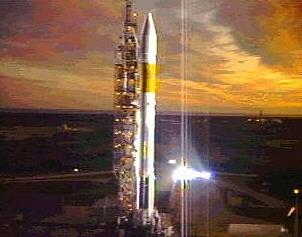 | Atlas Centaur - Atlas Centaur at Sunrise Credit: Lockheed Martin. 13,046 bytes. 302 x 237 pixels. |
Mariner 6 returned 49 far encounter and 26 near encounter images of Mars. Close-ups from the near encounter phases covered 20% of the surface. The spacecraft instruments measured UV and IR emissions and radio refractivity of the Martian atmosphere. Images showed the surface of Mars to be very different from that of the Moon, in some contrast to the results from Mariner 4. The south polar cap was identified as being composed predominantly of carbon dioxide. Atmospheric surface pressure was estimated at between 6 and 7 mb. Radio science refined estimates of the mass, radius and shape of Mars.
Mars flyby 5 August 1969; returned 126 images of Martian surface. Mariner 7 was launched on a direct-ascent trajectory to Mars 31 days after Mariner 6. On 8 April 1969 a midcourse correction was made by firing the hydrazine moter for 7.6 seconds. On 8 May Mariner 7 was put on gyro control to avoid attitude control problems which were affecting Mariner 6. On 31 July telemetry from Mariner 7 was suddenly lost and the spacecraft was commanded to switch to the low-gain antenna. It was later successfully switched back to the high-gain antenna. It was thought that leaking gases, perhaps from the battery which later failed a few days before encounter, had caused the anomaly.
At 09:32:33 GMT on 2 August 1969 Mariner 7 bagan the far-encounter sequence involving imaging of Mars with the narrow angle camera. Over the next 57 hours, ending about 5 hours before closest approach, 93 images of Mars were taken and transmitted. The spacecraft was reprogrammed as a result of analysis of Mariner 6 images. The new sequence called for the spacecraft to go further south than originally planned, take more near-encounter pictures, and collect more scientific data on the lighted side of Mars. Data from the dark side of Mars were to be transmitted directly back to Earth but there would be no room on the digital recorder for backup due to the added dayside data. At closest approach, 05:00:49 GMT on 5 August, Mariner 7 was 3430 km above the martian surface. Over this period, 33 near-encounter images were taken. About 19 minutes after the flyby, the spacecraft went behind Mars and emerged roughly 30 minutes later. X-band occultation data were taken during the entrance and exit phases. Science and imaging data were played back and transmitted over the next few days. The spacecraft was then returned to cruise mode which included engineering and communications tests, star photography TV tests, and UV scans of the Milky Way and an area containing comet 1969-B. Periodic tracking of the spacecraft in its heliocentric orbit was also done.
Science Results
The total data return for Mariners 6 and 7 was 800 million bits. Mariner 7 returned 93 far and 33 near encounter images. Close-ups from the near encounter phases covered 20% of the surface. The spacecraft instruments measured UV and IR emissions and radio refractivity of the Martian atmosphere. Images showed the surface of Mars to be very different from that of the Moon, in some contrast to the results from Mariner 4. The south polar cap was identified as being composed predominantly of carbon dioxide. Atmospheric surface pressure was estimated at between 6 and 7 mb. Radio science refined estimates of the mass, radius and shape of Mars.
Applications Technology Satellite; communications tests. Launch vehicle put payload into geosynchronous transfer orbit. Spacecraft maneuvered into geostationary orbit at 108 degrees W. Also tested ion engine.
Orbiting Astronomical Observatory. Launch vehicle was to have put payload into geosynchronous transfer orbit
Stationed at 24.5 deg W. Spacecraft engaged in practical applications and uses of space technology such as weather or communication (US Cat C). Launch vehicle put payload into geosynchronous transfer orbit
Intended Mars flyby.
The first spacecraft to orbit another planet. The Mariner Mars 71 mission was planned to consist of two spacecraft on complementary missions. Mariner 8 was to map 70 % of the Martian surface and Mariner 9 was to study temporal changes in the Martian atmosphere and on the Martian surface. The launch failure of Mariner 8 forced Mariner 9 to combine the mission objectives of both. For the survey portion of the mission, the planetary surface was to be mapped with the same resolution as planned for the original mission, although the resolution of pictures of the polar regions would be decreased due to the increased slant range. The variable features experiments were changed from studies of six given areas every 5 days to studies of smaller regions every 17 days. Mariner 9 was launched on a direct trajectory to Mars. Separation from the booster occurred at 22:36 GMT. The four solar panels were deployed at 22:40 GMT. The sensors locked onto the Sun at 23:16, shortly after the spacecraft left the Earth's shadow and Canopus acquisition was achieved at 02:26 GMT 31 May. A planned midcourse maneuver was executed on 5 June. Mariner 9 arrived at Mars on 14 November 1971 after a 167 day flight. A 15 minute 23 second rocket burn put the spacecraft into Mars orbit. The insertion orbit had a periapsis of 1398 km and a period of 12 hr, 34 min. Two days later a 6 second rocket burn changed the orbital period to just under 12 hours with a periapsis of 1387 km. A correction trim maneuver was made on 30 December on the 94th orbit which raised the periapsis to 1650 km and changed the orbital period to 11:59:28 so that synchronous data transmissions could be made to the Goldstone 64-m DSN antenna.
Imaging of the surface of Mars by Mariner 9 was delayed by a dust storm which started on 22 September 1971 in the Noachis region. The storm quickly grew into one of the largest global storms ever observed on Mars. By the time the spacecraft arrived at Mars no surface details could be seen except the summits of Olympus Mons and the three Tharsis volcanoes. The storm abated through November and December and normal mapping operations began. The spacecraft gathered data on the atmospheric composition, density, pressure, and temperature and also the surface composition, temperature, gravity, and topography of Mars. A total of 54 billion bits of scientific data were returned, including 7329 images covering the entire planet. After depleting its supply of attitude control gas, the spacecraft was turned off on 27 October 1972. Mariner 9 was left in an orbit which should not decay for at least 50 years, after which the spacecraft will enter the Martian atmosphere.
The Mariner 9 mission resulted in a global mapping of the surface of Mars, including the first detailed views of the martian volcanoes, Valles Marineris, the polar caps, and the satellites Phobos and Deimos. It also provided information on global dust storms, the gravity field as well as evidence for surface aeolian activity.
Over Atlantic. Spacecraft engaged in practical applications and uses of space technology such as weather or communication (US Cat C). Launch vehicle put payload into geosynchronous transfer orbit
Over Pacific. Spacecraft engaged in practical applications and uses of space technology such as weather or communication (US Cat C). Launch vehicle put payload into geosynchronous transfer orbit
Jupiter flyby December 1973; first man-made object to leave solar system. The spacecraft achieved its closest approach to Jupiter on December 3, 1973, when it reached approximately 2.8 Jovian radii (about 200,000 km). As of Jan. 1, 1997 Pioneer 10 was at about 67 AU from the Sun near the ecliptic plane and heading outward from the Sun at 2.6 AU/year and downstream through the heliomagnetosphere towards the tail region and interstellar space. Additional Details: Pioneer 10.
Over Indian Ocean. Spacecraft engaged in practical applications and uses of space technology such as weather or communication (US Cat C). Launch vehicle put payload into geosynchronous transfer orbit
UV observations of stellar objects. Spacecraft engaged in research and exploration of the upper atmosphere or outer space (US Cat B). Launch vehicle put payload into geosynchronous transfer orbit