9,857 bytes. 103 x 435 pixels.
| astronautix.com | Atlas II |
|
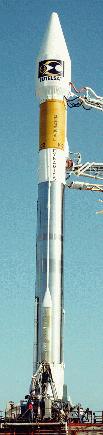
| Atlas 2 - Atlas 2 - AC-102 - COSPAR 1991-083 9,857 bytes. 103 x 435 pixels. |
The Atlas II booster was 2.7-meters longer than an Atlas I and included uprated Rocketdyne MA-5A engines. The Atlas I vernier engines were replaced with a hydrazine roll control system. The Centaur stage was stretched 0.9-meters compared to the Centaur I stage. Fixed foam insulation replaced Atlas I's jettisonable insulation panels. The original Atlas II model was developed to support the United States Air Force Medium Launch Vehicle II program. Its Centaur used RL10A-3-3A engines operating at an increased mixture ratio. The first Atlas II flew on 7 December 1991, successfully delivering AC-102/Eutelsat II F3 to orbit.
Launches: 10. Failures: 0. Success Rate: 100.00% pct. First Launch Date: 07 December 1991. Last Launch Date: 16 March 1998. LEO Payload: 6,580 kg. to: 185 km Orbit. at: 28.5 degrees. Payload: 2,810 kg. to a: Geosynchronous transfer trajectory. Liftoff Thrust: 215,220 kgf. Total Mass: 187,600 kg. Core Diameter: 3.1 m. Total Length: 47.5 m. Launch Price $: 85.00 million. in 1994 price dollars.
Stationed at 16 deg E. Telecommunications satellite. French registration 1991-8. Transfer orbit was 663 min, 200 x 36000 km x 7.0 deg. Registered by France in ST/SG/SER.E/249 until EUTELSAT can register the satellite. EUTELSAT is the European Telecommunications Satellite Organi zation. Launch vehicle put payload into supersynchronous earth orbit with IFR trajectory option.
Spacecraft engaged in research and exploration of the upper atmosphere or outer space (US Cat B). Launch vehicle put payload into geosynchronous transfer orbit with GCS trajectory option.
Spacecraft engaged in practical applications and uses of space technology such as weather or communication (US Cat C). Launch vehicle put payload into geosynchronous transfer orbit with GCS trajectory option.
Spacecraft engaged in practical applications and uses of space technology such as weather or communication (US Cat C). Launch vehicle put payload into geosynchronous transfer orbit with GCS trajectory option.
Spacecraft engaged in practical applications and uses of space technology such as weather or communication (US Cat C). Launch vehicle put payload into geosynchronous transfer orbit with GCS trajectory option.
 | Atlas 2 Credit: © Mark Wade. 2,539 bytes. 76 x 568 pixels. |
UHF Follow-On #4; US Navy communications . Stationed at 177.0 deg W. Launch vehicle put payload into subsynchronous earth orbit with MRS trajectory option.
UHF Follow-On #5; US Navy communications . Stationed at 72.3 deg E. Launch vehicle put payload into subsynchronous earth orbit with MRS trajectory option.
UHF Follow-On #6; US Navy communications. Stationed at 105.3 deg W. Launch vehicle put payload into subsynchronous earth orbit with MRS trajectory option.
UHF Follow-On F8 was the first Block III UHF Follow-On satellite, replacing the old FLTSATCOM satellites. It carried UHF, EHF and Ka-band transponders, including a video broadcast payload. This was the last Atlas II launch; future Atlas launches would use the Atlas IIA, IIAS and III models. Geostationary at 171.8 degrees E.