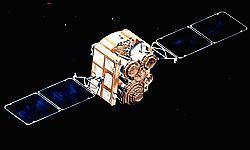
Credit: USAF. 6,090 bytes. 250 x 150 pixels.
| astronautix.com | DSCS III |
|
| DSCS-3 - Credit: USAF. 6,090 bytes. 250 x 150 pixels. |
DSCS provides secure voice and data communications for the US military. The contract is managed by the DCA (Defense Communications Agency) for the USAF. Recurring cost is quoted as $160 million in Aviation Week (8/7/95). Spacecraft: 3-axis stabilisation (0.1 deg control in pitch, roll) using reaction wheels, earth and sun sensors. Two articulated solar arrays produce 1240 W (BOL), NiCd batteries with 105 AHr, 28V bus. S-Band (SGLS) and X-Band command and telemetry links. Blowdown hydrazine propulsion system with 16 x 1-lbf thrusters. Payload: Six SHF channels. Ch1: 50 MHz, 40 W; Ch2: 75 MHz, 40 W; Ch3: 85 MHz, 10 W; Ch4: 85 MHz, 10 W; Ch5: 60 MHz, 10 W; Ch6: 50 MHz, 10 W. Full Earth and narrow coverage capabilities. Receive antennas: two Earth coverage horns, one steerable 61-beam nulling lens. Transmit antennas: two Earth coverage horns, two steerable 19-beam wave guide lens, one high gain parabolic gimballed dish.
Financial/Operational:
General Electric received contract in February 77 for DSCS III. First General Electric DSCS III F1 launch was in 1982.
Design Life: 10 years. Total Length: 2.1 m. Maximum Diameter: 2.0 m. Total Mass: 2,613 kg.
Spent boosters, spent maneuvering stages, shrouds and other non-functional objects (US Cat D).
Released from STS 51J 10/4/85; boosted into orbit with DSCS 3 F3 on single IUS booster. Spacecraft engaged in practical applications and uses of space technology such as weather or communication (US Cat C).
Spacecraft engaged in practical applications and uses of space technology such as weather or communication (US Cat C).
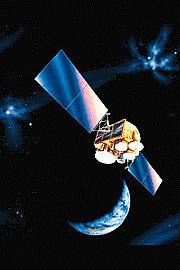 | DSCS Credit: USAF. 8,307 bytes. 180 x 270 pixels. |
Spacecraft engaged in research and exploration of the upper atmosphere or outer space (US Cat B). Launch vehicle put payload into geosynchronous transfer orbit with GCS trajectory option.
Spacecraft engaged in practical applications and uses of space technology such as weather or communication (US Cat C). Launch vehicle put payload into geosynchronous transfer orbit with GCS trajectory option.
Spacecraft engaged in practical applications and uses of space technology such as weather or communication (US Cat C). Launch vehicle put payload into geosynchronous transfer orbit with GCS trajectory option.
Spacecraft engaged in practical applications and uses of space technology such as weather or communication (US Cat C). Launch vehicle put payload into geosynchronous transfer orbit with GCS trajectory option.
Geosynchronous. Launch vehicle put payload into geosynchronous transfer orbit with GCS trajectory option.
Part of the US Air Force Defense Satellite Communications System. To be stationed in geosynchronous orbit over the Pacific Ocean.