
Credit: NASA. 28,885 bytes. 380 x 282 pixels.
| astronautix.com | Skylab |
|
| Skylab - Credit: NASA. 28,885 bytes. 380 x 282 pixels. |
First US space station. The project began life as the Orbital Workshop (see separate entry) - outfitting of an S-IVB stage with a docking adapter with equipment launched by several subsequent S-1B launches. Curtailment of the Apollo moon landings meant that surplus Saturn V's were available, so the pre-equipped, five times heavier, and much more capable Skylab resulted.
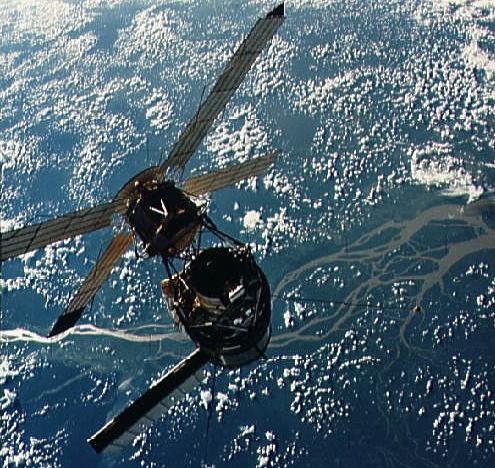
The external solar/meteoroid shield ripped off during ascent, tearing away one solar panel wing and debris jamming the remaining panel. Without the shield internal temperatures soared to 52 deg C (126 deg F). Launch of the first crew was delayed for 10 days to develop procedures and crew training to make the workshop habitable. Repairs by subsequent crews led to virtually all mission objectives being met. It was intended that the station would be revisited and boosted to a higher orbit on the third flight of the space shuttle. But delays in the shuttle program and higher-than-anticipated atmospheric drag led to the station decaying from orbit well before the first shuttle launch. Skylab re-entered the earth's atmosphere amid worldwide hysteria on July 11, 1979, with chunks of the disintegrating space station crashing over a wide area of Australia.Payload: Imaging cameras. White-light coronagraph. Ultraviolet scanning polychromator- spectroheliometer. Extreme ultraviolet and X-ray telescope. Space manufacturing experiments. Externally mounted Earth resources instruments included a multispectral imaging camera, an Earth terrain camera, an infrared spectrometer, a multispectral scanner, a microwave radiometer/scatterometer and altimeter, and an L-band microwave radiometer. From fore to aft, Skylab was made up of the following modules, each with their own development history and heritage from the earlier Orbital Workshop and Apollo Applications Program: MDA Multiple Docking Adapter: 5.2 m x 3.05 ft diameter / ATM Apollo Telescope Mount: 3.96 m x 3.05 ft diameter / AM Airlock Module: 5.49 m x 3.05 ft diameter / IU Instrument Unit: 0.9 m x 2.04 m diameter / OWS Orbital Workshop: 14.6 m x 6.7 ft diameter.
Craft.Crew Size: 3. Design Life: 600 days. Orbital Storage: 730.00 days. Total Length: 36.1 m. Maximum Diameter: 6.6 m. Total Habitable Volume: 361.00 m3. Total Mass: 76,295 kg. Electric system: 11.00 total average kW. Electrical System: Solar Panels, 2 Wings + 4 Windmill, each 14.94 m l.
 | Skylab Cutaway - Cutaway of the Skylab space station. Credit: NASA. 65,903 bytes. 640 x 515 pixels. |
During several visits to MSC, NASA Administrator James E. Webb raised a number of technical and policy questions relating to programs and management practices. Webb seemed particularly concerned about the difficulty of getting the program offices at Headquarters and the Centers to take an active interest in NASA's potential influence in the national economy and world affairs. Additional Details: Webb sees time as right to begin serious study of a Saturn V space station..
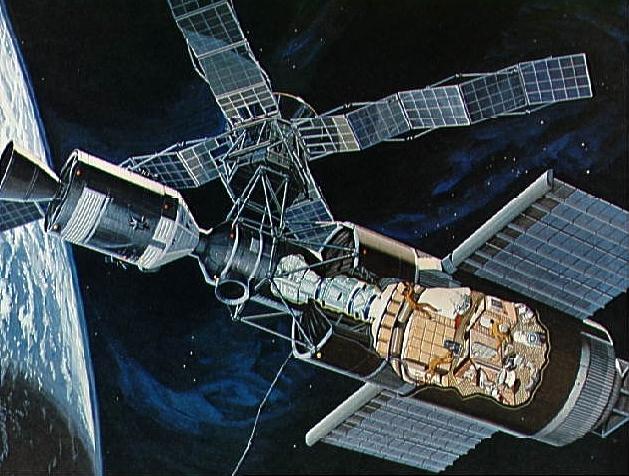 | Skylab - Artist's concept of Skylab space station cluster in Earth's orbit Credit: NASA. 69,090 bytes. 629 x 476 pixels. |
MSC and MSFC program officials and engineers held their first coordination meeting on the S-IVB Orbital Workshop and related Apollo Applications Program experiment activities. Among the most significant results of this meeting was a request by Houston for inclusion of an artificial gravity experiment as part of the S-IVB command and service module concept of the Workshop. MSFC officials undertook to define the feasibility of such an experiment, examining several possible technical approaches (including cables a concept that MSC found less shall appealing). MSFC investigators also sought help from LaRC, where considerable work along this line had been done as part of that Center's MORL study program.
Among these would be three 'S-IVB/Spent-Stage Experiment Support Modules' (i.e., 'wet' Workshops), three Saturn V-boosted orbital laboratories, and four Apollo telescope mounts. The initial AAP launch was slated for April 1968. The schedule was predicated upon non-interference with the basic Apollo lunar landing program, minimum modifications to basic Apollo hardware, and compatibility with existing Apollo launch vehicles.
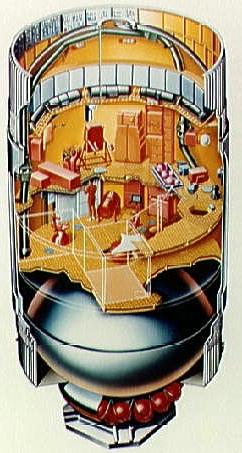 | Skylab - Artist's concept illustrating cutaway view of Skylab 1 Orbital Workshop (OWS) Credit: NASA. 30,321 bytes. 242 x 453 pixels. |
Maurice J. Raffensperger, Earth Orbital Mission Studies Director in NASA Hq, spelled out revised criteria for design of a one-year Workshop in space (criteria to be incorporated by MSFC and MSC planners into their proposed configurations). Maurice J. Raffensperger, Earth Orbital Mission Studies Director in NASA Hq, spelled out revised criteria for design of a one-year Workshop in space (criteria to be incorporated by MSFC and MSC planners into their proposed configurations): This 'interim space station' should be ready for launch in January 1971. The design had to be a minimum-cost structure capable of a two-year survival in low Earth orbit. (Raffensperger speculated that a 'dry-launched' S-IVB stage could be employed without major structural changes.) Initial vehicle subsystems were to consist of flight-qualified Apollo and Manned Orbiting Laboratory hardware capable of one-year operation. Operation of the station during the second year was to be accomplished by means of a long- duration 'developmental systems' module that would be attached to the original space station structure (and would be developed separately as part of the long-duration space station program). Initial launch of the station would be with a Saturn V (and include CSM). This interim space station must be suited for operation in either zero-g or with artificial gravity (using the 'simplest, least expensive' approach). Cost of the hardware must not exceed $200 million (excluding launch vehicle and the long-duration subsystems module). Cargo resupply and crew changes were to be carried out using Apollo Applications- modified CSMs (limited to three Saturn IBs per year).
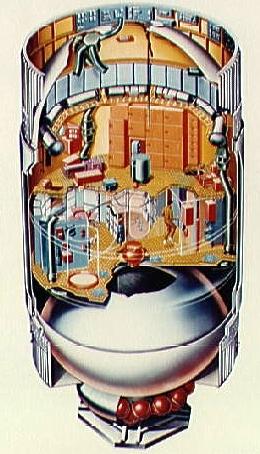 | Skylab - Artist's concept illustrating cutaway view of Skylab 1 Orbital Workshop (OWS) Credit: NASA. 32,944 bytes. 260 x 454 pixels. |
Six months later, a LM/ATM launch would follow a second manned flight. The LM/ATM would rendezvous and dock to the cluster. The first Workshop launch was scheduled for June 1968. As opposed to the habitable OWS and cluster concept which projected a much more complex program, the S-IVB SSESM had been a comparatively simple mission requiring no rendezvous and docking and no habitation equipment. A major similarity between the old S-IVB/SSESM concept and the cluster concept was use of the S-IVB stage to put the payload into orbit before passivation and pressurization of the stage's hydrogen tanks. The new cluster concept embodied the major step of making the Saturn IVB habitable in orbit, incorporating a two-gas atmosphere (oxygen and nitrogen) and a 'shirt- sleeve' environment. The OWS would contain crew quarters in the S IVB hydrogen tank (two floors and walls installed on the ground), which would be modified by Douglas Aircraft Company under MSFC management; an airlock module (previously called the SSESM) attached to the OWS, which would be built by McDonnell Aircraft Corporation under MSC management; and a multiple docking adapter (MDA), which would contain five docking ports permitting up to five modules to be docked to the Workshop at any one time. The MDA would also house most OWS astronaut habitability equipment and many experiments. The schedule called for 22 Saturn IB and 15 Saturn V launches. Two of the Saturn IBs would be launched a day apart-one manned, the other unmanned. Flights utilizing two Saturn V Workshops and four LM ATM missions were also scheduled.
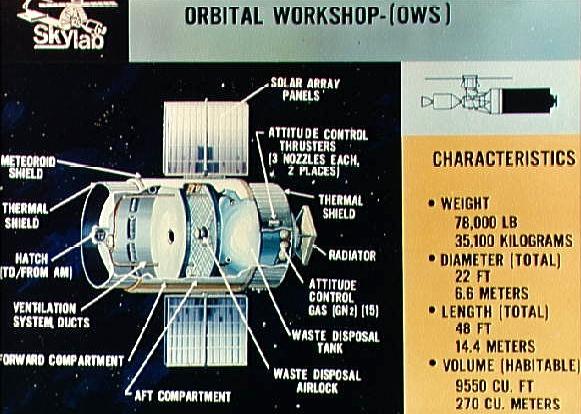 | Skylab - Artist's concept illustrating cutaway view of Skylab 1 Orbital Workshop (OWS) Credit: NASA. 57,785 bytes. 581 x 414 pixels. |
Because of the Apollo 204 accident in January and the resulting program delays, NASA realigned its Apollo and AAP launch schedules. The new AAP schedule called for 25 Saturn IB and 14 Saturn V launches. Major hardware for these launches would be two Workshops flown on Saturn IB vehicles, two Saturn V Workshops, and three ATMs. Under this new schedule, the first Workshop launch would come in January 1969.
This contract marked the first Saturn V procurement in support of Apollo Applications Program.
NASA Hq issued a revised AAP schedule incorporating recent budgetary cutbacks. The schedule reflected the reduction of AAP lunar activity to four missions and of Saturn V Workshop activity to 17 Saturn IB and 7 Saturn V launches. There would be two Workshops launched on Saturn IBs, one Saturn V Workshop, and three ATMs. Launch of the first Workshop was scheduled for March 1970.
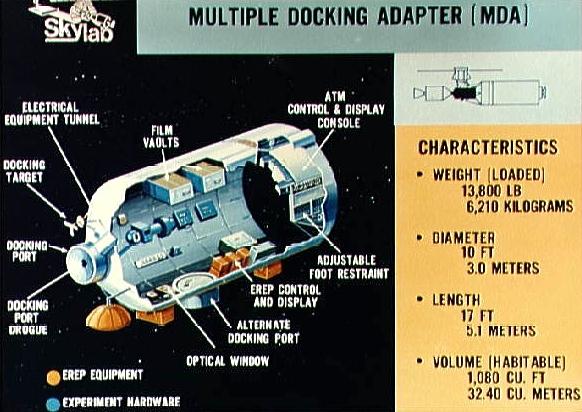 | Skylab - Artist's concept illustrating cutaway view of Skylab multiple docking adapter Credit: NASA. 53,730 bytes. 582 x 412 pixels. |
NASA budgetary restraints required an additional cut in AAP launches. The reduced program called for three Saturn IB and three Saturn V launches, including one Workshop launched on a Saturn IB, one Saturn V Workshop, and one ATM. Two lunar missions were planned. Launch of the first Workshop would be in April 1970.
Nomenclature for the OWS included in the AAP presented in the FY 1969 budget was confirmed by NASA. The ground-outfitted OWS to be launched with Saturn V would be designated the 'Saturn V Workshop.' (This had sometimes been called the 'dry Workshop.') The OWS that would be launched by a Saturn IB would be referred to as the 'Saturn I Workshop.' (Colloquially it had been referred to as the 'wet workshop.') Terminology 'Uprated Saturn I' would not be used officially. This launch vehicle would be referred to as the 'Saturn IB.'
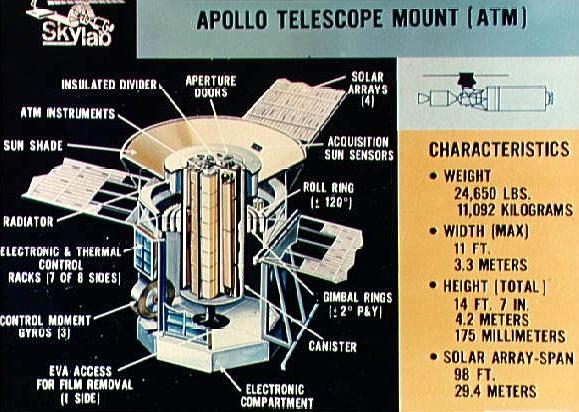 | Skylab - Artist's concept illustrating cutaway view of Skylab Apollo Telescope Mount Credit: NASA. 59,440 bytes. 579 x 412 pixels. |
NASA released a new AAP launch readiness and delivery schedule. The schedule decreased the number of Saturn flights to 11 Saturn IB flights and one Saturn V flight. It called for three Workshops. One of the Workshops would be launched by a Saturn IB, and another would serve as a backup. The third Workshop would be launched by a Saturn V. The schedule also included one ATM. Launch of the first Workshop would be in November 1970. Lunar missions were no longer planned in the AAP.
Gilruth and Von Braun support decision to fly a complete integrated solution on a single Saturn V launch. Additional Details: Saturn V "dry" Workshop decision..
NASA Administrator Thomas O. Paine approved the shift from a 'wet' to a 'dry' Orbital Workshop concept for AAP following a review presentation by program officials on the potential benefits of such a change. On 22 July, AAP Director William C. Schneider ordered program managers at the three Centers to implement the change, abandoning the idea of using a spent Saturn IB second stage for a Workshop and adopting the concept of a fully equipped 'dry' configuration-with the ATM integrated into the total payload-launched aboard a Saturn V. Additional Details: NASA Administrator Paine approved the shift from a "wet" to a "dry" Orbital Workshop for AAP..
 | Skylab - Artist's concept illustrating cutaway view of Skylab Airlock Module Credit: NASA. 53,082 bytes. 582 x 413 pixels. |
Program objectives for AAP remained unchanged, however. The schedule called for first launch in 1972. The Workshop would be placed in a circular orbit first. About a day later, the three-man crew would ride aboard a Saturn IB into orbit to link up with the Workshop-ATM cluster, thus beginning the manned portion of the mission.
Representatives from NASA Hq, KSC, MSC, MSFC, Harvard College Observatory, and Naval Research Laboratory attended. Except for the mechanical reticle subsystem, a requirement recently added to the telescope system, the Perkin-Elmer design appeared sound. Only minor discrepancies were noted.
MSFC definitized the existing contract with McDonnell Douglas for two Orbital Workshops for the Apollo Applications Program, converted S IVB stages to be launched by Saturn V boosters. The contract was slated to run through July 1972, with most of the work to be performed at the company's plant at Huntington Beach, California. The first Workshop was tentatively scheduled for flight in mid-1972, with the second article initially serving as a backup vehicle if needed.
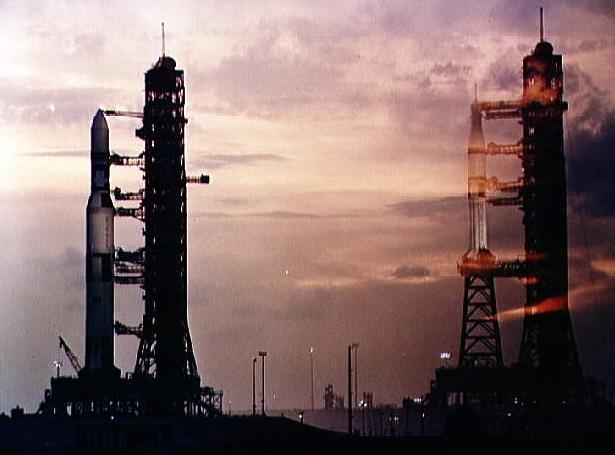 | Skylab - Double exposure to illustrate size difference between Skylab 1 and 2 Credit: NASA. 34,373 bytes. 615 x 455 pixels. |
The objectives, constraints, and guidelines for a second OWS were stated in general terms along the following lines: OWS would reflect the same physical features and capabilities exhibited by the initial Workshop and would use the flight hardware to be procured as backup for the first Workshop missions. Crew complement would consist of three men (at least one scientist astronaut). Operating life would be 12 to 24 months, nominally continuously manned. Orbital altitude would be in the range of 390 to 500 km at an inclination up to 55°. Additional Details: The objectives, constraints, and guidelines for a second Skylab OWS..
Two major directions were identified for manned space flight in the next decade. These were further exploration of the Moon, with possibly the establishment of a lunar surface base, and the continued development of manned flight in Earth orbit, leading to a permanent manned space station supported by a low-cost shuttle system. To maintain direction, the following key milestones were proposed: 1972 - AAP operations using a Saturn V launched Workshop 1973 - Start of post-Apollo lunar exploration 1974 - Start of suborbital flight tests of Earth to orbit shuttle - Launch of a second Saturn V Workshop 1975 - Initial space station operations - Orbital shuttle flights 1976 - Lunar orbit station - Full shuttle operations 1977 - Nuclear stage flight test 1978 - Nuclear shuttle operations-orbit to orbit 1979 - Space station in synchronous orbit By 1990 - Earth orbit space base - Lunar surface base - Possible Mars landing
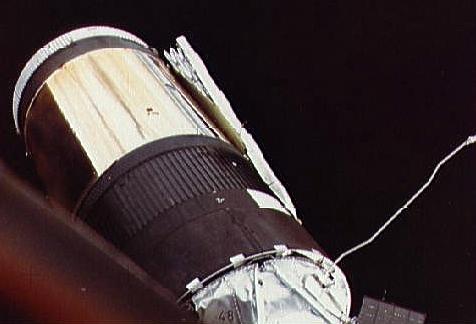 | Skylab 2 - Rendezvous and Fly Around Inspection of Skylab I Orbital Space Station Credit: NASA. 20,009 bytes. 476 x 324 pixels. |
The stage had earlier been used as a Saturn V facilities vehicle to check out manufacturing, testing, and launching facilities during the Apollo/Saturn V program.
Among the items covered were the film vault design, film test program, subsystems status, module ground test program, quality and reliability, mission operations support to MSC, prototype refurbishment, project schedules, and funding.
NASA announced that the Apollo Applications Program had been redesignated the Skylab Program. The name Skylab, a contraction connoting a laboratory in the sky, was proposed by Donald L. Steelman, USAF, while assigned to NASA. The name was proposed following an announcement by NASA in 1968 that they were seeking a new name for AAP. Then NASA decided to postpone renaming the program because of budgetary restrictions. Skylab was later referred to the NASA Project Designation Committee and was approved 17 February 1970.
 | Skylab 2 - Rendezvous and Fly Around Inspection of Skylab I Orbital Space Station Credit: NASA. 33,352 bytes. 440 x 460 pixels. |
The requirement was not mandatory for mission success. The schedule impact was unacceptable.
The contract called for delivery by July 1971 of a six-lens camera unit which would become part of the Earth resources experiment package in the Skylab missions.
Apollo 18 and 19 might be scrapped because some NASA planners wanted to use the boosters and spaceships already being built to speed the space base and space station programs. Assistant Administrator George M. Low was reported as saying NASA already was studying the possibility of canceling Apollo 19 and using its Saturn V booster and the Apollo spacecraft for a second Skylab. NASA said there was sentiment for using Apollo 18 equipment for an even more ambitious venture-base station-that would stay aloft for 10 years (vs. 1 year for Skylab) and could be added onto until it could accommodate 100 men.
 | Skylab 2 - Skylab 2 Crewmember During EVA to Repair and Deploy Damaged Solar Panel Credit: NASA. 32,045 bytes. 509 x 418 pixels. |
The focus was on those actions available to ensure the rapid return of command and service modules in the event of a malfunction forcing an abort and possible actions that would permit completion of OWS onboard functions to ensure acquisition of maximum experiment data.
The feasibility of docking a second Orbital Workshop to Skylab 1 had been under consideration. However, the practical problems that would be engendered by such an operation were formidable. They included such items as docking loads, docking control, flight attitude of tandem Skylabs, consumables, and in-orbit storage of Skylab 1.
The agreement definitized a letter contract issued in March 1969.
The multispectral scanner would be flown as part of Skylab's Earth resources experiment package. Purpose of the scanner would be to detect and measure radiated and reflected solar energy from materials on Earth.
 | Skylab 2 - Skylab 2 Farewell View from the Departing Skylab Command/Service Module Credit: NASA. 18,331 bytes. 344 x 303 pixels. |
General Electric Company, Valley Forge, Pennsylvania, was awarded a contract for the design, development, and delivery of a microwave radiometer-scatterometer/altimeter instrument for the Skylab Program. The instrument would be part of the Earth-resources experiment package, which also included a multispectral photographic facility, an infrared scanner, and a 10-band multispectral scanner. Objectives of the microwave radiometer- scatterometer/altimeter experiment would be to determine the usefulness of active and passive microwave systems in providing information on land and sea conditions.
The AC Electronics contract would provide Apollo CSM and LM guidance and navigation systems test and mission support at KSC for the Apollo and Skylab Programs. The General Electric contract would provide personnel and equipment for maintenance and operation of acceptance checkout equipment and quick look data systems which were designed and built by General Electric.
The radiometer would measure brightness and temperature of the terrestrial surface of the Skylab ground track.
 | Skylab 2 - Skylab 2 Farewell View from the Departing Skylab Command/Service Module Credit: NASA. 50,165 bytes. 380 x 477 pixels. |
The AM was a 1.6-m-diameter tunnel attached to the top of the Workshop. It provided the major work area and support equipment required to activate and operate the Workshop and also formed a passageway for the astronauts to move from the Apollo CM and MDA into the Workshop. The airlock could also be depressurized and sealed off for exit into space outside the vehicle.
The review was a detailed technical examination of the total AM, including the environmental control systems, electrical and power management, data and communications, structural and mechanical, and other miscellaneous and experiment-support systems.
This was the final technical review before approval for manufacturing flight hardware.
 | Skylab 2 - Skylab 2 Farewell View from the Departing Skylab Command/Service Module Credit: NASA. 23,329 bytes. 470 x 240 pixels. |
An Orbital Workshop critical design review was conducted at McDonnell Douglas, Huntington Beach. Personnel from NASA Hq, MSC, KSC, MSFC, and McDonnell Douglas participated. The review was conducted by panels representing six different technological disciplines. Areas of potential major impact included the urine system, microbiological contamination, the water storage system, and the OWS window vibration test.
Singer-General Precision, Inc., Link Division, Houston, was selected for the award of a contract to design, develop, install, and support a Skylab simulator to provide astronaut and ground crew training at MSC. The simulator would serve as a ground-based trainer with controls and displays similar to those used during manned operations. It would also be operated in conjunction with the command module simulator and the Mission Control Center to provide complete mission training.
 | Skylab 3 - View of the Skylab space station cluster photographed against black sky Credit: NASA. 44,662 bytes. 627 x 471 pixels. |
The week-long EVA review included astronaut performance under normal Earth gravity in the Saturn Workshop mockup and simulated weightlessness in the neutral buoyancy simulator. Ten astronauts from MSC took part in the review activities.
The Skylab MDA flight unit was flown from MSFC to Martin Marietta's Denver division where it was to be outfitted with controls and display panels for solar astronomy and Earth resources experiments, storage vaults for experiment film, and a thruster attitude control system.
It would undergo testing there until 30 December and then would be shipped to MSC for extensive ground tests. This Workshop was a version of one that would be used in the Skylab Program to accommodate teams of three astronauts for stays of up to 56 days in Earth orbit. NASA planned to launch the Skylab cluster with a Saturn V vehicle in 1972. Called a 'dynamic test article,' the Workshop model would be tested at MSC to verify its bending and vibration characteristics. The Workshop was scheduled to arrive at Michoud 17 December and at MSC 5 January.
 | Skylab 3 - View of the Skylab space station cluster photographed against black sky Credit: NASA. 106,135 bytes. 615 x 479 pixels. |
The Orbital Workshop dynamic test article arrived at the Clear Lake Creek Basin adjacent to MSC aboard the barge Orion. It was offloaded on 7 January and moved to the MSC acoustic test facility where it was set up for vibroacoustic testing scheduled to start on 20 January. The acoustic test facility had been checked out previously, and the acoustic environments generated met simulated conditions surrounding the Skylab during Skylab I liftoff and Skylab 1 maximum gravity.
An Orbital Workshop management review was conducted at McDonnell Douglas. Representatives from McDonnell Douglas, NASA Hq, KSC, MSFC, and MSC attended. Significant agenda items included the program schedule, engineering changes, design status, component tests, and procurement status. The OWS flight module was about three months behind schedule. The component development and qualification testing was also behind schedule. McDonnell Douglas reorganized the procurement activity and was making a significant effort to improve this area since it directly impacted the schedule slip.
During the final testing, the dynamic test article was exposed to the full intensity of the aerodynamic acoustic environment to qualify the Workshop structural design. No major problems were encountered. However, vibration levels in some areas exceeded the established criteria. The new vibration levels were given to McDonnell Douglas, and adjustments in the qualification test criteria were made as appropriate.
 | Skylab 3 - View of the Skylab space station cluster photographed against black sky Credit: NASA. 75,104 bytes. 495 x 468 pixels. |
During the past Near, design and essentially all phases of development testing had been completed for Skylab, and flight hardware was in fabrication. Definition of Space Shuttle was nearing completion. To develop a limited capability to rescue Skylab astronauts from space, NASA had initiated design action on a modification kit to give Skylab the capacity to carry two men up to orbit and five men back to Earth. Stranded astronauts could use the SkyIab cluster as shelter while the modification kit was installed and the Apollo-Saturn IB launch vehicle assigned to next revisit was made ready for launch.
Although use of Launch Complex 37 for Space Shuttle engine testing had been considered, other options were chosen, and the complexes were to be removed from NASA operational facilities inventory.
Orbital Workshop vibration test objectives, test article status, test facility preparation status, and test schedules were reviewed by MSFC and MSC during a test readiness review prior to a Skylab OWS vibration test at MSC. The review board concluded, upon resolution of one test constraint, that the initial run could proceed on schedule on 19 March.
 | Skylab 3 - View of Arabella, one of two Skylab spiders and her web Credit: NASA. 48,337 bytes. 622 x 475 pixels. |
Dale D. Myers, NASA Associate Administrator for Manned Space Flight, testifying before the Senate Committee on Aeronautical and Space Sciences, said that in the Skylab Program three separate three-man Skylab; flight crews would be selected during the coming year. Scientist astronauts would he included and would perform about 50 experiments in various disciplines. Twenty of these would be in the life sciences, to determine how human beings adjust and perform under conditions of prolonged space flight, up to two months' duration. The scientist astronauts would also operate the Skylab Earth resources experiment package in the second space flight phase of NASA's Earth resources program. These observations would be in conjunction with and complementary to those of the automated Earth Resources Test Satellite (ERTS) to be launched in 1972.
The firing was made without problems. Depletion of both oxidizer and fuel occurred at about the same time.
 | Skylab 3 - Skylab Astronaut participates in EVA to deploy twin pole solar shield Credit: NASA. 21,146 bytes. 325 x 473 pixels. |
During the conference, a weight control limit of 86 000 kg was imposed.
The official Skylab launch and mission designations were announced: Workshop launch: SL-1. First manned visit: SL-2. Second manned visit: SL-3. Third manned visit: SL-4.
A study was conducted at MSFC on the effects of various pitch attitudes at the time of the Skylab payload shroud jettison on the possibility that the shroud would collide with the Skylab at a later date. Based on the study, a 10-degree attitude error constraint on a 90-degree-pitch (nose down) shroud separation attitude was recommended to preclude such a collision.
All available stowage space in the command module would be needed for film, experiment samples and specimens, flight data files, life support equipment, and supplies.
 | Skylab 3 - Dummy left behind by Skylab 3 crew for the Skylab 4 crew Credit: NASA. 41,675 bytes. 336 x 472 pixels. |
Apollo experience was utilized in the design and development of the Skylab water system which consisted of Ten 272-kg storage tanks A chiller and three water dispensers for drinking water A heater and two water dispensers for food reconstitution A heater and water dispenser for personal hygiene A portable water container and fixed and flexible plumbing with disconnect fittings
At MSFC, the ATM was placed in a clean room in the Quality and Reliability Assurance Laboratory for a system checkout. It would next undergo vibration testing in the Astronautics Laboratory and then would be refurbished to serve as a backup for the flight model. While at MSC, the ATM prototype, which was assembled at MSFC, had been subjected to space conditions in a large chamber used for testing the Apollo spacecraft.
 | Skylab 3 - Hurricane Ellen over the Atlantic Ocean taken by Skylab 3 crewmen Credit: NASA. 33,929 bytes. 478 x 420 pixels. |
A Skylab crew news conference, with prime and backup crewmen, was held at MSC. Astronaut Charles Conrad, Jr., said preparations were on schedule for an April 1973 launch. Contractor checkouts and tests of hardware were expected to be completed for delivery to KSC in July. Skylab would carry some 20 000 pieces of stowed equipment on board to provide life support for nine men for 140 days. 'So it all goes up at one time, and we've got a great deal of work to do, not only to learn how to operate this vehicle but also all the experiments in it. It became apparent that we could not be 100-percent cross-trained as we had been in Apollo, so we've . . . defined some areas for each guy to become expert in. That allowed us to balance out the training hours. Additional Details: A Skylab crew news conference; preparations on schedule for April 1973 launch..
Evaluation of events and redesign resulting from the May 1971 OWS-1 meteoroid shield deployment test indicated that a successful 'mechanical separation and deployment' must be demonstrated prior to shipment of the flight article to KSC. Additional Details: Results from the May 1971 OWS-1 meteoroid shield deployment test..
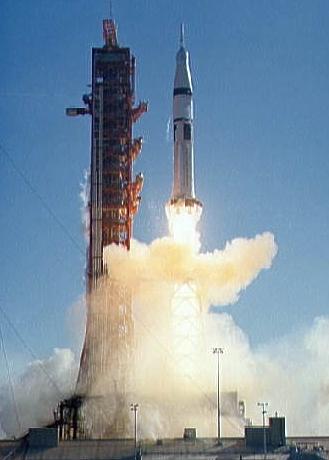 | Skylab 4 - Launch of the Skylab 4/Saturn 1B space vehicle Credit: NASA. 18,311 bytes. 329 x 460 pixels. |
During an Orbital Workshop meteoroid shield test at MSFC, it was discovered that in one hinge section of the foldout panel, nine of the 15 torsion springs were installed in such a manner that they were only 50-percent effective in action to assist shield deployment. Action was initiated to ensure proper spring action.
MSFC, KSC, and MSC performed studies which identified the cost and reliability tradeoffs on planned one- and two-week slips between the launches of SL-1 and SL-2. An analysis of the studies identified significant cost and reliability penalties that would be incurred if the SL-2 mission were slipped, reconfirmed the desirability of getting the CSM docked to the Orbital Workshop as soon as possible after launch of SL-1, and recommended against extending the launch interval between SL-1 and SL-2. Launch plans called for a 1-day interval between the two launches.
Astronauts would step inside a ring on the floor and raise a fireproof beta cloth curtain on a hoop and attach it to the ceiling. A flexible hose with push-button shower nozzle could spray 2.8 liters of water from the personal hygiene tank during each bath. Used water would be vacuumed from the shower enclosure into a disposable bag and deposited in the waste tank.
 | Skylab 4 - Astronaut Edward Gibson stands at Apollo Telescope Mount in Skylab Credit: NASA. 65,436 bytes. 628 x 440 pixels. |
Ninety percent of the crew compartment fit and function hardware items were satisfactorily reviewed. Problems identified by the crew included numerous mechanical problems in the urine collection system, tools breaking, snaps debonding, and velcro debonding.
Two teams of six astronauts performed checkout activities in two, six-hour shifts daily for three days, activating the Workshop to demonstrate that it could support all activities planned for missions. The test was one of the last two major tests for the Workshop, which was 14.6 m long, 6.7 m in diameter, and scheduled for launch in early 1973. A flight demonstration would be conducted before the spacecraft was shipped to KSC during the summer.
The ATM development began in 1965 and was scheduled for launch in 1968. The long delay in launch time meant that the Principal Investigators, their in-house staffs, and their contractors had to be supported for the additional four years. Other factors which contributed to the cost increase were new state-of-the art developments for which NASA or the Principal Investigators had no previous experience.
 | Skylab 4 - Skylab 4 crewmen passing trash bags in to the OWS waste disposal tank Credit: NASA. 50,417 bytes. 405 x 478 pixels. |
An Orbital Workshop all-systems test began on 17 July 1972 and was completed on 7 August 1972 at McDonnell Douglas' Huntington Beach Vehicle Checkout Laboratory. Following the test, which lasted 309 hours, a meeting was held to verify that the OWS all-systems test had been successfully completed. At the conclusion of the meeting, it was agreed that pending closeout of the test anomalies, all test requirements had been satisfied.
A special ceremony at McDonnell Douglas, Huntington Beach, marked completion of the OWS, the main section of the Skylab space station. The OWS, with a volume equivalent to that of a five-room house, was being readied for shipment to Cape Kennedy aboard the USNS Point Barrow. The trip would take 13 days.
The Skylab 1 Orbital Workshop was offloaded from a NASA barge and moved into the transfer aisle of the Vehicle Assembly Building (VAB) at KSC. The OWS had arrived the preceding day (22 September) aboard the Point Barrow at Port Canaveral, where it was transferred to a smaller barge for the journey through the locks, up the Banana River, and through the access canal to the barge unloading area at the VAB. Following preliminary checkout, the OWS, with its 361.4 cu m of living and working area, was scheduled to be mated to the twostage Saturn V launch vehicle on 28 September.
 | Skylab 4 - View of Skylab 4 Command/Service module in docked configuration Credit: NASA. 50,057 bytes. 627 x 431 pixels. |
Examples cited were The payload shroud, where a conservative estimate of savings at the expense of 5900 kg of payload was approximately $35 million. The gas storage system where a 2700-kg heavier payload resulted in an estimated savings of $5 million. Other structural elements, in addition to the payload shroud, accommodated 2200 kg of added payload weight for an additional savings of $35 million.
Studies were conducted to determine the feasibility of conducting a controlled deorbit of the Orbital Workshop. Three methods were considered: (l) using the CSM service propulsion system; (2) using the CSM reaction control system; and (3) implementing an S-II (Saturn V second stage) deorbit. The service propulsion system deorbit was assessed as not feasible; the reaction control system deorbit was considered technically feasible but, like the service propulsion system, it had an inherent program and crew safety risk associated with it. Implementation of an S-II deorbit would have serious time and cost impacts on the program. A 1970 study, which indicated that the probability of damage from the deorbiting Skylab was so small that changes which caused major impact in cost and schedule were not worth pursuing, was confirmed.
 | Skylab 4 - Astronaut Gerald Carr during EVA on Skylab 4 Credit: NASA. 67,713 bytes. 618 x 439 pixels. |
First and only US space station to date. Project began life as Apollo Orbital Workshop - outfitting of an S-IVB stage with docking adapter with equipment launched by several subsequent S-1B launches. Curtailment of the Apollo moon landings meant that surplus Saturn V's were available, so the pre-equipped, five times heavier, and much more capable Skylab resulted.
An unexpected telemetry indication of meteoroid shield deployment and solar array wing 2 beam fairing separation was received 1 minute and 3 seconds after liftoff. However, all other systems of the OWS appeared normal, and the OWS was inserted into a near-circular Earth orbit of approximately 435 km altitude. The payload shroud was jettisoned, and the ATM with its solar array was deployed as planned during the first orbit. Deployment of the Workshop solar array and the meteoroid shield was not successful. In fact the xternal solar/meteoroid shield had ripped off 63 seconds into ascent, tearing away one solar panel wing and debris jamming the remaining panel. Without shield temperatures soared in station. Repairs by crews led to virtually all mission objectives being met.
 | Skylab 4 - View of a South Pacific storm photographed from Skylab space station Credit: NASA. 43,807 bytes. 474 x 473 pixels. |
Upon completion of the engineering tests, Skylab was positioned into a stable attitude and systems were shut down. It was expected that Skylab would remain in orbit eight to ten years. It was to have been visited by an early shuttle mission, reboosted into a higher orbit, and used by space shuttle crews. But delays in the first flight of the shuttle made this impossible.
On July 11, 1979, Skylab disintegrated when it re-entered the earth's atmosphere after a worldwide scare over its pending crash. The debris stretched from the south-east Indian Ocean into Western Australia. Additional Details: Skylab 1.
The review board determined that a 'Skylab parasol,' with a strengthened ultraviolet resistant material, deployed through the scientific airlock would be the prime method for the deployment of a thermal shield on the Orbital Workshop. A 'twin pole' thermal shield and a standup extravehicular thermal sail would be flown as backup methods. Following final assessment of mission readiness with favorable recommendations, a certification of flight worthiness for the new hardware was executed.
 | Skylab 4 - View of portion of Queensland, Australia from Skylab space station Credit: NASA. 49,980 bytes. 475 x 477 pixels. |
Succeeded in release of jammed solar panel.
Replacement of film cartridges for solar camera.
At 9:49 a.m. EDT, Skylab 2 splashed down in the Pacific Ocean 9.6 km from the recovery ship, U.S.S. Ticonderoga , and 1320 km southwest of San Diego. At 10:28 a.m., the crew and spacecraft were aboard the Ticonderoga. The objectives of the SL-1/SL-2 mission were to establish the Orbital Workshop in Earth orbit, obtain medical data on the crew for use in extending the duration of manned space flight, and perform inflight experiments. A summary assessment of the mission objectives indicated a very high degree of completion, particularly when the reduction in experiment time due to parasol deployment, solar array wing deployment, and OWS system anomalies were considered. Additional Details: Skylab 2 splashed down..
The launch date for Skylab 3 was officially established as 28 July 1973. The launch window would open at 7:08 a.m. EDT for 10 minutes and would provide for a rendezvous in five revolutions. Recovery of SL-3 was planned for 22 September 1973. Two members of the Skylab 3 crew, Jack R. Lousma, left, and Owen K. Garriott, center, inspect a part of the twin-pole solar sail at MSFC (above). At right, Lousma practices erecting the solar sail over a portion of the Orbital Workshop mock in the MSFC Neutral Buoyancy Tank. Nylon netting was used for this underwater training instead of the aluminized fabric the actual sail was made of.
 | Skylab 4 - View of Melbourne, Australia as seen from Skylab space station Credit: NASA. 45,310 bytes. 494 x 474 pixels. |
The Skylab 3 crewmen experienced motion sickness during the first three visit days. Consequently, the Orbital Workshop activation and experiment implementation activities were curtailed. By adjusting the crew's diet and maintaining a low workload, the crew was able to complete the adjustment to space flight in five days, after which flight activities returned to normal. On 25 September, the command module was reactivated and the crew performed the final OWS closeout. Following undocking and separation, the command module entered the atmosphere and landed in the Pacific Ocean approximately 300 km southwest of San Diego. Splashdown was at 6:20 p.m. EDT. The recovery ship, U.S.S. New Orleans, retrieved the command module and crew 42 minutes after landing. The total flight time was 1427 hours 9 minutes 4 seconds. Additional Details: Skylab 3 activation activities curtailed..
Anomalies that had occurred during micrometeoroid shield testing were summarized. Additional Details: Anomalies during micrometeoroid shield testing..
NASA decided to delete the Skylab backup Saturn V Orbital Workshop launch capability effective 15 August. All work associated with the completion, checkout, and support of Skylab backup hardware, experiments, software, facilities, and ground support equipment would be canceled immediately, except for the work that would directly support SL-3, SL-4, and rescue missions.
Replaced solar camera film cartridges; installed replacement gyroscopes.
Replaced film cartridges for solar camera.
The reactivation included the reservicing of the airlock module primary coolant loop. The commander and pilot experienced symptoms resembling motion sickness during the initial three days of the visit, and flight plan activities were adjusted accordingly. Crew health was good thereafter. Additional Details: Skylab Orbital Workshop activation by the crew of Skylab 4..
Repaired antenna. Replaced solar camera film cartridges.
Photographed Comet Kohoutek and replaced solar camera film cartridges.
Photographed Comet Kohoutek.
Studies had been conducted to determine an end-of-mission configuration for the Orbital Workshop and for maintaining the option of an OWS revisit at some future date. MSFC assessed the special deactivation requirements for the AM, MDA, and the Workshop required to establish a satisfactory, economical configuration. JSC made an evaluation of ground support monitoring and control options. The OWS would be left in a configuration that would permit a revisit at some future date without reactivation.
Retrieved solar camera film cartridges and external materials exposure package.
MSFC published a summary of Skylab operations. Additional Details: Summary of Skylab operations..
NASA realized that after the completion of the Apollo, Skylab, and ASTP programs there would still be significant Apollo surplus hardware. This amounted to two Saturn V and three Saturn IB boosters; one Skylab space station, three Apollo CSM's and two Lunar Modules. After many iterations NASA considered use of these assets for a second Skylab station in May 1973. A range of options were considered. Saturn V SA-515 would boost the backup Skylab station into orbit somewhere between January 1975 and April 1976. It would serve as a space station for Apollo and Soyuz spacecraft in the context of the Apollo ASTP mission. The Advanced or International Skylab variants proposed use of Saturn V SA-514 to launch a second workshop module and international payloads. This station would be serviced first by Apollo and Soyuz, then by the space shuttle. Using the existing hardware, these options would cost anywhere from $ 220 to $ 650 million. But funds were not forthcoming. The decision was taken to mothball surplus hardware in August 1973. In December 1976, the boosters and spacecraft were handed over to museums. The opportunity to launch an International Space Station, at a tenth of the cost and twenty years earlier, was lost.
MSFC definitized the existing contract with McDonnell Douglas for two Orbital Workshops for the Apollo Applications Program, converted S IVB stages to be launched by Saturn V boosters. The contract was slated to run through July 1972, with most of the work to be performed at the company's plant at Huntington Beach, California. The first Workshop was tentatively scheduled for flight in mid-1972, with the second article initially serving as a backup vehicle if needed.
The objectives, constraints, and guidelines for a second OWS were stated in general terms along the following lines: OWS would reflect the same physical features and capabilities exhibited by the initial Workshop and would use the flight hardware to be procured as backup for the first Workshop missions. Crew complement would consist of three men (at least one scientist astronaut). Operating life would be 12 to 24 months, nominally continuously manned. Orbital altitude would be in the range of 390 to 500 km at an inclination up to 55°. Additional Details: The objectives, constraints, and guidelines for a second Skylab OWS..
NASA announced that the Apollo Applications Program had been redesignated the Skylab Program. The name Skylab, a contraction connoting a laboratory in the sky, was proposed by Donald L. Steelman, USAF, while assigned to NASA. The name was proposed following an announcement by NASA in 1968 that they were seeking a new name for AAP. Then NASA decided to postpone renaming the program because of budgetary restrictions. Skylab was later referred to the NASA Project Designation Committee and was approved 17 February 1970.
Definition studies for a second Orbital Workshop (Skylab II) were under study. Mission objectives would respond to the following major objectives: continued development and expansion of the ability to live, work, and operate effectively in space; exploitation of space for practical benefits through the observation of Earth and its environment; and the use of space for scientific research.
The feasibility of docking a second Orbital Workshop to Skylab 1 had been under consideration. However, the practical problems that would be engendered by such an operation were formidable. They included such items as docking loads, docking control, flight attitude of tandem Skylabs, consumables, and in-orbit storage of Skylab 1.
MSFC issued a modification to an existing contract with McDonnell Douglas for Skylab Program work. The modification would pay for the conversion of the original OWS to be launched by a Saturn IB booster to a completely outfitted Workshop to be launched by a Saturn V. Originally the plan was to launch the second stage (S IVB) of a Saturn IB into Earth orbit. The S-IVB would be filled with fuel so that it could propel itself into orbit. Astronauts launched by a second Saturn IB would then rendezvous with the empty stage and convert it into living and working quarters. A decision was made 21 May 1969 to outfit an S-IVB on the ground and launch it ready for use on a Saturn V.
An Orbital Workshop critical design review was conducted at McDonnell Douglas, Huntington Beach. Personnel from NASA Hq, MSC, KSC, MSFC, and McDonnell Douglas participated. The review was conducted by panels representing six different technological disciplines. Areas of potential major impact included the urine system, microbiological contamination, the water storage system, and the OWS window vibration test.
The Orbital Workshop dynamic test article arrived at the Clear Lake Creek Basin adjacent to MSC aboard the barge Orion. It was offloaded on 7 January and moved to the MSC acoustic test facility where it was set up for vibroacoustic testing scheduled to start on 20 January. The acoustic test facility had been checked out previously, and the acoustic environments generated met simulated conditions surrounding the Skylab during Skylab I liftoff and Skylab 1 maximum gravity.
An Orbital Workshop management review was conducted at McDonnell Douglas. Representatives from McDonnell Douglas, NASA Hq, KSC, MSFC, and MSC attended. Significant agenda items included the program schedule, engineering changes, design status, component tests, and procurement status. The OWS flight module was about three months behind schedule. The component development and qualification testing was also behind schedule. McDonnell Douglas reorganized the procurement activity and was making a significant effort to improve this area since it directly impacted the schedule slip.
Training mockups of several components of the Skylab spacecraft arrived at MSC. The Orbital Workshop and the Apollo telescope mount arrived aboard the NASA barge Orion. The shipment also included the multiple docking adapter exterior shell and a portion of the airlock module mockup. The AM one-g trainer had arrived previously at MSC on a contingent of six trucks. The trainers and hardware were scheduled for use by MSC in training prospective Skylab crewmen for missions.
During an Orbital Workshop meteoroid shield test at MSFC, it was discovered that in one hinge section of the foldout panel, nine of the 15 torsion springs were installed in such a manner that they were only 50-percent effective in action to assist shield deployment. Action was initiated to ensure proper spring action.
An Orbital Workshop all-systems test began on 17 July 1972 and was completed on 7 August 1972 at McDonnell Douglas' Huntington Beach Vehicle Checkout Laboratory. Following the test, which lasted 309 hours, a meeting was held to verify that the OWS all-systems test had been successfully completed. At the conclusion of the meeting, it was agreed that pending closeout of the test anomalies, all test requirements had been satisfied.
A special ceremony at McDonnell Douglas, Huntington Beach, marked completion of the OWS, the main section of the Skylab space station. The OWS, with a volume equivalent to that of a five-room house, was being readied for shipment to Cape Kennedy aboard the USNS Point Barrow. The trip would take 13 days.
The Skylab 1 Orbital Workshop was offloaded from a NASA barge and moved into the transfer aisle of the Vehicle Assembly Building (VAB) at KSC. The OWS had arrived the preceding day (22 September) aboard the Point Barrow at Port Canaveral, where it was transferred to a smaller barge for the journey through the locks, up the Banana River, and through the access canal to the barge unloading area at the VAB. Following preliminary checkout, the OWS, with its 361.4 cu m of living and working area, was scheduled to be mated to the twostage Saturn V launch vehicle on 28 September.
Studies were conducted to determine the feasibility of conducting a controlled deorbit of the Orbital Workshop. Three methods were considered: (l) using the CSM service propulsion system; (2) using the CSM reaction control system; and (3) implementing an S-II (Saturn V second stage) deorbit. The service propulsion system deorbit was assessed as not feasible; the reaction control system deorbit was considered technically feasible but, like the service propulsion system, it had an inherent program and crew safety risk associated with it. Implementation of an S-II deorbit would have serious time and cost impacts on the program. A 1970 study, which indicated that the probability of damage from the deorbiting Skylab was so small that changes which caused major impact in cost and schedule were not worth pursuing, was confirmed.
Succeeded in release of jammed solar panel.
Replacement of film cartridges for solar camera.
Installed second sunshade. Replaced solar camera film cartridges. During EVA by crew members of Skylab 3, a twin-boom sunshade, developed by MSFC, was deployed over the parasol of the OWS. A redesigned and refined thermal parasol had been launched with Skylab 3. However, its use would have required jettisoning the parasol deployed by crew members of Skylab 2, with the possibility of creating the same thermal problems that existed on the OWS prior to the parasol deployment. Following erection of the twin-pole sunshade, the cabin temperature stayed at a comfortable 293-297 K (67.7°F-74.9°F).
NASA decided to delete the Skylab backup Saturn V Orbital Workshop launch capability effective 15 August. All work associated with the completion, checkout, and support of Skylab backup hardware, experiments, software, facilities, and ground support equipment would be canceled immediately, except for the work that would directly support SL-3, SL-4, and rescue missions.
Replaced solar camera film cartridges; installed replacement gyroscopes.
Replaced film cartridges for solar camera.
Repaired antenna. Replaced solar camera film cartridges.
Photographed Comet Kohoutek and replaced solar camera film cartridges.
Photographed Comet Kohoutek.
Studies had been conducted to determine an end-of-mission configuration for the Orbital Workshop and for maintaining the option of an OWS revisit at some future date. MSFC assessed the special deactivation requirements for the AM, MDA, and the Workshop required to establish a satisfactory, economical configuration. JSC made an evaluation of ground support monitoring and control options. The OWS would be left in a configuration that would permit a revisit at some future date without reactivation.
Retrieved solar camera film cartridges and external materials exposure package.
NASA realized that after the completion of the Apollo, Skylab, and ASTP programs there would still be significant Apollo surplus hardware. This amounted to two Saturn V and three Saturn IB boosters; one Skylab space station, three Apollo CSM's and two Lunar Modules. After many iterations NASA considered use of these assets for a second Skylab station in May 1973. A range of options were considered. Saturn V SA-515 would boost the backup Skylab station into orbit somewhere between January 1975 and April 1976. It would serve as a space station for Apollo and Soyuz spacecraft in the context of the Apollo ASTP mission. The Advanced or International Skylab variants proposed use of Saturn V SA-514 to launch a second workshop module and international payloads. This station would be serviced first by Apollo and Soyuz, then by the space shuttle. Using the existing hardware, these options would cost anywhere from $ 220 to $ 650 million. But funds were not forthcoming. The decision was taken to mothball surplus hardware in August 1973. In December 1976, the boosters and spacecraft were handed over to museums. The opportunity to launch an International Space Station, at a tenth of the cost and twenty years earlier, was lost.